Embedding Multiple Capabilities in Compact AI Causes 'Conflicts'... Korean Researchers Find a Solution [Reading Science]
DGIST and KAIST Develop Training Method to Reduce "Skill Conflict" Between Prediction and Path Planning
Enhanced Performance Without Increasing Model Size... Potential for Use in Physical AI for Robotics and Autonomous Driving
Robots that move among people must simultaneously predict where a person in front of them will move and determine which path to take to avoid collisions. Assigning each of these capabilities to a separate artificial intelligence (AI) increases accuracy but leads to higher computational load and memory usage. Conversely, embedding multiple capabilities into a single small AI model can result in the models interfering with one another during training.
A team of Korean researchers has developed a training technique that reduces such interference, known as "Skill Conflict," when integrating multiple functions into a compact AI model. This technology is expected to play a role in lightening the AI models used in robotics and autonomous driving—fields that require physical AI to make many decisions at once with limited computing resources.

The operating principle of Disentangled Parameter Training (DPT). It divides the areas required for path planning and motion prediction without overlap, trains them separately, and then combines only the core parts of each task into a single model to reduce interference between functions. Provided by the research team
View original imageOn September 11, the Daegu Gyeongbuk Institute of Science and Technology (DGIST) announced that Professor Dahee Park's team from the Department of Electrical Engineering and Computer Science, in collaboration with researchers from the Korea Advanced Institute of Science and Technology (KAIST), has developed a "Disentangled Parameter Training (DPT)" technology. This enables compact AI models to simultaneously perform human motion prediction and robot path planning.
"Resource Contention" Inside Compact AI Models
Robots navigating crowded areas need to predict how people nearby are moving, while simultaneously computing routes that avoid collisions. Using separate AI models for each task increases computational and memory requirements, making it difficult to deploy such systems on small robots.
The challenge is that simply combining multiple functions into a single model does not solve the problem. Different tasks end up using the same regions of the AI model for learning, causing interference and potential degradation of performance for each task. The research team defined this phenomenon as "Skill Conflict" and confirmed its occurrence when motion prediction and path planning were trained together.
The DPT method developed by the research team separates training so that each function focuses on different regions within the AI model. Only the necessary parts for each task are then selectively combined into a single model, reducing interference between motion prediction and path planning without increasing model size.

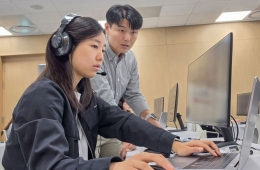
Photo of the research team. (From left) Dahee Park, Professor of Electrical, Electronics and Computer Engineering at DGIST, Taewon Seo, Master's student, Sonae Jeon, undergraduate research student. Provided by DGIST
View original imageThe team validated the model's performance using datasets commonly used in robotics movement research, such as JRDB and JTA. Their results showed improved accuracy in predicting the movement of surrounding people, as well as reductions in route error and the likelihood of collisions for the robot. Additional experiments on autonomous driving AI also confirmed performance improvements.
Professor Park commented, "AI operating in real-world environments, such as robots or autonomous vehicles, must make many decisions at once with limited computing resources. We've addressed the issue of performance degradation when integrating various functions into a compact AI model, and we plan to further verify its potential by applying it to actual robots."
Hot Picks Today
![Selling Like Crazy Every Year... 30-Year-Old Hetbahn Takes on a New Challenge: Tastes Better Than "Mom's Home Cooking" [On-Site Report]](https://cwcontent.asiae.co.kr/asiaresize/93/2026102216175071025_1792653470.jpg) Selling Like Crazy Every Year... 30-Year-Old Hetbahn Takes on a New Challenge: Tastes Better Than "Mom's Home Cooking" [On-Site Report]
Selling Like Crazy Every Year... 30-Year-Old Hetbahn Takes on a New Challenge: Tastes Better Than "Mom's Home Cooking" [On-Site Report]
- "Please Pay Me at Least 3 Million Won a Month": More Than Half of Young People Today Prioritize "Working Conditions" Over Company Size
- A 12-Year-Old Girl Went to the Hospital After Her Blood Pressure Hit 225 and Was Stunned: "What Is This Coral Reef-Like Thing in Her Aorta?"
- "Hey, Lady, Teach Your Kids to Behave!" ... 300,000 Won in Cash and a Bodily Injury Claim Demanded Over Child's Door Ding
- Beachgoer Finds 'Plastic' That Turns Out to Be Perfume Ingredient Worth More Than Twice as Much as Gold
The research involved Taewon Seo (master’s student) and Sunae Jeon (undergraduate researcher) from DGIST, with Professor Park serving as the corresponding author. The results have been accepted for presentation at the European Conference on Computer Vision (ECCV) 2026, to be held in Malmo, Sweden, from October 10 to 12. The project was supported by the NVIDIA Academic Hardware Grant Program.
© The Asia Business Daily. All rights reserved. Unauthorized AI training and use prohibited.