Park Hongkeun Unveils Exit Strategy for 162 Trillion Won 'Future Response Fund': "Transfer to General Account If Revenue Dries Up"
Revealing the Fund’s Operational Strategy to Reporters in Busan
Active Communication to Prevent Budget Misunderstandings... On Cabinet Controversy: “Will Refrain from Comment”
Hongkeun Park, Minister of Planning and Budget, acknowledged that the 162 trillion won 'Future Response Fund' could eventually be depleted depending on revenue conditions. However, he presented plans to ensure continuity by transferring necessary projects to the general account. His approach is to leverage the temporary tax windfall from the semiconductor boom as a starting point for proactive investment in national future initiatives, while also operating an exit strategy with consideration for when the fund runs out in the future.
The 162 Trillion Won Fund ‘Exit Strategy’: Converting to General Account or Other Funds

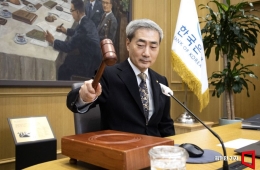
Hongkeun Park, Minister of Planning and Budget, is delivering opening remarks at a meeting with the chairman group of the University Presidents' Council held on the afternoon of September 10 at Pusan National University in Geumjeong District, Busan. Ministry of Planning and Budget.
View original imageOn September 10, during a press briefing at Pusan National University while inspecting budgets for essential medical care in the Southeast region and local universities in Busan, Minister Park explained, “Since the additional tax revenue is based on the extraordinary prosperity of semiconductors, if there is no further revenue, it will naturally be exhausted at some point. If and when the fund is depleted, projects can be continued through the general account or by utilizing other funds.”
Minister Park made it clear that the fund represents an unprecedented measure beyond conventional fiscal frameworks. He stressed, “The Future Response Fund is a new type of scheme we had not considered before. In some countries, funds are designed for fiscal stabilization, in others, for investment. In our case, we designed it so that both aims could be pursued simultaneously, at significant scale, without compromising fiscal soundness.”
He predicted that the lifespan of the fund would depend on future tax revenue and the speed of industrial transformation. Minister Park noted, “It is impossible to predict future revenue conditions, so we must closely monitor the semiconductor cycle. The duration of the four project accounts will be determined by how quickly post-semiconductor growth drivers stabilize and increase tax revenue, as well as how much we can reduce the issuance of new government bonds.”
Regarding concerns about the fund’s impact on local finances, Minister Park clearly drew the line. Addressing criticisms that reforms to the Local Education Fiscal Grant might undermine the autonomy of local governments, he countered, “Even compared to the current system, next year’s Local Allocation Tax will increase by 3.5 trillion won and rise dramatically to over 100 trillion won by 2028. Local financial resources will continue to increase.”
“Busan Symbolizes the 5 Poles and 3 Special Zones”… Field Visits to Boost Essential Medical Services and Local Universities
On this day, Minister Park visited Pusan National University Hospital, Pusan National University, and Gijang-gun Health Center one after another, inspecting on-site the region-complete medical system and higher education reform plans that are at the core of next year's budget proposal. Explaining the reason for his visit to Busan, he said, “Busan is a symbolic region in the government’s ‘5 Poles, 3 Special Zones’ national balanced development strategy. Pusan National University was selected as part of the base national university support package, and the university hospital is now qualified for essential medical support after passing a new preliminary feasibility study, representing a convergence of several policy priorities.”
He also shared reflections on the unprecedented 821 trillion won budget proposal. Minister Park noted, “Although this is the first budget I have formulated since taking office, it is also the first in the history of the Korean government to include this scale, direction, and scope of investment. I have been making media appearances, meeting stakeholders, and making field visits from dawn until late at night because if the public fails to understand this hard-earned budget, or if the National Assembly misunderstands it, that would be a great loss.”
Hot Picks Today
 Despite "Insufficient Balance" Notices, They Board Anyway... Reports of Foreign Fare Evasion Mounting
- A 'Premium Dessert' from Korea... 'Orion Custard' Hits Big in China and Vietnam as Production Lines Expand
- "I Hide in the Classroom Alone to Eat Steamed Buns. Please Help Me"... Tearful Plea Draws 600 Million Views, But It Turns Out...
- "I Killed My Mother": Daughter in Her 40s Reports Herself to Police; Police Make Emergency Arrest
- [Exclusive] "We Came for a KRW 140,000 Trip": Following Chinese Tourists in Korea Uncovers a 'Suspicious' Tour
Meanwhile, Minister Park refrained from commenting on recent controversies over the vetting of cabinet appointments that have dominated political circles. When asked about the nominations of Hyein Yong as Minister of Gender Equality and Family and Seungwon Kim as Minister of Justice, Minister Park answered, “It is inappropriate for a cabinet minister to make political statements as a personal opinion during official working hours,” providing a principled response without elaborating further.
© The Asia Business Daily. All rights reserved. Unauthorized AI training and use prohibited.