"Plunging 220 Won in Two Months: What Drove the Won's Rollercoaster Ride? [Exchange Rate Swings, the Logic Has Changed]①"
Exchange Rate Falls by 219.7 Won in Just Two Months
Won Value Jumps 15.7% Against US Dollar in Q3
The Logic of "Current Account Surplus = Stronger Won" Is Changing
"Focus Shifts to Foreign Investment Patterns and Redistribution Flows"
Hynix AD
This year, the won-dollar exchange rate has experienced a roller-coaster movement, surging sharply in a short period and then dropping just as suddenly. In particular, while market expectations in the first half of the year were tilted toward a further increase, there has been a dramatic turnaround in the second half, with projections now calling for an additional decline in the exchange rate (strengthening of the won) after it has already dropped by nearly 220 won in just two months. Experts note that the traditional logic of "current account surplus = won strength" has broken down, and say what matters now is the supply of dollars driven by the semiconductor supercycle and the corresponding shifts in market sentiment.

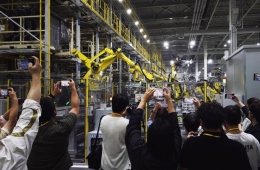
On the 8th, employees are monitoring the stock market and exchange rates at the Hana Bank headquarters in Jung-gu, Seoul. Photo by Yonhap News Agency
View original imageExchange Rate Drops by 219.7 Won in Two Months…Won Gains 15.7% Against U.S. Dollar in Q3
According to the Bank of Korea's Economic Statistics System (ECOS) on September 10, the won-dollar exchange rate (based on weekly closing prices) tumbled from 1,555.8 won on July 2 to 1,336.1 won on September 9, a drop of just over two months. The change in the weekly closing rate during the third quarter of this year was 219.7 won. Looking at the highest and lowest intraday figures in the same period, the decline reached as much as 224.6 won.
!["Plunging 220 Won in Two Months: What Drove the Won's Rollercoaster Ride? [Exchange Rate Swings, the Logic Has Changed]①"](http://www.asiae.co.kr/news/img_view.htm?img=2026091010444823320_1789004689.jpg)
This kind of sharp, short-term drop in the exchange rate is rare. The only comparable short-term decline since the global financial crisis (measured as the gap between intraday highs and lows) was from late October 2022, when the U.S. began monetary tightening, with the rate falling from 1,444.2 won to 1,216.4 won in early February 2023—a drop of 227.8 won. At the time, a growing perception that U.S. inflation had peaked fueled expectations the Federal Reserve (Fed) would pivot toward easing, prompting a retreat of dollar strength. Even during the COVID-19 crisis, the difference between the high and low was 215.7 won—smaller than the current episode. Back then, the exchange rate soared to 1,296.0 won in March 2020, but subsequently dropped to 1,080.3 won by year-end, as the Korea-U.S. currency swap agreement, liquidity supply, and vaccine development drove expectations higher.
The key issue is that during the sharp surge in the first half of this year, the exchange rate also followed an unprecedented trajectory. Starting slightly above 1,400 won at the beginning of the year, the rate briefly soared to the 1,560 won level in June, the highest in 17 years since the global financial crisis. In the second quarter, the rate jumped from the 1,430 won level in early May to the 1,560 won level in late June, with a volatility of 121.9 won. This was followed by an unprecedented surge, then an extraordinary plunge. In the first half of this year, the won weakened against the U.S. dollar by 7.10%—a larger depreciation than major currencies such as the Indonesian rupiah (-6.92%), Thai baht (-5.39%), Japanese yen (-3.52%), Canadian dollar (-3.33%), and the euro (-2.76%). However, in the third quarter, the won reversed course and surged 15.71%, outpacing other currencies such as the yen (5.86%), rupiah (2.61%), euro (2.25%), and baht (1.40%).
The Revised Logic Behind the Won's Strength: Key Factors Behind Exporters' Change in Stance
The established logic for a strong won has changed. Instead of focusing solely on external fundamentals like the current account surplus, market participants now scrutinize how accumulated foreign currency is held as different types of external assets, and how these are reallocated through various financial accounts. In the first half of this year, Korea’s current account surplus stood at $191 billion, 1.5 times the record annual surplus seen in all of last year. This was the second-largest surplus in the world, after China. Nevertheless, outbound investments in overseas stocks by Korean residents (including "Seohak Ants"—domestic retail investors buying foreign stocks) at the end of last year and the net selling of Korean stocks by foreign investors in the first half of this year determined the direction of the exchange rate.
Amid expanding overseas investment and a build-up of net external assets, the current account surplus fueled outward investment rather than currency conversion at home, sometimes turning the surplus into downward pressure on the won. Cha Younghoo, a researcher at Eugene Investment & Securities, noted, "Since 2023, the correlation between capital outflows from securities and direct investments and the weakening of the won has intensified. Net outflows from securities and direct investments have reached an annualized $130 billion over the last 36 months, rising sharply to $212 billion over the latest 12 months." The heavy selling of the won and the buying of the dollar in a single direction sent the exchange rate sharply higher. The expectation that the rate would continue to rise caused market participants to delay selling their dollars, opting instead to increase their exposure to exchange rate fluctuations ("open position"), adding further momentum to the rising exchange rate.
A major catalyst for the sudden change in atmosphere was the inflow of funds raised via SK hynix's American Depositary Receipts (ADR). This was followed in August by the corporate tax payment period, which prompted major companies to accelerate their dollar selling, and shipbuilders increased their hedging ratios. The government's three mega-projects (semiconductors, physical artificial intelligence (AI), and AI data centers), along with the shareholder return policies of "Samjeonnix" (Samsung Electronics and SK hynix), also provided downward pressure on the exchange rate. This prompted further currency conversion demand among major exporters, amplifying the drop. Since export companies had held off selling their dollars until the first half of the year, widening the gap between fundamentals and the exchange rate, their subsequent change in strategy is viewed as one of the key reasons for the rapid drop in the won-dollar exchange rate.
The capital outflow pressure, which had previously contributed to a higher exchange rate, has diminished significantly. In July, Korea’s current account posted a surplus of $42.08 billion, the second-largest on record, but direct investment reached only $4.13 billion and securities investment $5.4 billion. Lee Junghoon, an economist at Daishin Securities, pointed out, "From the second half of last year through the first half of this year, overseas securities and stock investments accounted for 65% and 82% of the current account, respectively, but by July these shares had shrunk to just 13% and 15%."
!["Plunging 220 Won in Two Months: What Drove the Won's Rollercoaster Ride? [Exchange Rate Swings, the Logic Has Changed]①"](http://www.asiae.co.kr/news/img_view.htm?img=2026090714435718511_1788759837.png)
"How Will Earned Dollars Be Used?"—Key Determinant for Future Exchange Rate Movements
The exchange rate is expected to attempt further declines for the time being. In terms of supply and demand, the domestic investment impact of Samsung and SK Group—amounting to a total of KRW 4,755 trillion (based on the government’s mega-projects and the "Samjeonnix" shareholder return policies)—is projected to more than offset potential outbound capital flows. Researcher Cha said, "Assuming both companies continue with shareholder returns equivalent to 50% of their accumulated free cash flow (FCF), shareholder returns will amount to approximately KRW 220 trillion per year." He estimated, "If over the next year, both companies convert 60% of that amount and, assuming a 30% capital outflow effect (offsetting the conversion effects) for dividends and share buybacks, the net annualized impact of currency conversion could be around KRW 92.5 trillion."
Hot Picks Today
 "Why Owners Spend Hundreds of Thousands to Replace Working Air Conditioner Refrigerant with the Old Type"
- "To Predict When AI Semiconductors Will Slow Down, 'Look Here': Korea Ratings Identifies New Risk Channel"
- Don Spike Announces Fresh Start After Release... "Reflecting on Mistakes from Four Years Ago"
- Jennie Faces Unexpected Backlash Over 'Year-Long Project' Launch: "Please Cut Ties"
- "The Flavor That Won Over Ahn Yujin" Now at Convenience Stores... 500,000 Units Sold Out in 5 Days, What's Behind the Craze?
Moon Dawoon, a researcher at Korea Investment & Securities, said, "Given the U.S. economic and employment situation, the policy rate is expected to remain on hold for the rest of the year," and projected that the dollar index, currently at the 98 level, would drop further. The policy rate outlook at the Bank of Korea, currently at an annualized 3.00%, is also rising, leading to expectations that export companies—especially in the semiconductor sector—will continue to seek out won funding. Lee Jinkyung, an economist at Shinhan Investment & Securities, explained, "As foreign currency deposits and reserves from postponed currency conversion in the first half accumulate, demand for currency conversion may rise in the second half due to performance bonus payments and exposure management needs."
© The Asia Business Daily. All rights reserved. Unauthorized AI training and use prohibited.