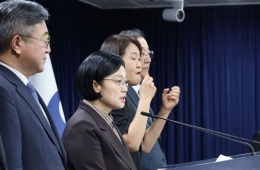
President Lee: "Escalating Confrontations Between Nations... Increasing Concern Over the Possibility of War"
Meeting with OECD Secretary-General
"Economic Polarization Lies at the Root of Conflicts"
Cormann: "Looking Forward to Trade Order Reform and Supply Chain Cooperation"
On September 9 (local time), President Lee Jae-myung stated, "I am concerned that as confrontations and conflicts between nations intensify, the likelihood of these situations escalating into war is increasing." Diagnosing that economic polarization underlies both the polarization of the international community and the spread of extremism within societies, he called on the Organisation for Economic Co-operation and Development (OECD) to play a more proactive role in fostering "inclusive growth" by ensuring that both the opportunities and benefits of growth are distributed equitably.

President Lee Jae-myung shakes hands with Mathias Cormann, Secretary-General of the Organisation for Economic Co-operation and Development (OECD), at a hotel in Paris, France, on the 9th (local time) before their meeting. 2026.9.9 Yonhap News Agency Photo by Yonhap News
View original imageDuring his state visit to France, President Lee met with Mathias Cormann, Secretary-General of the OECD, at a hotel in downtown Paris on the same day. He said, "Recently, international relations have become highly unstable, hostile sentiments among people have worsened, and there is an increase in the number of individuals adopting extremist views, leading to more intense conflicts because of them."
Regarding the reasons behind deepening conflicts between countries and groups, President Lee remarked, "If we probe a bit deeper, I believe economic polarization plays an especially significant role." He added, "Ensuring that opportunities for growth and the fruits of growth are shared as fairly as possible is ultimately the path to sustainable growth," and continued, "There are many times when I feel a stronger emphasis should be placed on the so-called concept of inclusive growth."
He specifically urged the OECD to "place greater emphasis on policy and political efforts to fundamentally address polarization," and added, "I hope you will also pay more attention to the Republic of Korea and discuss ways we can work together."
This meeting was held to mark the 30th anniversary of Korea's accession to the OECD. President Lee stated, "The OECD has provided extensive research outcomes and guidance on global economic and social policy, which has greatly benefited the Republic of Korea." He also said, "During this time, the Republic of Korea has transformed from an aid recipient to a country that now provides aid, and I expect our contributions will continue to grow."
Secretary-General Cormann assessed Korea as "an extraordinary success story among OECD member states." He commented, "The Republic of Korea successfully transitioned from an aid recipient to a donor country and has grown into a major power with tremendous export competitiveness. The Korean government's experience has also inspired stronger connections with Southeast Asia and other regions."
Secretary-General Cormann also cited imbalances in the global trading order and supply chain issues as major challenges. He said, "Various imbalances are worsening worldwide, and we are seeing unfair trading behaviors that distort markets." He assessed that supply chain resilience, especially regarding critical minerals, is a particularly important agenda for Korea, given its focus on producing semiconductors and electronics.
He went on to say, "The key is to reform the future structure of trade agreements. We must reform them to better promote open markets and rule-based trade." He also emphasized that cooperation between Korea and the OECD in this area would benefit all member states.
Secretary-General Cormann expressed his "full agreement" with President Lee's emphasis on the need for inclusive growth. He also pointed out that productivity slowdowns and population aging are structural challenges commonly faced by OECD member countries, stating, "I am well aware that the Korean government is pursuing several innovative alternatives to address these issues."
During the subsequent closed-door talks, Secretary-General Cormann praised Korea's active engagement in the OECD, such as serving as the Vice Chair of the OECD Ministerial Council Meeting this year, and expressed his gratitude for Korea's enthusiastic participation and contributions. He also stated his anticipation of deepening cooperation in various fields, such as artificial intelligence (AI) and digital transformation, in the future.
In response, President Lee highlighted, "With the rapidly changing international economic environment, the importance of reliable and objective analysis and policy recommendations is growing," expressing his appreciation for the OECD's role and requesting continued support for Korea's sustainable economic and social development.
Hot Picks Today
 "Why Owners Spend Hundreds of Thousands to Replace Working Air Conditioner Refrigerant with the Old Type"
- "If Home Prices Continue Rising Like This... I Will Stop Commenting" Even the Real Estate Expert Personally Tapped by President Lee Has Turned Critical
- 'Divorce of the Century': Kwon Hyuk-bin Ordered to Divide 2.55 Trillion Won in Assets... Ex-wife Responds
- Inspection Team Returns After Assessing Conditions for Possible Deployment to Hormuz
- "Still Mocked as 'Mistress'... Tears of Injustice" Attorney's Post After Kim Keon-hee's Tearful Statement
Additionally, according to senior presidential spokesperson Kang Yoo-jung, President Lee and Secretary-General Cormann agreed that as the global economy faces complex challenges such as demographic shifts, low growth rates, technological innovation including AI, and supply chain restructuring, it is essential to develop common solutions based on objective analysis. They also shared their intent to explore ways to cooperate in securing future engines of growth for the AI era.
© The Asia Business Daily. All rights reserved. Unauthorized AI training and use prohibited.