Bullish Stock Market Drives Securities Firms' Q2 Net Profits Beyond 5 Trillion Won
Financial Supervisory Service Releases Q2 Business Results for Securities and Futures Firms
Net Profits Surge 82% Year-on-Year, Driven by Soaring Brokerage Commissions
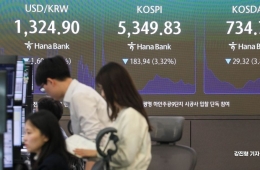
Securities firms posted more than 5 trillion won in net profit in the second quarter of this year, buoyed by a bullish stock market. This strong performance was driven by a sharp increase in stock trading volume, which led to a surge in commission income, as well as improved proprietary trading results related to equities and funds on the back of higher stock prices.
According to the "Second Quarter Operating Results of Securities and Futures Companies (Provisional)," released by the Financial Supervisory Service on September 10, the combined net profit of Korea's 61 securities firms for the second quarter was 5.1914 trillion won. This represents a staggering 2.3412 trillion won (82.1%) jump compared to the same period last year. On a quarterly basis, net profit increased by 864.6 billion won (20.0%). The return on equity (ROE) for securities firms in the second quarter stood at 4.9%, up 0.6 percentage points from the previous quarter and up 1.8 percentage points year-on-year.

The surge in commission income brought about by market activity was the key driver of this performance. In the second quarter, securities companies posted commission income of 8.8675 trillion won, up 2.1746 trillion won (32.5%) from the previous quarter. Of this, consignment commissions totaled 5.7708 trillion won, up 1.4657 trillion won (34.0%). The transaction value in the Korea Exchange main market reached 4,438 trillion won, marking a 59.9% increase from the previous quarter.
Commission income from wealth management and investment banking (IB) divisions also increased. IB division fees reached 1.2008 trillion won, up 27.5% from the previous quarter, attributable to higher fees related to debt guarantees. Wealth management fees jumped to 1.0531 trillion won, a 56.7% increase, mainly due to growth in investment advisory commissions.
In addition, proprietary trading gains for securities firms in the second quarter amounted to 5.9825 trillion won, up 1.8799 trillion won (45.8%) from the previous quarter. During the quarter, profits related to stocks and funds, including Exchange Traded Funds (ETFs), rose by 37.3826 trillion won on the back of stock price increases, while derivatives-related gains, including hedging operations, fell by 37.1870 trillion won.
An official from the Financial Supervisory Service commented, "Performance remained strong following the previous quarter," and added, "Thanks to a favorable market environment, consignment commission income served as the main driver, but proprietary trading gains also increased, resulting in improved results for both large and small- to mid-sized firms."
Securities firms' assets and equity also expanded. As of the end of June, total assets of securities companies stood at 1,256.1 trillion won, up 14.4% compared to the end of March. Total liabilities rose 15.1% to 1,140.9 trillion won. Equity capital totaled 115.1 trillion won, an increase of 7.7%.
Financial soundness also improved. As of end-June, the average net capital ratio (NCR) for securities firms was 1,140.5%, up 140.1 percentage points compared to the end of March. All 61 securities firms exceeded the regulatory minimum ratio of 100%. The average leverage ratio stood at 723.4%, up 5.1 percentage points from the previous quarter, but all remained within the regulatory cap of 1,100%.
During the same period, the performance of futures companies also improved. The net profit of the three domestic futures companies in the second quarter totaled 36.84 billion won, up by 14.31 billion won (12.8%) year-on-year and by 4.19 billion won (12.8%) quarter-on-quarter. The second quarter ROE of futures companies came in at 3.6%, up 0.4 percentage points from the previous quarter.
Hot Picks Today
 He Left It in the Car and Forgot... "I Nearly Collapsed with Joy": Man Wins $1.48 Million Lottery
- Goldman Sachs Cuts KOSPI Target by 25%... "Excessive Pessimism, Still Attractive"
- "'Nodding Off' on the Subway? Here's Why Koreans Are Getting Even Less Sleep"
- "Please Pay Me at Least 3 Million Won a Month": More Than Half of Young People Today Prioritize "Working Conditions" Over Company Size
- Beachgoer Finds 'Plastic' That Turns Out to Be Perfume Ingredient Worth More Than Twice as Much as Gold
An official from the Financial Supervisory Service stated, "We will continue to encourage securities companies to proactively address potential problem assets in light of the prolonged geopolitical risks and the possibility of increased financial market volatility at home and abroad, as well as stepped-up monitoring of profitability and soundness." The official added, "We also plan to push ahead with institutional improvements, including the overhaul of liquidity regulatory frameworks and the rationalization of calculation methods for net capital ratio (NCR)."
© The Asia Business Daily. All rights reserved. Unauthorized AI training and use prohibited.