"I'm Scared, Please Don't Go to Japan Right Now"... Tourists on High Alert as Deaths Occur and Trains Halt
Record-Breaking Rainfall Observed South of Tokyo
Woman in Her 60s Dies in Fukushima
Growing Anxiety Among Domestic Travelers
Record-breaking heavy rainfall continues across the Japanese archipelago, causing flooding and river overflows in various regions from the Izu Islands near Tokyo to the Tokai region in central Honshu and Fukushima Prefecture. In the Izu Islands, total precipitation over the 48-hour period reached 757.5mm. In Fukushima Prefecture, casualties have occurred, including the death of a woman in her 60s who was trapped in a submerged vehicle. Disruptions to transportation, school closures, and evacuation orders have heightened travel alerts for visitors to Japan.

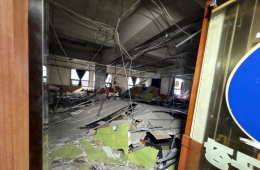
Roads flooded in Nagoya due to heavy rain on the 8th. Photo by Reuters and Yonhap News Agency
View original imageRecord Rainfall in the Izu Islands...Highest Level Alert Issued
According to the Japan Meteorological Agency on the 8th, the maximum rainfall in Oshima, part of the Izu Islands south of Tokyo, reached 757.5mm over 48 hours. This is the highest 48-hour September rainfall ever recorded in Oshima.
In Nijima, the 48-hour rainfall was 569mm, while Oshima Kitanoyama and Toshima saw 539.5mm and 513mm, respectively. Due to these record rainfall levels, a Level 5 landslide alert, the highest in Japan’s disaster warning system, was issued in parts of the Izu Islands, with residents instructed to secure safety immediately. Casualties have been reported; in Iwaki, Fukushima Prefecture, a woman in her 60s who was in a submerged underpass vehicle was rescued and taken to a hospital but passed away.
The heavy rain also disrupted the Tokyo metropolitan transportation network. Major train lines such as the JR Yamanote, Chuo, and Sobu Lines temporarily reduced services before resuming normal operations, but the Joban, Suigun, and Hachiko Lines saw suspensions in some sections. All Nippon Airways (ANA) also canceled two flights between Haneda Airport and Hachijojima in the Izu Islands.
Nagoya Also Submerged...School Closures Due to River Overflows
The Tokai region in central Honshu was also severely affected. In Aichi and Gifu prefectures, intense rain clouds formed due to a stationary front and a tropical depression, leading to the development of a linear rain belt and concentrated downpours.
A Level 5 special flood warning was issued for the Shonai River, which flows through Aichi and Gifu prefectures. The Japan Meteorological Agency strongly urged immediate safety precautions, noting that disaster occurrence in those areas was highly likely.
In Nagoya, as of 5:00 p.m. on the 8th, 104.5mm of rain fell in just one hour. According to the Japan Meteorological Agency, this hourly rainfall in Nagoya is an all-time high since records began.

The suddenly swelling Ueda River overflowed, submerging roads and causing vehicles to become inundated. With the heavy rainfall continuing, all public elementary, middle schools, and kindergartens in Nagoya temporarily closed.
With the Aichi-Nagoya Asian Games approaching, water leaks were detected in some competition venues, and athletes who had arrived early and were staying in nearby accommodations were also temporarily ordered to evacuate. Beyond Nagoya, 51mm of rain per hour was recorded in Nanbujo, Yamanashi Prefecture; 40mm in Hachioji, Tokyo; and 38.5mm in Koga, Ibaraki Prefecture.
More Heavy Rain Forecast Through the 10th...Travelers on Alert
This heavy rainfall event is attributed to the unstable atmosphere caused by the inflow of warm, moist air from a tropical depression that formed as Typhoon No.24 "Kirovan" weakened and moved north, combining with the autumn rain front. The typhoon weakened to a tropical depression on the morning of the 7th, but its merger with the front created intense rain clouds over a wide area.
The Japan Meteorological Agency is warning of the possibility of further damage. Between now and 6:00 a.m. on the 10th, rainfall of up to 200mm is expected in the Tokai and Kinki regions, 150mm in Shikoku, 120mm in Kanto, Koshin, and Hokuriku, and 80mm in Tohoku over the next 24 hours.
The agency projects the rain will continue across western Japan to Tohoku as the tropical depression merges with the front and moves northeast. In particular, there is a possibility of warning-level heavy rain persisting in the Tokai, Kinki, Shikoku, Kanto, and Koshin regions.
With record cumulative rainfall, soil and rivers in many areas are already heavily saturated, meaning the risk of landslides, flooding in low-lying areas, and river overflows is likely to remain high even if the rain eases temporarily. In fact, the Japan Meteorological Agency has reported a series of record-breaking rainfall readings across various regions since the beginning of September.
Hot Picks Today
![[Exclusive] "We Warned You Four Times"... Another Defect Found in Bathroom at LH Happy Housing Site](https://cwcontent.asiae.co.kr/asiaresize/93/2023073107570824314_1690757828.png) [Exclusive] "We Warned You Four Times"... Another Defect Found in Bathroom at LH Happy Housing Site
[Exclusive] "We Warned You Four Times"... Another Defect Found in Bathroom at LH Happy Housing Site
- "Eerily Similar to the COVID-19 Crisis"... Mysterious Death at Russian Research Institute Revives 'Pandemic Nightmare' [Current Affairs Show]
- "Busan Is in Big Trouble"... One Cockroach Can Produce 350 Nymphs; Establishment Confirmed, Causing Alarm
- "Older people won't be able to tell"... Gang targets convenience stores with counterfeit 50,000-won notes printed on A4 paper
- "I Hate Dog Meat and Skate, Love Pizza" ... "Let's Meet" Frenzy Over Beautiful 41-Year-Old Nurse, But There's a Twist
As a result, posts such as "I canceled my trip because of the heavy rain," "Even if I go, I won't be able to get around," "This month is really dangerous," and "How can I cancel my trip?" are appearing in domestic travel communities. With reports of heavy rain-related deaths making headlines daily, more people are reconsidering or postponing their trips to Japan.
© The Asia Business Daily. All rights reserved. Unauthorized AI training and use prohibited.






![AI Investment and Inflation Pressures... U.S. Rates to Rise Again? [Weekend Money]](https://cwcontent.asiae.co.kr/asiaresize/307/2026071504434646114_1784058227.jpg)