Gwangju-Jeonnam Venture Association and Industry-Academic Convergence Institute Vow to "Pursue Growth and Expand Networks"
Forum Renamed "Jeonnam Gwangju Venture Forum" Following Launch of Integrated Special City
Second Leaders Forum for the Gwangju Autonomous Vehicle Parts Specialized Complex Also Held
The Gwangju-Jeonnam Venture Business Association and the Gwangju Industry-Academic Convergence Institute announced on September 9 that they held the "2nd Leaders Forum for the Autonomous Vehicle Parts Gwangju Specialized Complex" and the "26th Jeonnam Gwangju Venture Forum."
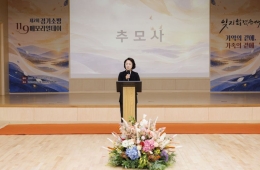
The forum was held on September 8 in the Grand Banquet Hall on the 4th floor of the Breve Gwangju by Lotte Hotel. Significantly, this was the first event since the name change from the "Gwangju-Jeonnam Venture Forum" to the "Jeonnam Gwangju Venture Forum," prompted by the launch of the integrated Jeonnam Gwangju Special City on July 1. The event was co-hosted by the Venture Business Association and the Gwangju Information and Culture Industry Promotion Agency, drawing around 80 participants including small and venture business owners from Jeonnam and Gwangju, heads of related organizations, and leaders of affiliated associations.

The Gwangju-Jeonnam Venture Business Association and the Gwangju Industry-Academia Convergence Institute held the '2nd Leaders Forum for the Gwangju Specialized Autonomous Vehicle Parts Cluster' and the '26th Jeonnam Gwangju Venture Forum.' Provided by Gwangju-Jeonnam Venture Business Association
View original imageThe theme of the event was "800 Trillion Won, AI Agents, and the Next Five Years for Jeonnam-Gwangju SMEs." Professor Kim Junha, who serves as the Dean of the Graduate School of AI Policy and Strategy at the Gwangju Institute of Science and Technology (GIST), delivered an insight lecture.
Professor Kim provided an in-depth diagnosis of both the substance of the Southwest Korea Semiconductor Mega Project—under which Samsung Electronics and SK hynix plan to invest a combined 800 trillion won to build four advanced memory semiconductor fabs on the site of Gwangju Military Airbase—and the current state of the local industrial ecosystem. Leveraging the McKinsey Three Horizons Framework, he presented a detailed roadmap for how regional SMEs and startups should prepare over the next five years.
Professor Kim emphasized that "waves do not become ours on their own," highlighting the need for concrete action plans to ensure that massive investments translate into meaningful revenue for local companies. For the "Future Growth Strategy of Jeonnam-Gwangju Materials, Components, and Equipment Companies," designated as a core topic, he explained that, to gain a foothold in the future mobility value chain by using "Physical AI" and Gwangju’s unique status as the only city-level real-world autonomous driving testbed in the world, companies should focus on a specific component or process—such as LiDAR, vehicle control parts, or roadside communication units (RSU)—rather than aiming for complete vehicle manufacturing.
He also stressed that the pivotal battleground for AI transformation lies in data, particularly "implicit knowledge" held by skilled manufacturing workers. He urged companies to begin collecting on-site data immediately, such as equipment alarm logs, photos of defective products, and operator logs.
Next, Hong Seokjae, Head of the External Cooperation Team at the Venture Business Certification Agency, conducted an information session on the Venture Business Certification System.
Mr. Hong provided a thorough explanation of the intent behind the certification program, recent policy changes, the requirements for each certification type, the application and review process, and the support benefits—tax, financial, personnel, and market access—provided to certified companies. He particularly underscored the tangible advantages that regional SMEs and venture businesses can secure through certification in their efforts to attract investment and scale up, addressed considerations for applicants, and answered frequently asked questions.
Key attendees included Hyunsoo Kim, Chairman of the Association; Kim Masung, Director at the Gwangju-Jeonnam Regional Office of SMEs and Startups; Kim Taejoo, Head of the Honam Regional Headquarters at Korea Technology Finance Corporation; Yoo Seunghyuk, Team Leader at the Gwangju Industry-Academic Convergence Institute; Yoon Bongshik, Director of the AI Proof of Concept Center at Nambu University; Lee Seungwoo, Branch Manager at the Gwangju Startup Branch of Korea Credit Guarantee Fund; Park Seungmin, Head of the Gwangju Branch of the Korea Invention Promotion Association; and Kim Jaechul, Head of the Southwest Investment Center at Korea Development Bank.
In his welcoming remarks, Chairman Hyunsoo Kim stated, "The change in the forum's name, coinciding with the launch of the integrated Jeonnam Gwangju Special City, signifies that our regional venture ecosystem is now at a new starting line. With the unprecedented opportunity presented by the 800 trillion won semiconductor investment and the wave of AI transformation, this forum has served as a meaningful occasion for local small and venture businesses to establish practical strategies for the future."
Hot Picks Today
!["Samsung Electronics Employees Commute by Shuttle Bus"... More Than 5,000 Homes to Be Supplied in Seoul and Busan [Real Estate A to Z]](https://cwcontent.asiae.co.kr/asiaresize/93/2026092515334340873_1790318023.jpg) "Samsung Electronics Employees Commute by Shuttle Bus"... More Than 5,000 Homes to Be Supplied in Seoul and Busan [Real Estate A to Z]
"Samsung Electronics Employees Commute by Shuttle Bus"... More Than 5,000 Homes to Be Supplied in Seoul and Busan [Real Estate A to Z]
- A 12-Year-Old Girl Went to the Hospital After Her Blood Pressure Hit 225 and Was Stunned: "What Is This Coral Reef-Like Thing in Her Aorta?"
- “We’ve Hit Bottom”: Samsung Electronics and SK hynix “Undervalued at Global Financial Crisis Levels” Set for W-Shaped Rebound - But When? [Weekend Money]
- "Lady, Teach Your Kids Properly!"... Demanded 300,000 Won in Cash Over Child's 'Door Ding'
- "If This Airs, I'm Dead"... Why a Restaurant Refused to Let Jeon Hyunmoo's Show Film
Through this forum, the Association and the Institute aimed to help local SMEs and venture businesses explore growth strategies and expand their networks with investors and related organizations. They also announced plans to pursue a variety of additional programs going forward.
© The Asia Business Daily. All rights reserved. Unauthorized AI training and use prohibited.