Nuclear Power Becomes a Key U.S. Investment Card as Government Leads and KEPCO, KHNP Take Action
'Investment in Eight U.S. Nuclear Plants' Puts Export System to the Test
Risks and Economic Feasibility Analyzed by Joint Public-Private Nuclear Power Export Committee
Westinghouse Equity Acquisition and Joint Venture Considered
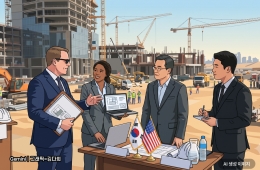
With the construction of eight nuclear power plants in the United States emerging as a strong candidate for major investment projects into the U.S., the government's revamped export system for nuclear power is facing a significant test. Rather than simply channeling Korean capital into U.S. nuclear power plants, a comprehensive government-led strategy is required for Korea Electric Power Corporation and Korea Hydro & Nuclear Power to secure project rights, construction volumes, and participation opportunities for the domestic supply chain.
According to the "Measures to Streamline the Nuclear Power Export System" and "Guidelines on Cooperation and Promotion Structure for Overseas Nuclear Power Projects between Korea Electric Power Corporation and its Subsidiaries" prepared by the Ministry of Trade, Industry and Energy on September 9, the government will oversee negotiations with target export countries, business-specific negotiation strategies, investment structure, and risk and economic viability analysis. Based on these frameworks, Korea Electric Power Corporation and Korea Hydro & Nuclear Power will take charge of actual business negotiations and project execution. To this end, a joint public-private Nuclear Power Export Planning Committee under the Nuclear Power Export Strategy Council will be established to analyze negotiation strategies, project risks, and economic feasibility for each country. As nuclear power exports have become more of an intergovernmental negotiation rather than simple business competition, the government intends to take the lead. Since 2010, almost all of the approximately 20 nuclear power export deals worldwide—except for the Czech project secured by Korea Hydro & Nuclear Power—have been executed through direct government-to-government contracts or intergovernmental agreements (IGAs).

The barriers between Korea Electric Power Corporation and Korea Hydro & Nuclear Power for nuclear power export will also be dismantled. The Minister of Trade, Industry and Energy can designate or change the main agency in charge of each overseas nuclear power project, allowing the institution best suited for each business to be at the forefront. Korea Electric Power Corporation will leverage its international network and investment and financial capabilities, while Korea Hydro & Nuclear Power will provide expertise in nuclear plant construction and operation, dividing the roles accordingly. The government also plans to introduce a new Nuclear Power Export Promotion Act within this year. This will grant the government the right to hold prior consultations for major decision-making by public nuclear power export institutions and establish legal grounds for a "central coordinating agency for nuclear power exports," which would oversee the entire process from project development and feasibility studies to client negotiations, bidding, and contracting.
This export system is expected to become even more critical should the investment into U.S. nuclear plants materialize. If, during negotiations with the U.S. government, Korea is able to secure not only investment terms and project structure but also construction volumes, equipment supply, and revenue sharing for Korean companies, these investments will go beyond simple funding to become a new avenue for nuclear power exports. The possible involvement in Westinghouse equity exemplifies this. If Korea secures an equity stake, it can expand its platform for participating in the U.S. nuclear power plant projects and open the door for the Korean nuclear industry’s supply chain to enter the U.S. market. Previously, the U.S. government signed a construction partnership with the major shareholder of Westinghouse and obtained rights to acquire up to a 20% stake. Subsequently, the Korean government and Korea Electric Power Corporation were reportedly offered the opportunity to participate in acquiring a stake in Westinghouse.
Hot Picks Today
 Switching from Grandeur to EV Saves 2 Million Won Annually...165 km on a 10-Minute Fast Charge
- [Breaking] Lee Jae-yong Buys 7.18 Million Samsung Electronics Shares from Mother Hong Ra-hee for 1.9 Trillion Won
- "With Interest Rates at 5%, Investors Tremble Over Melting Accounts...But Some Stocks Are Smiling [Real Life Investment]"
- "Works at a Major Corporation and Wins the Lottery Too"...Is the 1.2 Billion Won Prize Claim by 30s Employee Real?
- "How Can You Wear Something That See-Through?" Consumers Turn Away from Leggings, Lululemon Falters
There is also discussion of Korea Electric Power Corporation and Korea Hydro & Nuclear Power establishing a joint venture with Westinghouse. In this case, Westinghouse would handle local U.S. licensing and basic designs, while Korea would be responsible for design, construction, operation, and equipment supply. If the Korean-designed APR1400 nuclear reactor is adopted for some of the eight new plants, the character of the project would become even more distinctly Korean. Participating as investors and taking responsibility for design, construction, operation, and supply would allow Korea to position the U.S. as a new export market for its nuclear power business. An official from the Ministry of Trade, Industry and Energy stated, "The governments of Korea and the United States are in discussions on various aspects of nuclear investment cooperation," adding, "Specific details have not yet been decided."
© The Asia Business Daily. All rights reserved. Unauthorized AI training and use prohibited.

!["Four Women Who Shaped the President: Holding the Keys to Power" [World Photo]](https://cwcontent.asiae.co.kr/asiaresize/307/2026090916431922293_1788939800.png)