[No Filter Robot] Humanoids That Used to Dance and Run Now Face a "War of Hands"
Wuji Joins Samsung SDS’s Robotics Team
Features 20 Degrees of Freedom and Flexibility
Kairos of Korea Institute of Machinery and Materials Focuses on Hands After Actuators
Aiming for Full-Body Tactile Sensing for Industrial Deployment
The distinctive feature of robots that can dance, run, and jump is their legs. However, the core focus of next-generation humanoid robot competition is shifting from legs to hands. There are increasing attempts to adopt advanced technologies from China or to develop robotic hands with domestic technology, positioning the hand as the "ultimate trump card" in the humanoid race.

At the Real Summit hosted by Samsung SDS on the 8th, a robotic hand from Chinese company Wuji was exhibited. Photo by Paek Jongmin, Tech Specialist
View original imageIn its Robot Transformation (RX) strategy unveiled on September 8, Samsung SDS announced the formation of "Team REX (Robotics EXcellence)" together with 10 domestic and international companies, including Rainbow Robotics and Walden Robotics. The team includes the Chinese company Wuji, renowned for its robotic hand technology. Wuji's products were exhibited alongside robots from Rainbow Robotics—a Samsung affiliate—indicating the direction in which Samsung's future humanoid robot hands may be realized.
Robotics experts cite the hand as a key challenge for humanoids. Professor Park Jongwoo of the Department of Mechanical Engineering at Seoul National University explained that among all robotic technologies, the hand is the most difficult to engineer.

The latest robotic hand developed by Woozi has the flexibility to move its joints backward depending on the situation, just like a human hand. Photo by Woozi, YouTube capture
View original imageChina, which is leading in the humanoid sector, is making remarkable achievements when it comes to robotic hands as well, with Wuji as a representative player. Wuji's latest hand is said to have overcome the limitations of metal. With 20 active degrees of freedom distributed across five fingers, each joint is actuated independently, allowing the fingers to meet or spread apart laterally.
Especially noteworthy is the adoption of a "backdrivable" direct-drive structure that enables the joints to move in the opposite direction under external force. This means the hand is not rigidly fixed when colliding with objects but can yield or change its posture in response to force. Professor Park also remarked, "Unlike other robotic hands, its flexibility stands out." Wuji has also equipped its hand with tactile sensors.
In Korea, too, "tactile sense" in the hands is emerging as a differentiating technology for humanoids. Ryu Seok-hyun, President of the Korea Institute of Machinery and Materials, emphasized the importance of the hand, stating at the "2026 Global Mechanical Technology Forum" on September 7 that "after actuators, the hand is the second most important component for humanoid robots."
Hot Picks Today
 Despite "Insufficient Balance" Notices, They Board Anyway... Reports of Foreign Fare Evasion Mounting
- "If It Helps My Child's Studies, It's Worth Every Penny"... U.S. Parents Open Their Wallets for $10,000 Tests
- [Exclusive] "We Came for a KRW 140,000 Trip": Following Chinese Tourists in Korea Uncovers a 'Suspicious' Tour
- "I'm paying to stay, and you want me to do the laundry and dishes too?" ... Airbnb bans excessive cleaning demands
- "Baek Jongwon Had Been Quiet, Then Hit It Big"... Waits in the 100s in U.S. Despite KRW 46,000 Pork Belly
Like Wuji, Kairos also aims to replicate tactile sensation and human skin. President Ryu identified tactile sense as the technology that will distinguish Kairos from other humanoids. Tactile technologies are not limited to the hand; the Korea Institute of Machinery and Materials plans to cover the arms, feet, knees, and torso with tactile-sensitive skin as well.

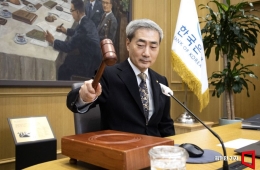
Ryu Seokhyun, President of Korea Institute of Machinery and Materials, is explaining the development strategy of the humanoid robot "Kairos" at the "2026 Global Machinery Technology Forum" held on the 7th. Photo by Paek Jongmin, Tech Specialist
View original imagePresident Ryu highlighted the importance of tactile sense by citing examples like fitting into the cramped driver’s seat of an auto assembly line or welding in tight spaces at a shipyard. He explained that it is difficult for a robot to accurately determine if its arm or knee is touching nearby structures simply by using cameras. President Ryu anticipated, "Robots must sense contact across their whole body and adjust their movements accordingly, like humans do, in order to truly replace people on real industrial sites."
© The Asia Business Daily. All rights reserved. Unauthorized AI training and use prohibited.