Concerns Over 'National Emergency Declaration' and Suspicions of 'Military Deployment to Polling Stations'... US Opposition Parties on Edge Ahead of November Election
Joint Chiefs Chairman: "No Plans to Deploy Troops"
However, ICE Could Be Deployed for Threats or Warrant Execution
Trump: "Will Do Whatever It Takes for an Honest Election"
With the U.S. midterm elections just over two months away in November, controversy is raging in U.S. political circles amid speculation that the Donald Trump administration might deploy military forces or federal immigration enforcement agents to polling stations. Although top military officials have clearly stated that there are no plans to deploy troops, anxiety is rising because President Trump has not definitively ruled out the possibility, and Immigration and Customs Enforcement (ICE) agents could still be present at polling locations.

On the "military deployment" theory, Joint Chiefs Chairman says "No such plan"
According to international media outlets such as CNN and The Guardian on September 8 (local time), Dan Kain, Chairman of the Joint Chiefs of Staff, stated in a letter responding to Democratic Senator Elissa Slotkin’s inquiry that there are no plans to deploy federal troops or federalized National Guard personnel to polling stations during the midterm elections in November. He also made it clear that there are no plans to use military personnel to seize ballots, voting machines, or other election-related materials.
Chairman Kain emphasized, "There are no plans to deploy federal military personnel or National Guard troops to polling stations, nor to mobilize military forces to seize ballots, voting machines, or other election-related materials." The letter also included a message that military authorities neither received nor anticipated any unlawful orders in connection to the 2026 elections.

Last August, the National Guard deployed in Washington DC. Photo by AP Yonhap News
View original imageTrump says, "Will do whatever it takes for an honest election"... Leaves possibility of ICE deployment open
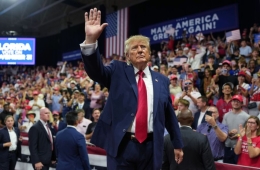
Nevertheless, Democrats remain concerned because the President himself has not firmly closed off the possibility. Earlier this year, when asked whether National Guard or federal agents might be dispatched to polling stations, President Trump responded, "I will do whatever is necessary to ensure an honest election."
Furthermore, the Trump administration has left open the possibility of dispatching Immigration and Customs Enforcement (ICE) agents to polling stations under specific circumstances. Markwayne Mullin, Secretary of Homeland Security, recently told reporters, "If there is a specific threat at a polling station or if there is a need to serve a warrant on a wanted individual, ICE agents could go to the polling station."

Citizens are protesting in front of the Washington headquarters of the U.S. Immigration and Customs Enforcement (ICE). Photo by AP Yonhap News
View original imageThe problem lies in the unique nature of polling stations. Even if deployed in response to actual criminal investigations or safety-related incidents, the presence of federal agents tasked with immigration enforcement could have an intimidating effect on some voters. In particular, immigrant and minority voters may avoid polling stations out of concern over federal enforcement presence. Experts warn that, more than actual physical intervention, the mere fear that intervention could occur might discourage voter turnout.
Distrust fueled by past remarks
The background to the current controversy includes President Trump’s actions following the 2020 presidential election. President Trump repeatedly claimed election fraud after the election and, earlier this year in an interview with The New York Times, expressed regret over not deploying the National Guard to seize voting machines at the time.
President Trump also made comments suggesting that federal elections should be managed by the central government, and controversy erupted when then-Director of National Intelligence (DNI) Tulsi Gabbard, who had no domestic law enforcement authority at the time, accompanied the FBI during its search and seizure of the Fulton County election office in Georgia regarding alleged fraud in the 2020 election.

'State of Emergency' Concerns Also Raised
The controversy has further spread to whether President Trump could declare a state of emergency under the pretext of the election. The British daily The Guardian recently reported that remarks and data disclosures by the Trump administration regarding the election have raised concerns about the fairness of U.S. elections. Among some of Trump’s supporters, expectations of a state of emergency declaration are mounting, and President Trump did not rule out the possibility when asked about it.
Hot Picks Today
 "Let's Give Unemployment Benefits to Those Who Find Jobs Quickly and Stay Long-Term"... Petition Takes Aim at Compensation for 'Voluntary Resignations'
- "How Much Can You Buy for 20,000 Won?" Bustling... Millennials and Gen Z Flock to an 'Unexpected Shopping Hotspot' [China.zip]
- "Same facial mole and gait?" ... Kim Jong Un appears in a show of defiance, rendering death rumors moot
- "Survives Fall from 35th Floor," Chinese Influencer Returns After 17 Months
- "Shares Hit Daily Limit on 56 Billion Won News"... Marubeni Launches Tender Offer for K-Beauty Firm of 'Chae Sira's Husband' Kim Taewook
A state of emergency is a system that allows the president to exercise special powers under the law to respond to emergencies related to national security, foreign relations, or the economy. However, it does not grant unlimited power to the president, nor does declaring a state of emergency allow the president to cancel or take control of the election through the proclamation alone. Still, if presidential powers under other laws combine with the state of emergency, the federal government’s involvement in election management could potentially be expanded.

© The Asia Business Daily. All rights reserved. Unauthorized AI training and use prohibited.