"Easy Check With a Simple Rub"... How to Identify Controversial Dyed Lettuce in China
"Dyes Are Water-Soluble, They Transfer Onto Paper"
"Thoroughly Rinse with Water Before Eating"
Following the discovery of carcinogens in Chinese cabbage, controversy has arisen in China over so-called ‘dyed (stem) lettuce’—lettuce treated with coloring agents to appear fresher. In response, local experts have provided advice on how to distinguish dyed lettuce.
On September 8, according to the Beijing Daily, the Agricultural and Rural Affairs Bureau, together with the Market Supervision and Administration Bureau, conducted a comprehensive inspection of 53 vegetable collection and storage companies. They identified six businesses using illegal coloring agents and initiated legal proceedings.

The authorities confiscated and discarded all problematic lettuce. At the same time, they launched investigations into the implicated companies and issued recurring warnings to other vegetable collection and storage operators to prevent similar incidents.
This scandal erupted after a Chinese blogger posted a video on social media exposing that stem lettuce (gongcai, also called wosun) was being dyed to look fresher. One produce distributor admitted that coloring was used to cover up bruising and oxidation that occur during transportation.
Li Zhonghai, Director of the Agricultural Product Quality and Safety Supervision Center in Lanzhou, Gansu Province, pointed out the seriousness of the issue: “While food coloring itself is permissible in some foods within determined limits, using it on fresh vegetables constitutes clear abuse of permitted boundaries.”
Xiao Hongmei, Professor at the College of Food Science and Technology, Nanjing Agricultural University, further explained, “Applying coloring agents to fresh fruits and vegetables can disguise inherent flaws, thereby preventing consumers from accurately assessing freshness and quality.”

Dye discovered at the site of 'Stem Lettuce Dyeing.' According to the Chinese Guanxin Newspaper.
View original imageProfessor Xiao advised consumers, “When purchasing, you can easily check if a product has been dyed by rubbing the surface with a paper towel. Non-dyed fruits and vegetables will leave nothing behind no matter how much you rub, whereas dyes—being water-soluble—will transfer color onto the paper.” She also recommended thoroughly rinsing produce with water before making a purchase decision.
Hot Picks Today
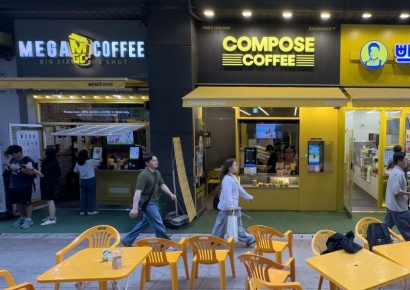 "Even on the Way to Work, There Are Lines at the 'Yellow Sign'... Mega MGC Coffee Achieves KRW 400 Million Sales Per Store with KRW 1,500 Coffee"
- "I Sold My Face for Just 100,000 Won"... My Likeness Appears as a Gangster or Adulteress Amid China Craze
- A 5 Million Won Proposal? Now "It's Identical for Only 800,000 Won”… Mines Shut Down En Masse
- "Will This Really Become Another Jamboree?" 70 Billion Won Spent, but Just "Luxury Vinyl Greenhouses"?... Yeosu Islands Expo Opening Weekend Falls Flat
- "It’s a Place I Frequented"... Before Body Found in Cafe Freezer, 'Normal Operations Resume Tomorrow' Shocks Netizens
Meanwhile, following news of this issue, South Korean authorities conducted emergency inspections of Chinese stem lettuce (gongcai) distributed domestically. According to the Ministry of Food and Drug Safety, eight emergency inspections revealed no traces of food coloring. The ministry stated, “We are continuously monitoring health safety information related to the use of food coloring on Chinese stem lettuce. We will enhance inspections not only during the import process but also throughout domestic distribution, ensuring prompt responses so that the public can consume food with confidence.”
© The Asia Business Daily. All rights reserved. Unauthorized AI training and use prohibited.