"With Interest Rates at 5%, Investors Tremble Over Melting Accounts...But Some Stocks Are Smiling [Real Life Investment]"
Soaring U.S. Treasury Yields Heighten Stock Market Uncertainty
Financials and Consumer Staples: Resilience Amid High Interest Rates
Bio and Tech: Sectors Requiring Large Capital Face High Rate Burden

With the Bank of Korea raising its benchmark interest rate for the second consecutive month and U.S. Treasury yields surging, the high interest rate era is fast approaching, throwing the stock market into turmoil. As concerns over high interest rates mount, the semiconductor stocks that previously led the rise in the Korean stock market have lost momentum, while traditional defensive sectors—such as banks, insurers, and consumer staples—are gaining attention and emerging as new market leaders. As the high interest rate era unfolds, investor focus is increasingly turning to which stocks will benefit and which will not.
Stock Market Volatility Intensifies Amid Climbing U.S. Treasury Yields
!["With Interest Rates at 5%, Investors Tremble Over Melting Accounts...But Some Stocks Are Smiling [Real Life Investment]"](http://www.asiae.co.kr/news/img_view.htm?img=2026090811055419894_1788833154.jpg)
According to Bloomberg and The Wall Street Journal (WSJ) on September 9, the yield on the 10-year U.S. Treasury recently rose to 4.821 percent. This marks the first time since November 1, 2023—after 2 years and 10 months—that the 10-year yield has surpassed 4.82 percent. The rise in U.S. Treasury yields has been attributed to several factors: the prolonged U.S.-Iran conflict resulting in persistently high oil prices, an increase in U.S. government bond issuance due to massive fiscal deficits, and a surge in corporate bond issuance by American big tech firms.
Market experts predict that the higher U.S. Treasury yields climb, the greater the pressure will be on the Korean stock market. As interest rates increase, investors can achieve higher returns from interest alone, reducing their incentive to take on risk by investing in equities.
Concerns are also rising that if the yield on the 10-year U.S. Treasury persistently breaks through the 5 percent level, the stock market could experience a sharp decline. Lee Euntaek, Director at KB Securities, stated, “A common denominator in historical stock market bubbles and their collapse has been a sustained upward trend in interest rates. If the 10-year U.S. Treasury yield persistently exceeds 5 percent, it would be dangerous.” Lee Sangjun, analyst at NH Investment & Securities, also pointed out, “If interest rates surpass 5 percent and continue to rise, the combined concerns over government debt ratios and fiscal soundness could accelerate downward pressure on stock prices.”
The stock market is already reflecting the anxiety surrounding rate hikes. The KOSPI dropped about 22 percent this past July, marking its worst month since the global financial crisis, with fears over U.S. interest rate hikes cited as a key factor.
!["With Interest Rates at 5%, Investors Tremble Over Melting Accounts...But Some Stocks Are Smiling [Real Life Investment]"](http://www.asiae.co.kr/news/img_view.htm?img=2026082710472294935_1787795241.jpg)
Financials and Consumer Staples Show Strength Despite High Interest Rates
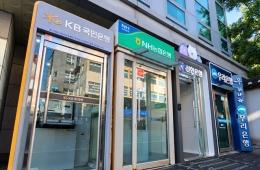
However, not all stocks decline when interest rates rise. In fact, for certain sectors, profitability can improve as rates go up. Banks are the prime example. As rates increase, financial holding companies with banking arms are attracting keen investor attention thanks to rising net interest margins. Even amidst corrections in the KOSPI since July, the four major financial holding companies—KB Financial, Shinhan Financial, Hana Financial, and Woori Financial—have seen their stock price returns rise by more than 10 percent.
Jaewoo Kim, analyst at Samsung Securities, commented, “As the Bank of Korea raises the base rate faster than expected, banks are poised to expand their net interest margins (NIM), which can accelerate the pace of interest income growth. This could also result in greater operating leverage.” Jiyeong Kim, analyst at Kyobo Securities, also forecast, “Banks will remain in the spotlight as beneficiaries of rising rates from base rate hikes.”
Financial holding companies are additionally benefiting from the drop in the KRW-USD exchange rate. As the exchange rate falls, Common Equity Tier 1 (CET1)—a key financial soundness indicator for financial holding companies—improves. Last month, the won-dollar exchange rate exceeded 1,550 KRW, but it has recently plunged to the 1,330 KRW range. Jeonguk Choi, analyst at Hana Securities, stated, “If the current exchange rate is maintained, major financial holding companies’ CET1 for Q3 will show notable improvement. As CET1 improves, the capacity for shareholder returns increases, likely supporting higher share prices.”
Rising rates are also a boon for insurance stocks. Typically, as rates rise, insurance companies can secure higher yields when they invest customers’ money into new bonds or products. The current market volatility also boosts the appeal of insurance stocks by offering high dividend yields. Baeseung Jeon, analyst at LS Securities, explained, “Rate hikes benefit insurance companies by enhancing new investment yields and the Contractual Service Margin (CSM). With continued improvements in insurance profitability in the second half and expectations of expanded shareholder returns, the rate hike environment offers positive investment conditions.”
Food stocks, long considered traditional defensive plays, are also drawing attention. Last month, Samyang Foods’ share price climbed about 31 percent, BINGGRAE surged 35 percent, and Nongshim gained 17 percent. All three companies showed balanced growth in both domestic and export markets. Eunjoo Shim, analyst at Hana Securities, projected, “Samyang Foods, BINGGRAE, and Nongshim are well-rounded companies with both solid results and dividends. As market volatility rises toward year-end, interest should grow in companies with strong downside protection.”

High Rates Weigh on Sectors Requiring Massive Capital, Such as Bio and Tech
In contrast, there are many sectors where rising interest rates pose a clear burden, most notably biotechnology. Bio companies often price their current valuation based on the value they expect to create in the future. However, as rates rise, the “discount rate” used to calculate future cash flows to their present value also rises, thereby reducing corporate valuation. In addition, as the development of new technologies and clinical trials requires significant funding, the high interest rate environment increases the cost of capital, placing further strain on company performance.
The tech sector is also feeling the pinch from higher rates. As leading growth stocks, tech companies tend to emphasize future growth prospects. Accordingly, their stock price valuations (price-to-earnings relative to earnings) are under more strain in high rate environments. Moreover, as many growth stocks aggressively pursue capital expenditures (CAPEX) and research and development (R&D) via borrowing, higher interest rates inevitably translate into greater interest expenses, weakening profitability.
Hot Picks Today
 "Why Is the Amount in My Account So Low?"... Why Pension Savings Subscribers Were Surprised
- "After Sleeping Well with Strangers"... Who Is the 24-Year-Old Woman Who Won 19 Million Won?
- "SK hynix to Hit 4.7 Million Won, Samsung 670,000 Won"... Why Nomura's Bold Forecast justifies it
- "Even Underwear Has to Be Cut Up with Scissors"... China Hit by Rise of "Trash Hunters" in an "If You're Slow, You're Out" Scramble
- "NPS loses 240 trillion won, 1990s-born get zero pension"... What's behind rumors spreading after the KOSPI plunge?
Securities companies are not immune to worries about a subdued stock market. When trading volume shrinks due to rate increases, brokerage commissions—the main income source for securities firms—also drop. Add to this the growing concerns over possible project financing (PF) defaults arising from a real estate slump, and overall investment sentiment is weakening. The analyst also noted, “Rate hikes accompanied by inflation slow real liquidity—a negative for the securities industry. For securities firms, whether they can offset lower brokerage commission income due to reduced trading volume with profit from investment banking (IB) operations will be a critical challenges in the second half of the year.”
© The Asia Business Daily. All rights reserved. Unauthorized AI training and use prohibited.