Minister Park Hongkeun Says "Kim Seungwon Unfairly Accused"...On Yong Hyein: "Excessive Ambition Against Public Sentiment"
"Revenue Outlook Expected to Be Accurate Through Next Year and the Following Year"
"'The Future Response Fund Is Not the Government’s Private Slush Fund'"
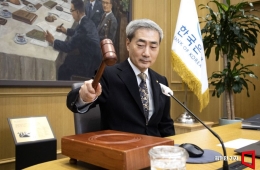
Park Hongkeun, Minister of Planning and Budget, commented on September 8 regarding allegations that Kim Seungwon, nominee for Justice Minister, was lobbied to approve a COVID-19 treatment clinical trial, saying, "It seems there are some things he is unfairly accused of."
Speaking on YTN Radio's "Jang Seongcheol's News Myeongdang" that morning, Minister Park addressed the suspicions surrounding nominee Kim, stating, "Assemblyman Han Donghoon pointed out that the case was opened when he served as Justice Minister, and under Prosecutor General Shim Woojung, the case was settled with a suspension of indictment."
He went on to say to the opposition, "I'm not sure where they obtained the materials, but they are making claims based on them," adding that nominee Kim expressed regret over the inappropriate way he conveyed a petition and acknowledged that it was 'inappropriate.'
Regarding Yong Hyein, nominee for Minister of Gender Equality and Family, he said, "She is one of the juniors I know well and care about," and added, "It seems that excessive ambition or overreaching actions are flowing in the public sentiment as being contrary to the nation’s sense of justice, fairness, and equity." He continued, "I think she needs to reflect on whether her own position and stance have contributed to the situation."

On the topic of next year’s 821 trillion won expansionary budget, he emphasized that "there is fierce global competition for supremacy in AI technology, and if Korea falls behind, it will be unable to avoid a peak out," adding, "The next one to two years are a golden opportunity to reopen Korea’s growth plate."
In response to concerns that the excess tax revenue from semiconductors should first be used for repaying national debt, he said, "Compared to other major countries and according to international organizations, the current level of national debt is manageable over the medium to long term."
The government explains that Korea’s debt-to-GDP ratio based on the D2 standard stands at only half—54.4%—of the advanced countries’ average (108.2%) set by the International Monetary Fund (IMF), and according to the IMF’s May announcement, Korea’s debt remains at a sustainable level and poses low risk.
He further said, "During the Yoon Suk Yeol administration, tax cut policies such as the corporate tax reduction, coupled with insufficient active investment in an economic downturn, resulted in massive tax shortfalls of approximately 100 trillion won, creating a vicious cycle of austerity." He stressed that now is the time to take this as a lesson and pursue active fiscal investment.
Minister Park added, "We are making proper investments to boost the growth rate to reduce the burden on future generations" and asked, "Please understand that our focus is on creating a virtuous cycle between economic growth and fiscal soundness."
According to the 2027 mid- to long-term national fiscal management plan announced earlier by the Ministry of Planning and Budget, the managed fiscal deficit ratio is projected to be kept within 3% in 2030, the last year of the current administration, and national debt is forecast to fall to 49%, down 10 percentage points from current levels.
When asked if these government projections are based on overly optimistic tax revenue forecasts, he stated, "They are based on the Ministry of Economy and Finance’s taxation office’s revenue projections," adding, "At a minimum, this year, next year, and the year after, the revenue outlook is expected to be generally accurate." He continued, "How long this three- to five-year cycle will last will depend on the state of the semiconductor market."
Concerning worries that the 162 trillion won Future Response Fund might become the government’s private slush fund, he countered, "It is established by law and can only be finalized after prior deliberation and resolution in the National Assembly."
Hot Picks Today
 "The Transfer Failed, but 'Ding Dong' Money Came In"... 32.5 Billion Won Financial Incident at Toss Bank
- "They Wouldn't Give It a Second Look When Offered to Ancestors"... MZ Goes Wild for 80-Year-Old Ceremonial Liquor as a Household Must-Have
- [Good Morning Stock Market] U.S. Stocks End Mixed as "AI Concerns Persist"; South Korean Stocks Likely to Pare Losses After Opening Lower
- Kim Taewon, Blue House Senior Secretary for Youth and Future Affairs, Reports 16.1 Billion Won in Assets, Including Google Shares
- "Baek Jongwon Had Been Quiet, Then Hit It Big"... Waits in the 100s in U.S. Despite KRW 46,000 Pork Belly
He explained, "Like general budgets and other funds, the government submits the operational plan for the Future Response Fund to the National Assembly in the same way," adding that "any changes can only be made within the 20% to 30% range, and a completely new project that has not been subject to prior National Assembly review cannot be suddenly planned and funded by changing the fund."
© The Asia Business Daily. All rights reserved. Unauthorized AI training and use prohibited.