Iran: "Final Stage Reached in Joint Management Agreement with Oman over Hormuz"
Temporary Safe Passage to Be Registered with the IMO
Potential Strengthening of Iran's Control Over the Strait
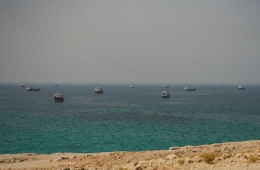
Iran is expected to soon conclude an agreement with Oman to jointly manage vessel passage through the Strait of Hormuz and adjacent Omani waters. If finalized, the agreement could significantly strengthen Iran’s control over the strait, drawing attention to potential responses from the United States.

On September 7, local time, Iranian Foreign Ministry spokesperson Esmail Baghaei Khoshrood announced at a press conference, “The negotiations with Oman to designate a temporary safe passage through the Strait of Hormuz have reached their final stage.”
Spokesperson Baghaei stated that the details of the ‘understanding’ between the two countries would be registered with the International Maritime Organization (IMO), an agency under the United Nations that oversees international shipping. He highlighted that “the negotiations have made very good progress,” and added—without naming specific parties—that he hopes no third party will intervene in the talks.
Iran and Oman, both coastal states bordering the Strait of Hormuz, have been discussing temporary routes and management measures for vessel passage over the past several weeks. The forthcoming agreement may also include provisions for imposing transit service fees on ships.
This approach contradicts the position of the United States, which insists that the Strait of Hormuz must remain freely accessible, as it was before the recent conflict. Currently, the United States is blockading Iranian ports in an effort to halt Iran’s oil exports.
Following reports of the potential agreement, the surge in international oil prices temporarily subsided. The anticipated increase in safe transits by oil tankers and other commercial ships—and a decrease in the risk of attacks against vessels—contributed to this market reaction. According to Bloomberg, Brent crude prices peaked at $97.93 per barrel during trading, before settling around $97 per barrel at noon London time that day.
Nevertheless, the recent exchange of hostilities targeting warships and oil tankers between the United States and Iran has kept uncertainty high for maritime transportation. Iran claimed it attacked three vessels using unauthorized routes, as well as three vessels linked to the U.S., although these statements have not been independently verified.
On September 5, the U.S. Central Command stated that, in response to Iran’s Islamic Revolutionary Guard Corps (IRGC) launching ballistic missiles at two U.S. naval vessels, U.S. forces struck three Iranian oil tankers. Of these, two became inoperable, while one unmanned oil tanker—its crew already having evacuated—was destroyed. There were no U.S. casualties.
Hot Picks Today
!["Just 5 Minutes to Departure" Ride a Maybach to Your Flight... Ultra-Luxurious VIP-Only Terminal Available for 950 Euros [Reportage]](https://cwcontent.asiae.co.kr/asiaresize/93/2026090414502016544_1788501020.jpg) "Just 5 Minutes to Departure" Ride a Maybach to Your Flight... Ultra-Luxurious VIP-Only Terminal Available for 950 Euros [Reportage]
"Just 5 Minutes to Departure" Ride a Maybach to Your Flight... Ultra-Luxurious VIP-Only Terminal Available for 950 Euros [Reportage]
- "Five Dresses for Travel at 40,000 Won"...After the Perfect Photo, Straight to the Trash
- "Once a Dream Job With 1,000-to-1 Competition, Now on the Verge of Becoming an Unpopular Career in China"
- "Nowhere Else in Asia Like Korea"—What’s Giving Foreign Tourists 'Seoul Fever'?
- "The Smart Newcomer Never Stops Working... This 'Rookie' Is Intimidating [Click e-Industry]"
Meanwhile, the Strait of Hormuz, which serves as a transit route for approximately 20% of global oil shipments, has effectively been closed since late February following a U.S. and Israeli airstrike on Iran. Ongoing negotiations since then have yielded little progress and, for the past seven months, sporadic retaliatory attacks have resulted in a continued state of instability between the parties.
© The Asia Business Daily. All rights reserved. Unauthorized AI training and use prohibited.