Jeju Governor’s Apology Fuels Accountability Clash Over 'Empty Qingdao Ship' and KRW 20 Billion Taxpayer Loss
Only 10% of Break-Even Reached...“Empty Vessel” Operations
KRW 20 Billion Loss Due to Skipped Central Investment Review
Calls for “Indemnity Claims” Continue Despite Governor’s Apology
Amid a highly publicized campaign touting the opening of the first regular international trade route in 57 years, the Jeju–Qingdao cargo ship has been operating at just 10% of its break-even cargo load, running nearly empty. As a result, more than KRW 20 billion in local taxpayers’ money has been wasted, and the project is now mired in controversy for skipping the mandatory central investment review required under the Local Finance Act.

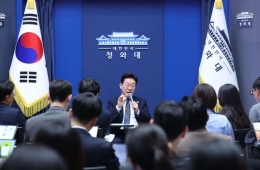
In the 4th plenary session of the 1st regular meeting of the 454th session of the Jeju Special Self-Governing Provincial Council, Kim Hwangguk of the People Power Party is intensively questioning Jeju Governor Won Heesung about the astronomical financial losses and procedural illegality arising in the operation of the Jeju-Qingdao international cargo ship route. Provided by Jeju Special Self-Governing Provincial Council.
View original imageAt the Jeju Provincial Council’s government questioning session on September 7, lawmakers delivered sharp criticism, demanding claims for indemnity over the massive financial loss and seeking accountability from both past and current administrations. Jeju Governor Won Hee-ryong eventually issued a formal apology, admitting an “administrative misjudgment,” but the debate over responsibility for the loss of public funds continues to escalate uncontrollably.
At the 4th plenary session of the 1st regular meeting of the 454th Jeju Special Self-Governing Province Council, Kim Hwangkook, a member of the People Power Party (representing Yongdam 1 and 2 neighborhoods in Jeju City), focused on the astronomical financial losses and procedural illegality that occurred during the operation of the Jeju–Qingdao international cargo ship route.
Assemblyman Kim strongly criticized the project, stating, “The break-even point for each operation is 220 TEU, but only about 22 TEU—just 10%—is actually being transported. Operating at just 10% of capacity effectively means the ship is running empty. KRW 8.6 billion in taxpayers’ money has already been spent on this, and another KRW 12 billion will need to be covered this year alone.”
Indeed, under the agreement Jeju Province signed with the Chinese shipping company in 2024, Jeju has been solely responsible for covering losses from insufficient cargo, operating under highly unfavorable terms.
Since its inaugural voyage in October last year, the ship made 31 trips until May this year, transporting a total of 715 TEU—just 10.4% of the break-even point, resulting in a growing cumulative deficit for Jeju Province.
That day’s government questioning session brought to the forefront not only the waste of public funds but also the “penalty aftershock” of violating legal procedures as a central issue.
Assemblyman Kim pursued the administration, saying, “The administration pushed ahead with establishing the route while skipping the mandatory central investment review (Jungtusim), which the Local Finance Act requires for projects involving large-scale budgets. If the government later imposes heavy financial penalties, such as reductions in local allocation tax, because of this, who will take responsibility for these financial and national losses?” In response, Governor Won admitted, “I believe this was an administrative misjudgment,” immediately acknowledging procedural and policy mistakes.
The crux of the debate ultimately became identifying the parties legally and politically responsible for the losses.
Assemblyman Kim pressed, “This is a serious issue that warrants considering indemnity claims against those involved. Should former Governor Oh Younghun, who planned and pushed the project, be held responsible, or is it Governor Won Hee-ryong, who inherited and continued it?”
He pointed out that despite pouring over KRW 12 billion in annual subsidies into the project like water into a bottomless pit, no one has stepped forward to accept responsibility.
Facing heated questioning, Governor Won bowed his head in apology, stating, “I offer my official apology to Jeju residents for the huge waste of local taxpayers’ money on the Qingdao route.”
He further explained, “We are in the process of renegotiating the unfavorable clauses with the Chinese side, within the bounds of preserving diplomatic relations. We will also activate a working-level consultative body to secure cargo volume and utilize the Shandong representative office to identify local importers, all in an effort to minimize the losses.”
However, local political circles and the community remain deeply skeptical.
This is because the “showcase administration,” implemented with unrealistic projections for cargo volumes and without rigorous feasibility studies or the required central government legal review, has ultimately led to a “fiscal disaster” that swallowed up local taxpayers’ money.
Hot Picks Today
 "Tried leveraged semiconductor stocks, watched 3.5 billion won shrink to 200 million won": Salaried investor in tears
- "Please Let Me Go Home"... Customers Trapped in Department Store Parking Lot for 5 Hours Vent Their Anger
- "I Should Enjoy It After Retirement": Prices Quadruple... Memberships Over 100 Million Won Popular, but Closures Mount
- “The Strong Drink This” Goes Viral on Social Media... What China's Millennials and Gen Z Are Hooked on After Ditching Coffee and Milk Tea
- "Come Live With Me on My Farm": Man Sells Everything and Travels 1,930 km, Trusting a Beautiful Woman
As a single statement of regret from the governor cannot conceal losses exceeding KRW 20 billion and the looming risk of allocation tax cuts, calls are growing for a full-scale audit of the decision-making process at the time the agreement was signed, as well as for a review of legal claims for indemnity to ensure accountability.
© The Asia Business Daily. All rights reserved. Unauthorized AI training and use prohibited.