Jaehun Jung, CEO of SKT: "The Battleground is AIDC... Advancing as an AI-Native Company" [AIDC Era: Telecoms Take the Lead]
Full-Stack AI Connecting Data Centers, Models, and Agents
"Reborn as an AI-Native Company"
Jaehun Jung, CEO of SK Telecom, has a vision to connect every stage of the AIDC (AI Data Center) business within the group by leveraging SK Group's capabilities in semiconductors, energy, and power generation, as well as its experience in operating its own data centers and its collaborative relationships with big tech companies.
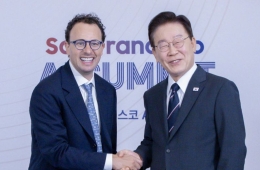
On September 1, during a lecture titled "Choices and Opportunities in the AI Era" at Seoul National University in Gwanak-gu, Seoul, Jung stated regarding the AIDC business, "This is not a business that can be done with capital alone," and added, "You must have capabilities not only in semiconductors and power, but also in establishing and operating facilities, as well as stable demand."

He predicted that the core unit of the future AI-driven economy will be the 'token,' which represents intelligence. Jung said, "In the past, data centers were simply warehouses for storing data, but now, AIDCs are factories for producing tokens. However, there is currently a shortage of data centers." He went on to emphasize, "This is why SK Telecom is simultaneously preparing both AI data centers that generate tokens and AI that consumes these tokens."
Jung sees the AI business as similar to SK Telecom's well-established telecommunications work. Just as the telecommunications business involves building a nationwide network to serve customers, AI business also entails building infrastructure and developing models to provide services to people. Jung stated, "We see the next future growth engine in AI-driven industries, and we will further advance our core telecommunications business through an AI transformation (AX)." He continued, "With these two strategies, SK Telecom's goal is to be reborn as an AI-native company."
To this end, SK Telecom is orienting itself as a full-stack AI company that connects data centers, models, and agents. SK Telecom is currently building a 100-megawatt (MW) AIDC in Ulsan as part of the government's three major mega projects. Afterward, the company plans to expand by an additional 900MW, reaching more than 1 gigawatt (GW), and operate a total of 5GW of AIDC in South Korea in stages starting in 2029. In the long term, the company aims to increase its capacity up to 15GW. SK Telecom is also participating in the government's "AI for Everyone" initiative, which provides AI services to all citizens, and is developing executable agent services based on its in-house AI model, 'A.Dot X K2.'
Jung also believes that securing AI infrastructure and models is an issue of national competitiveness, not just inter-company competition. He argued, "If oil was a strategic asset in the past, now AI is emerging as the new strategic asset. If we rely solely on the general-purpose AI models of global big tech, we will inevitably fall behind in model accessibility, pricing, and data utilization." He insisted on the need to secure sovereign AI capabilities, especially as borders now increasingly exist for data necessary for AI training and operations.
Hot Picks Today
 "They're Coming After My Pension Too?" Public Unease Mounts... Spain Sees Mass Protest Over Reform Push
- "Where Do You Go Every Lunch Break?"... 'Time-Poor' Men in Their 40s: Where They Spend Their Money.
- "Could Usage Dip Again When Coupons End?" Public Delivery Apps Consider Point Rewards, Merchant Incentives
- "Naked Again?" Controversial Actress Crosses a Line... Slammed for Sexualizing 'Child Characters'
- "Stockpile 9 Liters of Bottled Water and Three Days' Worth of Food"... UK on Edge as Nationwide Emergency Preparedness Alert Issued
"We are entering an era where we must not only compete on model performance, but also manage the costs associated with using those models," he said. "Going forward, how many tokens a company can secure will be a core competitiveness factor," he emphasized.
© The Asia Business Daily. All rights reserved. Unauthorized AI training and use prohibited.