"Spot-Seizing and Trash Left Behind: The Uncomfortable Aftermath of the Fireworks Festival"
Leaving Mats and Food Behind, Heading Home
1,200 Hanwha Employees Clean Late Into the Night
107 Cases Caught in First ‘Spot-Seizing’ Crackdown
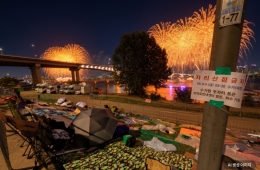
After the Seoul World Fireworks Festival, which brilliantly lit up the autumn night sky, came to a close, huge "mountains of trash" were left scattered across Yeouido Hangang Park in Seoul. Once again this year, the issue of public awareness has been criticized as some festivalgoers left behind picnic mats they had spread out to secure prime viewing spots, as well as leftover food, repeating concerns that have been raised every year.

Garbage scheduled for collection is piled up at Yeouido Hangang Park on the 6th after the '2026 Seoul International Fireworks Festival' ended. Photo by Yonhap News Agency
View original imageAccording to Hanwha Group on the 6th, approximately 1 million people attended the "Seoul World Fireworks Festival 2026" held the previous day in the Yeouido Hangang Park area, based on Hanwha's estimate. The police estimated the number of attendees at about 340,000. The event concluded without any major incidents despite the massive crowds, but after the spectators departed, the appearance of the park was a stark contrast to the spectacular night sky of the festival.
Fireworks Last 70 Minutes, Cleanup All Night... 80 Tons of Trash Left in Yeouido After One Million Visitors
Disposable picnic mats, delivery food containers, plastic bottles, and plastic bags were left scattered around the lawns. In many areas, containers with uneaten food were discarded, making it virtually impossible to distinguish between recyclables, general waste, and food waste. In particular, it was reported that some visitors left behind their picnic mats used to reserve good spots for viewing the fireworks. The city of Seoul cracked down for the first time this year on so-called "spot-seizing" at the festival, detecting a total of 107 cases during both the eve event and the main event. Ultimately, the cleanup fell to the event staff, environmental cleaners, and volunteers.
On the day of the festival, about 1,200 Hanwha employees and volunteers stayed late into the night cleaning up the site, but given the sheer volume of trash, same-day cleaning was insufficient. Approximately 100 staff from the Seoul Metropolitan Government’s Future Hangang Headquarters and an external contractor also worked through the night to remove trash until the next morning. It was reported that the amount of trash collected from the Yeouido area alone exceeded what could fill more than ten 8-ton trucks.
This amounts to at least 80 tons. Around 50 additional volunteers continued the next day, collecting garbage as they walked from Mapo Bridge to Wonhyo Bridge. Even more frustrating were cases where people had hidden trash behind street lamps or trees where it was difficult to see.

On the day of the festival, about 1,200 Hanwha employees and volunteers worked late into the night cleaning the site, but the amount of trash generated was so large that cleaning on the day alone was insufficient. Yonhap News
View original imageAs photos and news of the situation circulated, criticism poured in online as well. Netizens called out the behavior of some festivalgoers, emphasizing that "it is basic etiquette to take home the trash you generated." Many pointed out that leaving behind picnic mats and food waste in a public space used by hundreds of thousands is a matter of individual responsibility that should be observed regardless of event size.
In particular, as the fireworks festival is held annually and the trash problem recurs every year, there were comments questioning, "How long do volunteers and cleaning staff have to clean up after others?" Meanwhile, some argued that the issue should not be blamed solely on civic awareness. In reality, some large garbage bins at the venue were nearly full even before the main event started, and as the event progressed, new piles of trash accumulated around each bin.
For the Festival to End Not Just ‘Safely,’ But ‘Cleanly’
Given that nearly 1 million people attended this large-scale festival, some have pointed out that operational improvements are needed, such as increasing the number of trash bins, collecting waste more frequently, and deploying more staff for separated waste disposal.

Trash scheduled for collection piles up at Yeouido Hangang Park on the 6th after the conclusion of the "2026 Seoul International Fireworks Festival." Photo by Yonhap News Agency
View original imageThe Seoul Metropolitan Government announced before the event that it would add additional garbage collection facilities in Yeouido and Ichon, but after the festival ended, trash exceeded the disposal capacity in multiple areas. An official from the city’s Future Hangang Headquarters stated that the volume of trash this year was similar to last year, indicating that this chronic problem has not been significantly addressed.
The fact that the event concluded without major incidents is seen as a positive in terms of safety management. Seoul Metropolitan Government, Hanwha Group, the police, fire department, and local district offices in Yeongdeungpo, Yongsan, Dongjak, and Mapo operated an integrated safety center and deployed a total of 6,800 personnel for safety control and maintaining order. Safety fences and related equipment were increased by 20% compared to last year.
Hot Picks Today
!["Just 5 Minutes to Departure" Ride a Maybach to Your Flight... Ultra-Luxurious VIP-Only Terminal Available for 950 Euros [Reportage]](https://cwcontent.asiae.co.kr/asiaresize/93/2026090414502016544_1788501020.jpg) "Just 5 Minutes to Departure" Ride a Maybach to Your Flight... Ultra-Luxurious VIP-Only Terminal Available for 950 Euros [Reportage]
"Just 5 Minutes to Departure" Ride a Maybach to Your Flight... Ultra-Luxurious VIP-Only Terminal Available for 950 Euros [Reportage]
- "Five Dresses for Travel at 40,000 Won"...After the Perfect Photo, Straight to the Trash
- [Breaking] Minister of the Interior and Safety Recommends Kim Ji-yong as Inaugural Chief of Serious Crimes Investigation Agency
- "Nowhere Else in Asia Like Korea"—What’s Giving Foreign Tourists 'Seoul Fever'?
- "I Would Want My Daughter to Work Here": Amorepacific Claims First-Ever Top Spot Among Top 100 Firms for Executive-Level Advancement [2026 Gender Equality Index]
However, to raise the standard of Korea’s flagship festival, which is enjoyed by one million people, calls have grown for the festival to be not only ‘safe’ but also ‘clean at the end.’ There is a consensus that in order to change the recurring final scene of the fireworks festival, both a more responsible festival culture by attendees and more comprehensive waste management measures from organizers and administrators are needed.
© The Asia Business Daily. All rights reserved. Unauthorized AI training and use prohibited.