Blue House Weighs 'Minimum Deployment' Amid U.S. Pressure
Difficult to Continue Ignoring Trump’s Demands
Maintaining Readiness on the Korean Peninsula
Crucial to Draw a Line on Military Operations Against Iran
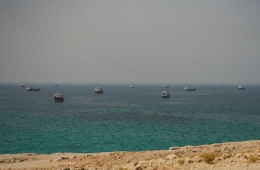
As the government considers deploying troops to the Strait of Hormuz, it appears to be weighing the 'minimum deployment level' necessary to maintain readiness on the Korean Peninsula. While it is becoming increasingly difficult to ignore the U.S. request for allied contributions, concerns are being raised that sending key forces to the Middle East for an extended period could undermine readiness against North Korea.
On September 6 (local time), the Trump Administration reiterated its call for “resource deployment from the Korean government” in the Strait of Hormuz. The forces under consideration for deployment include the P-8A maritime patrol aircraft, a logistics support vessel, and an explosive ordnance disposal (EOD) team. Previously, a Blue House official stated on September 4, “We believe we can move within the scope where there is no significant damage to our readiness posture on the Korean Peninsula.”
Given the ongoing conflict between the U.S. and Iran, it is also crucial to demonstrate allied contribution while clearly distinguishing South Korea’s activity from participation in military operations against Iran. Yoo Jihoon, a research fellow at the Korea Institute for Defense Analyses, said, “A strategy is needed that shows the United States our willingness to make necessary contributions as an ally, while making it clear to Iran that South Korea’s military involvement does not constitute participation in a war against Iran.”
If the P-8A, one of the assets being discussed, is included among those to be deployed, both the readiness posture on the Korean Peninsula and the duration of the deployment must be considered. Research fellow Yoo stated, “The P-8A plays a critical role in tracking and detecting North Korean submarines and identifying North Korean provocations at sea in advance,” adding, “It is important to operate flexibly so there are no security gaps on the Korean Peninsula.” He continued, “Even if it is sent to the Strait of Hormuz, sending it for an extended period would be problematic,” and emphasized that “it is crucial to coordinate with the United States regarding what missions to conduct and for how long.”
Hot Picks Today
!["Just 5 Minutes to Departure" Ride a Maybach to Your Flight... Ultra-Luxurious VIP-Only Terminal Available for 950 Euros [Reportage]](https://cwcontent.asiae.co.kr/asiaresize/93/2026090414502016544_1788501020.jpg) "Just 5 Minutes to Departure" Ride a Maybach to Your Flight... Ultra-Luxurious VIP-Only Terminal Available for 950 Euros [Reportage]
"Just 5 Minutes to Departure" Ride a Maybach to Your Flight... Ultra-Luxurious VIP-Only Terminal Available for 950 Euros [Reportage]
- "Five Dresses for Travel at 40,000 Won"...After the Perfect Photo, Straight to the Trash
- "Once a Dream Job With 1,000-to-1 Competition, Now on the Verge of Becoming an Unpopular Career in China"
- "Nowhere Else in Asia Like Korea"—What’s Giving Foreign Tourists 'Seoul Fever'?
- "The Smart Newcomer Never Stops Working... This 'Rookie' Is Intimidating [Click e-Industry]"
Yang Wook, a research fellow at the Asan Institute for Policy Studies, said, “Rather than the deployment itself, the focus should be on what exactly the United States wants from South Korea,” and added, “There are limitations on how much of a helpful force can be sent.”
© The Asia Business Daily. All rights reserved. Unauthorized AI training and use prohibited.