Market Reforms Push Out 'Name-Only Listed Companies' as Tokyo Stock Exchange Delistings Hit Record High for Third Year
Impact of 'Value-Up' Reform at the Tokyo Stock Exchange
Tougher Standards Lead to More Delistings
Voluntary Delistings Rise as Companies Partner with PEFs for Aggressive Investment
The number of delistings from the Tokyo Stock Exchange, the heart of Japan's stock market, is forecast to reach a record high for the third consecutive year. As regulators accelerate stock market reforms aimed at enhancing corporate value, there are expectations that so-called "name-only listed companies" will be significantly weeded out.
According to the Nihon Keizai Shimbun (Nikkei) on September 7, as of September 4, a total of 128 companies have been confirmed for delisting from the Tokyo Stock Exchange this year, surpassing last year's figure of 125. The Nikkei pointed out that there are also 29 companies designated as under surveillance, indicating a possibility of delisting in the future, and thus the number of delistings is likely to increase even further by the end of this year.
The total number of listed companies is also declining rapidly. Excluding the Tokyo Pro Market (Japan's equivalent of Korea's KONEX), the number of companies listed on the Tokyo Stock Exchange at the end of last month stood at 3,705, a decrease of 77 from the end of last year (3,782 companies). Compared to the end of 2023, when the number of listed companies was at an all-time high, the total has fallen by 4%, reaching its lowest level in seven years.

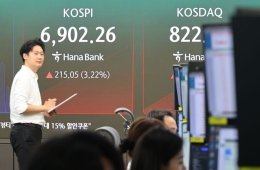
On the 4th, a citizen was passing by an electronic display board showing the Nikkei 225 index near a securities firm building in Tokyo, Japan. Tokyo (Japan) = AP Yonhap News.
View original imageThe Nikkei analyzed that this trend is closely linked to stock market reforms that the Tokyo Stock Exchange has been pursuing since 2022. At that time, the exchange reorganized its four-section structure (First Section, Second Section, JASDAQ, Mothers) into three markets (Prime, Standard, Growth), while revising requirements such as the minimum market capitalization for listing. Beginning in 2024, companies listed on the Prime and Standard markets have been asked to pursue value-up management, set targets for return on equity (ROE) and return on invested capital (ROIC), and release management plans to boost corporate value.
With the grace period, granted to companies that failed to meet the new criteria at the time of reform, now at an end, delistings are occurring in earnest this year. According to the Nikkei, following the expiration of the improvement period this March, ten companies that ultimately failed to meet the requirements are expected to be delisted on the first day of the following month.
As shareholder demands for maintaining a listing grow, more companies are choosing to delist voluntarily. According to the Nikkei, 28 companies—20% of those opting to go private—have partnered with private equity funds (PEFs). The Nikkei analyzed that these companies aim to leverage the financial resources of PEFs to streamline complex shareholder structures and reorganize business operations. The Nikkei also noted a growing trend in cases triggered by activist funds exerting pressure for management improvements.
The case of system development firm Mamezo exemplifies this trend. Despite strong earnings, the company delisted to pursue aggressive investment. Having been listed on the Tokyo Stock Exchange Growth Market in June 2024 and consistently posting solid results, Mamezo decided to join forces with European PEF EQT to delist, explaining the move was to pursue bold investment in the field of artificial intelligence (AI) without being constrained by short-term performance.
Some companies seeking to retain their public status are looking for new opportunities by moving to local exchanges. Last year, excluding the Pro Market, the number of new listings on the Nagoya, Fukuoka, and Sapporo exchanges surged to 47, compared to just three in 2020. This year, as of the end of August, 21 companies have secured listings on these regional exchanges.
Hot Picks Today
!["Just 5 Minutes to Departure" Ride a Maybach to Your Flight... Ultra-Luxurious VIP-Only Terminal Available for 950 Euros [Reportage]](https://cwcontent.asiae.co.kr/asiaresize/93/2026090414502016544_1788501020.jpg) "Just 5 Minutes to Departure" Ride a Maybach to Your Flight... Ultra-Luxurious VIP-Only Terminal Available for 950 Euros [Reportage]
"Just 5 Minutes to Departure" Ride a Maybach to Your Flight... Ultra-Luxurious VIP-Only Terminal Available for 950 Euros [Reportage]
- "Five Dresses for Travel at 40,000 Won"...After the Perfect Photo, Straight to the Trash
- "There's a Suspicious Item in Your Delivery"... A Look at Japan's New Scam Methods
- "Nowhere Else in Asia Like Korea"—What’s Giving Foreign Tourists 'Seoul Fever'?
- "I Would Want My Daughter to Work Here": Amorepacific Claims First-Ever Top Spot Among Top 100 Firms for Executive-Level Advancement [2026 Gender Equality Index]
The Nikkei analyzed that the latest reforms of the Tokyo Stock Exchange are intended to address the chronic problem in the Japanese market, where companies rush to go public without building a solid foundation, only to see their growth stall post-listing. The Nikkei added, “Hiromi Yamamichi, CEO of Japan Exchange Group (JPX), which oversees the Tokyo Stock Exchange, has declared that the sheer number of listed companies is not a priority. This reform has put a brake on Japan’s longstanding practice of hurrying to list by demanding that companies that simply remain on the exchange must eventually exit.”
© The Asia Business Daily. All rights reserved. Unauthorized AI training and use prohibited.