Gender Pay Gap Continues to Narrow... "Public Institutions Drop into 10% Range for the First Time"
"2025 Gender Wage Statistics Survey Results" Released
Structural Factors Such as Career Interruptions and the Glass Ceiling Still Remain
Introduction of the "Employment Equality Disclosure System" to Encourage Voluntary Reforms
As of 2025, the gender pay gap at private companies and public institutions stood at 29.3% and 19.0%, respectively, both showing improvement compared to the previous year. Notably, public institutions recorded a percentage in the 10% range for the first time since the statistics were compiled in 2020.
The Ministry of Gender Equality and Family announced these findings on September 7 with the release of the "2025 Gender Wage Statistics Survey Results." The ministry analyzed 3,146 companies subject to disclosure that submitted business reports to the Financial Supervisory Service's DART (Data Analysis, Retrieval and Transfer System) and 355 public institutions disclosed on the ALIO (All Public Information in One) management information disclosure system.
First, the average annual wage per male employee at companies subject to disclosure was 102.03 million won, while for female employees it was 72.16 million won. The gender pay gap was 29.3%, down 1.4 percentage points from 30.7% in the previous year.

This improvement was influenced by female wages rising 6.5% from the previous year, outpacing the 4.3% increase in male wages.
The proportion of female employees rose from 27.1% to 27.4%, and the average length of service for female employees increased from 9.4 years to 9.5 years. The gender gap in length of service was 19.8%, down by 1.1 percentage points from the previous year.
The industry with the largest gender pay gap was "Wholesale and Retail Trade" at 42.29%, followed by "Construction" at 42.26%. The industries with the smallest gaps were "Accommodation and Food Service Activities" (14.2%) and "Arts, Sports, and Recreation Services" (15.6%).
The gender pay gap at public institutions dropped into the 10% range for the first time since gender wage statistics began being announced in 2020. The ministry explained, "Efforts to enhance female representation in public institutions appear to have contributed to narrowing the gender pay gap."
In 2025, the average wage per male employee at public institutions was 74.79 million won, and for female employees it was 60.56 million won, making the gender pay gap 19.0%. This was a decrease of 1.0 percentage point from the previous year.
Female wages increased 4.1% from the previous year, exceeding the 2.9% increase in male wages. The average length of service was 10.6 years for men and 8.7 years for women, with the gender gap in length of service improving by 1.8 percentage points from the previous year to 18.1%.
However, it was found that the gender pay gap still exists due to structural factors such as occupational segregation by gender, career interruptions, and the glass ceiling, each contributing to the differences in length of service and pay.
In order to more precisely identify the causes of the gender pay gap and encourage companies to initiate their own reforms, the Ministry is pursuing the introduction of an "Employment Equality Disclosure System." This system requires companies to disclose gender employment status and pay gaps by occupation, job level, and type of employment, enabling a more detailed analysis of causes of gender disparities in the labor market.
The plan is to build a support system that goes beyond simply releasing information, connecting "disclosure, assessment, consulting, and policy improvement" so that companies can independently review and improve their hiring practices.
The government also plans to strengthen policy support to address the concentration of women in low-wage jobs by improving job evaluations in care work and by expanding female entry and career retention through vocational training in key fields such as artificial intelligence (AI) and other industrial transformation sectors.
Hot Picks Today
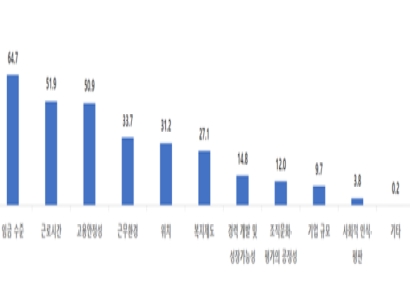 "Please Pay Me at Least 3 Million Won a Month": More Than Half of Young People Today Prioritize "Working Conditions" Over Company Size
- Selling Like Crazy Every Year... 30-Year-Old Hetbahn Takes on a New Challenge: Tastes Better Than "Mom's Home Cooking" [On-Site Report]
- He Left It in the Car and Forgot... "I Nearly Collapsed with Joy": Man Wins $1.48 Million Lottery
- Ran 18 km With 9-Year-Old Tied to Him at the Waist... "Man Banned From Competing for 3 Years"
- Beachgoer Finds 'Plastic' That Turns Out to Be Perfume Ingredient Worth More Than Twice as Much as Gold
Minister of Gender Equality and Family, Min Kyung Won, stated, "It is a positive change that the gender pay gap is narrowing at both listed companies and public institutions, but there remains a significant gap. We will do our utmost to accurately determine where the gender gap arises and to ensure that the introduction of the Employment Equality Disclosure System leads to tangible improvements in hiring practices by companies."
© The Asia Business Daily. All rights reserved. Unauthorized AI training and use prohibited.