Russia Erects Monument Depicting Destruction of Japan's Chrysanthemum Crest Marker... Rising Military Tensions
Takaichi: "Absolutely Unacceptable... Demanding Removal"
Tensions Rise Amid Putin's Visit to the Kuril Islands
The Japanese government has protested the construction of a Russian Victory over Japan Monument that depicts a Soviet soldier destroying a border marker engraved with the chrysanthemum crest, a symbol of Japan.
According to Yonhap News Agency and local media on September 6, Japanese Prime Minister Sanae Takaichi criticized the unveiling ceremony of the Victory over Japan Monument held in Khabarovsk, Russian Far East, in a post on X (formerly Twitter) the previous day. The statue portrays a Soviet soldier striking and apparently destroying a border marker engraved with the chrysanthemum crest using his rifle. This monument is modeled after border markers that Japan erected along the border with Russia after occupying southern Sakhalin following the Russo-Japanese War. According to the Mainichi Shimbun, the Russian side sees the chrysanthemum crest as a symbol of Japanese militarism.

Russia's Victory Monument over Japan established in Khabarovsk.
Photo by X Capture, Yonhap News
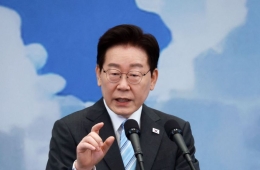
Prime Minister Takaichi strongly condemned the installation, stating, "The monument expressing the destruction of the chrysanthemum crest, which is widely regarded as a symbol of Japan, is absolutely unacceptable." She added, "We have strongly requested the Russian side to halt the installation or remove it, considering the sentiment of the Japanese people. We will continue to strongly demand its removal." She wrote her post on X in both Japanese and Russian.
The Japanese Ministry of Foreign Affairs also issued a statement by Foreign Minister Toshimitsu Motegi, saying the construction of the monument was "deeply regrettable." It was also reported that Japan has requested the Russian side to halt and remove the monument through diplomatic channels.
Recently, tensions between the two countries have risen after Russian President Vladimir Putin visited one of the four Kuril Islands (referred to as the Northern Territories in Japan), prompting a strong protest from Japan. The Kuril Islands are a volcanic archipelago spanning about 1,200 to 1,300 kilometers from the Kamchatka Peninsula toward Hokkaido. Of these, Japan and Russia are in a territorial dispute over the four southernmost islands. Russia currently maintains effective control over these islands, but Japan claims them as its own territory.
On September 2 (local time), during a visit to Kyrgyzstan to attend the Shanghai Cooperation Organization (SCO) summit, President Putin commented on relations with Japan by stating, "The deterioration of current relations is entirely Japan's responsibility." In response, the Japanese government immediately protested, saying, "This is unacceptable."
Hot Picks Today
 "KOSPI Surpassed 9,000, but May Fall Below 5,200 Next Year"...Expert Explains the Forecast
- In the Same Neighborhood, One Apartment Costs 2 Billion Won, Another 450 Million... What's Happening in Gangnam?
- "New Infections Sixteen Times Higher Than in 2019"... National Emergency Declared Over Spread of This Virus
- "I Thought I Lacked Willpower, But It Turns Out 'This Hormone' Is to Blame? [Experiment Note]"
- With Two Extra Days Added to Chuseok Holiday: "Pack Up, Let's Go Anywhere"... Domestic Travel Demand Surges
Russia has also issued a warning regarding a large-scale joint army exercise involving U.S. and Australian troops that Japan plans to conduct in northern Hokkaido and other areas from the 8th to the 24th, calling it "a provocative military activity" and indicating it may take corresponding measures.
© The Asia Business Daily. All rights reserved. Unauthorized AI training and use prohibited.