National Innovation Party: "Prosecution Office Without Investigative Powers Should Cut Prosecutor Staffing from 2,292 by One-Third"
Total Headcount to Be Cut by 21%, but Number of Prosecutors Remains Unchanged
Shin Jangsik Criticizes “Prosecutorial Privilege Maintenance Tactic”
Proposed Amendment to Prosecutor Staffing Act Announced
Government Claims Numbers Neede
The National Innovation Party has criticized the government's proposal to maintain the current prosecutorial staffing level at 2,292 prosecutors for the Prosecution Office, which is set to launch next month, and has urged for a reduction by at least one-third.

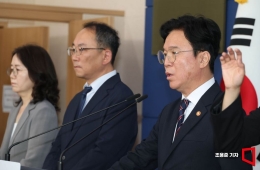
On the 6th, Shin Jangsik, leader of the National Innovation Party, and its members held a press conference at the National Assembly Communication Office criticizing the government's announced "Prosecution Office and Its Affiliated Institutions Organization Act" bill and the amendment to the "Prosecutor Staffing Act Enforcement Decree." Photo by Yonhap News Agency
View original imageOn September 6, Shin Jangsik, leader of the National Innovation Party, held a press conference at the National Assembly and stated, "The government should revisit its plans for the Prosecution Office organization and submit an amendment to the Prosecutor Staffing Act that aligns with the goal of separating investigative and prosecutorial functions." He further added, "Considering the abolition of prosecutors' investigative work, the number of line prosecutors in the Prosecution Office should be reduced by at least one-third."
On September 4, the Ministry of Justice announced that it had drafted the "Prosecution Office and Its Affiliated Institutions Organization Act" and the revised "Prosecutor Staffing Act Enforcement Decree," which will be open for legislative notice until September 9. The Prosecution Office is scheduled to launch with a total workforce of 8,412, consisting of 2,292 prosecutors and 6,120 administrative staff.
Compared to the current total prosecution workforce of 10,706 members, this represents a reduction by 2,294 people, or 21.4%. However, the number of prosecutors will remain unchanged at 2,292, and the bulk of workforce reductions will come from administrative positions. The current Prosecutor Staffing Act also stipulates the total number of prosecutors at 2,292.
Following the abolition of prosecutors' direct investigative authority, the organization will undergo significant restructuring. Forty-three existing direct investigation and joint investigation departments, as well as sixty-seven investigation and research divisions primarily staffed by prosecutorial investigators, will be abolished. The Chief of Criminal Information Planning and the Forensic Science Department at the Supreme Prosecutors’ Office will also be eliminated. Instead, there will be twenty-nine new Major Crime Units established in cooperation with the Major Crime Investigation Agency for investigatory and prosecutorial collaboration.
The oversight function over other investigative agencies, such as the police, will also be strengthened. Each regional Prosecution Office branch will establish a "Judicial Oversight Department" to review cases not forwarded by the police. The main headquarters will form dedicated teams for general criminal case management and agencies tasked with overseeing cooperation with the special judicial police.
The Innovation Party argued that retaining the current number of prosecutors despite significantly reducing investigative functions and related departments contradicts the intent to separate investigative and prosecutorial roles.
Leader Shin remarked, "More than one-third of prosecutorial work has traditionally consisted of investigations," adding, "It is only natural for the government to appropriately downsize the organization and workforce in line with a substantial reduction in duties."
The Innovation Party further asserted that not only line prosecutors but also senior positions such as heads, directors, and chiefs at the main Prosecution Office, as well as deputy chiefs and heads at the Seoul Central District Prosecution Office, should be reduced. The party also called for a reorganization of the Metropolitan Prosecution Offices and the Major Economic Crime Investigation Team, as well as the renaming and restructuring of traditional prosecutorial titles and roles, such as "Chief Prosecutor."
The party also took issue with the government’s approach of leaving the Prosecutor Staffing Act itself unchanged while only revising the enforcement decree that apportions staffing among local offices. Under the current law, the total number of prosecutors is stipulated by statute, and any reduction would require an amendment to the law by the National Assembly.
Leader Shin also criticized the Democratic Party for failing to fulfill its responsibilities regarding follow-up legislation for prosecution reform. After the press conference, he added, "It is a serious issue that the organizational structure for the Prosecution Office has not yet been finalized even though it is set to launch on October 2," stating that the party would promptly submit its own amendment to the Prosecutor Staffing Act.
The specific scale of reductions will be determined after reviewing the government's data on prosecutor staff calculation. Shin emphasized, "It is not appropriate to simply cut a third arbitrarily and submit a bill," and said, "We will try to submit an amendment as soon as possible."
Hot Picks Today
 "Why Is the Amount in My Account So Low?"... Why Pension Savings Subscribers Were Surprised
- "After Sleeping Well with Strangers"... Who Is the 24-Year-Old Woman Who Won 19 Million Won?
- "SK hynix to Hit 4.7 Million Won, Samsung 670,000 Won"... Why Nomura's Bold Forecast justifies it
- "Even Underwear Has to Be Cut Up with Scissors"... China Hit by Rise of "Trash Hunters" in an "If You're Slow, You're Out" Scramble
- "NPS loses 240 trillion won, 1990s-born get zero pension"... What's behind rumors spreading after the KOSPI plunge?
The Ministry of Justice explained that this restructuring is intended not only to downsize the organization in line with the abolition of direct investigation functions, but also to strengthen functions such as prosecution, case management, investigative agency oversight, and criminal asset recovery. After collecting public input during the legislative notice period, the Ministry aims to complete the enactment and amendment procedures in time for the Prosecution Office’s launch on October 2.
© The Asia Business Daily. All rights reserved. Unauthorized AI training and use prohibited.