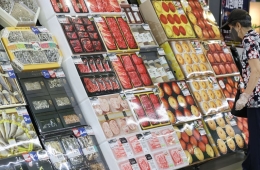
Crackdown on Fraudulent Origin Labeling Targeting Chuseok Peak... Origin Labeling Awareness Campaigns at Traditional Markets
Origin Labeling Inspections from September 7–23
Focused Management of Key Products and Frequently Violated Items
Joint Crackdown on Livestock Product Traceability
Ahead of Chuseok, the National Agricultural Products Quality Management Service will conduct comprehensive inspections of origin labeling for agricultural food products such as ribs, health foods, fruits, and edible greens, which are commonly used as gifts or ritual offerings, to prevent illegal distribution practices.
The agency announced on September 6 that it will carry out inspections targeting fraudulent origin labeling aimed at the Chuseok holiday peak for a total of 17 days, from September 7 to 23.

The origin labeling inspection team is checking the origin labeling of livestock products. Rural Development Administration
View original imageThis inspection will specifically focus on gift and ritual agricultural food products, whose consumption accelerates during Chuseok, with concentrated efforts scheduled from September 7 to 23. During the first phase (September 7–13), manufacturers, processors, and online retailers will be targeted. In the second phase (September 14–23), large supermarkets, traditional markets, and other distribution companies will be the primary focus of enforcement.
In particular, to ensure the effectiveness of the crackdown, key products for Chuseok as well as items that have recently seen frequent origin-labeling violations have been designated as priority management targets. Furthermore, joint inspections will be carried out in collaboration with relevant agencies such as the Korea Forest Service, Korea Customs Service, and local governments, focusing on regional specialties and forest products.
The National Agricultural Products Quality Management Service plans to deploy 285 special judicial police officers and 2,500 honorary monitoring officers from consumer and producer organizations for this enforcement operation. The team will thoroughly inspect activities such as falsely labeling imported agricultural food as domestic, misrepresenting products from less-known regions as specialty goods from famous domestic regions, and failing to indicate the origin at all. False labeling of origin can result in up to seven years of imprisonment or a fine of up to 100 million won, while the absence of origin indication is punishable by a fine ranging from 50,000 won to 10 million won.
To help consumers when purchasing ritual goods, the agency will also provide information on how to distinguish between domestic and imported agricultural products through its website. In addition, origin labeling awareness campaigns will be promoted at traditional markets in cooperation with the honorary monitoring officers to ensure proper origin labeling becomes standard practice.
Kim Cheol, head of the National Agricultural Products Quality Management Service, stated, "Since the consumption of gift and ritual agricultural foods increases significantly during Chuseok, we plan to strengthen origin labeling inspections and promotional activities so that the public can confidently purchase our domestic agricultural products." He also requested that "consumers should carefully check the origin labeling when purchasing gifts and ritual goods."
A joint inspection of the traceability, grading, and origin labeling of livestock products will also take place. From September 7 to 23, the National Agricultural Products Quality Management Service, Animal and Plant Quarantine Agency, local governments, and the Livestock Product Quality Evaluation Institute will inspect more than 1,000 sites, including online retailers suspected of violations and outlets with a history of breaches regarding the livestock traceability system. In cases where there are suspicions about the authenticity of traceability numbers during on-site inspections, DNA identity testing will also be conducted concurrently.
Hot Picks Today
 Net Worth of KRW 430 Million, Half Own Homes... 'Permanently Single' Households Are the Wealthiest Among Singles
- "Not Seoul, But Here": The Viral 'Busanbyung' Phenomenon Spreading Rapidly in Taiwan
- "Baseball Stadium's 'Chimaek Rule' Overturned: New Clean-Eating Food Trends Replace Greasy Classics"
- "40% of Victims Endure or Ignore Workplace Harassment Without Reporting... Serious Concerns Over Secondary Victimization"
- 'Million-Dollar Sports Bra' Gold Medalist Faces Backlash After Flaunting $7,800 Luxury Bag... Why?
If a traceability number is falsely indicated to hide the grade or origin of livestock products, a fine or penalty of up to 5 million won is currently imposed. However, following the revision of the “Act on the Management of Livestock and Livestock Product Traceability” that took effect on July 7, the penalty will be significantly strengthened from January 8 of next year to include up to one year of imprisonment or a fine of up to 10 million won.
© The Asia Business Daily. All rights reserved. Unauthorized AI training and use prohibited.