Ruling Party and Government to Submit Mega Special Zones Act in September, Accelerate Legislation Within the Year
"Legislation to Begin as a Member's Bill, with Party Endorsement to Follow"
"Further Discussions Planned on White-Collar Exemption"
On September 4, the Democratic Party of Korea and the government announced that they will introduce the Mega Special Zone Act, which will support the 'mega projects', within this month and aim to pass it in the National Assembly by the end of the year. However, how to reflect the controversial 'white-collar exemption' (an exception to the 52-hour workweek regulation) in the bill remains subject to further discussion.
The Democratic Party’s Mega Project and Regional Growth Special Committee held a party-government consultation at the National Assembly on the same day, receiving a report from Policy Chief Lim Ki Keun at the Office for Government Policy Coordination on the details and provisions of the government-drafted Mega Special Zone Act.

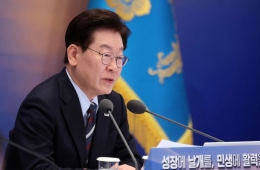
(Seoul=Yonhap News) Reporter Donghae Lee is speaking at the party-government meeting of the Mega Growth Special Committee held on September 4 at the National Assembly Members' Office Building. 2026.9.4 eastsea@yna.co.kr (End)
View original imageJang Cheolmin, the secretary of the special committee, met with reporters after the consultation and said, “We expect the bill to be submitted within September.” Jang added, “Rather than proposing it as a party-sponsored bill from the outset, we intend to have it submitted through individual lawmakers in the Political Affairs Committee, and after incorporating input from stakeholders, the public, and within the National Assembly, we will finalize the provisions and proceed with making it a party initiative.” The bill is expected to be formally sponsored by Assemblyman Park Sanghyuk, the ruling party’s secretary of the Political Affairs Committee.
Regarding the main point of contention in the Mega Special Zone Act—the 'white-collar exemption' to the 52-hour workweek—Jang stated, “There is no clause that clearly stipulates an exception to the 52-hour rule.”
However, Jang explained, “The government's deliberations contain their considerations on how to formulate a Korean-style version of the white-collar exemption in legal terms.” He continued, “It is inappropriate to comment on specific provisions at this stage. There may be confusion between the currently drafted and the finalized bill, so it is difficult to give a definitive answer at this time.”
At the meeting, party leader Kim Minseok emphasized, “For the mega growth initiative, all five axes—central government, local governments, the National Assembly, local councils, and civil society—must move in unison,” and stressed, “realistically, the party is the only entity that can coordinate all five axes.”
Policy Committee Chair Kwon Chilsung commented, “We are well aware of labor groups’ concerns regarding the (corporate) benefits relating to labor in the [mega special zones],” and added, “a societal grand compromise procedure is needed to gather the opinions of stakeholders to harmonize regulatory innovation for raising corporate competitiveness with the protection of workers’ rights.”
Meanwhile, the government side at the party-government meeting included, in addition to Policy Chief Lim, Vice Minister of Trade, Industry and Energy Moon Sinhak, and Lee Byeongheon, Acting Chair of the Presidential Commission for National Decentralization.
Hot Picks Today
 "Please Pay Me at Least 3 Million Won a Month": More Than Half of Young People Today Prioritize "Working Conditions" Over Company Size
- Selling Like Crazy Every Year... 30-Year-Old Hetbahn Takes on a New Challenge: Tastes Better Than "Mom's Home Cooking" [On-Site Report]
- "Americans Would Be Amazed If They Came": Wide-Eyed at a Sight They've Never Seen Before... Foreigners Also Fall for K-Baseball [K-Holic]
- President Lee Narrows Candidates for Next Justice Minister to Former Prosecutors Yang Bunam and Park Gyuntaek
- Beachgoer Finds 'Plastic' That Turns Out to Be Perfume Ingredient Worth More Than Twice as Much as Gold
The Mega Special Zone Act was originally discussed by the National Assembly’s Trade, Industry, Energy, SMEs and Startups Committee, but the Democratic Party is expected to submit it under the Political Affairs Committee’s jurisdiction. Currently, the chair of the Trade, Industry, Energy, SMEs and Startups Committee is Assemblyman Kim Sungwon of the People Power Party. If the opposition does not cooperate with the passage of the bill, the government's and ruling party’s goal of enacting the Mega Special Zone Act within the year could be delayed. The chair of the Political Affairs Committee is Assemblyman Yoo Dongsu of the Democratic Party.
© The Asia Business Daily. All rights reserved. Unauthorized AI training and use prohibited.