"Correction Over for Samsung and SK hynix" "670,000 for Samsung, 4.7 Million for SK hynix": Why Global IBs Remain Optimistic
Nomura: "Samsung and SK hynix Are Seriously Undervalued"
"Ready for a Sharp Rebound Despite Currency Headwinds"
Domestic Securities Firms Lower KOSPI Expectations
Due to the impact of volatility in global stock markets, the share prices of leading domestic semiconductor firms, Samsung Electronics and SK hynix, have plunged by around 37% from their highs. However, major overseas investment banks (IBs) remain optimistic about the Korean stock market. Nomura Securities has maintained its target prices for Samsung Electronics and SK hynix at 6.7 million won and 47 million won, respectively, based on the solid outlook for the memory segment. JP Morgan, Goldman Sachs, and others also view the recent correction as a temporary adjustment within a long-term upward trend, rather than the beginning of a structural decline.

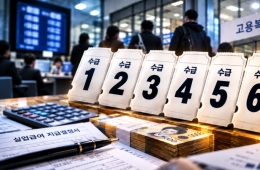
A dealer is working in the dealing room at the Seoul Hana Bank headquarters. Photo by Yonhap News Agency
View original imageNomura Bets on Memory Market
On September 4, Nomura Securities released its report, maintaining a ‘Buy’ rating on both Samsung Electronics and SK hynix. The target prices were kept unchanged at 6.7 million won for Samsung Electronics and 47 million won for SK hynix. This decision reflects Nomura’s assessment that the recent correction has lowered the valuation of both companies. According to Nomura, the share prices of these two companies have dropped by about 37% from their peaks, and their projected 2027 price-earnings ratios (P/E) are at low levels—only 3 times on average—indicating undervaluation.
The key rationale is surging memory demand driven by expanding investments in artificial intelligence (AI). Nomura stated, “The current memory market is benefitting from unprecedented demand, spurred by the AI investment cycle, while supply remains critically insufficient. To accommodate the explosive demand, global memory production capacity must double to 7.2 million wafers per month within four years and triple to 11 million wafers per month within six years.” Although Chinese companies are working to expand capacity, Nomura pointed out that the overall global supply shortfall will not be meaningfully alleviated, projecting that the shortage will continue through 2028.

Nomura also highlighted the expansion of long-term agreements (LTAs) between memory suppliers and big tech companies as a positive factor. Major clients are signing five-year contracts that set a price ceiling up to 20% higher than current prices to secure required volumes, with 20-30% prepayments and strong penalty clauses attached. Nomura assessed that such contract structures provide Samsung Electronics, SK hynix, and Micron—key suppliers—with greater visibility and stability in sales and profitability than in the past.
Won Strength Is a Drag... ASP to Offset Impact
However, Nomura identified the recent rapid strengthening of the won as a risk factor for short-term earnings. Reflecting the currency’s appreciation, Nomura revised its operating profit estimate for SK hynix in the third quarter downward from the previous 8.6 trillion won to 7.7 trillion won, while projecting Samsung Electronics’ third-quarter operating profit at 10.7 trillion won.
Nomura explained, “Korean memory companies receive settlements in dollars, but a significant portion of their costs (about 20% of sales) are paid in won. Thus, a 10% appreciation of the won leads to roughly a 12% decline in operating profit, posing a short-term earnings burden.”
However, Nomura believes the sharp increase in memory average selling prices (ASP) will more than offset the negative impact of the exchange rate. The firm noted that the massive trade surplus created by the semiconductor supercycle is a natural cause of won strength. As the capital expenditure capabilities of big tech companies prove stronger than market concerns, and with robust memory market conditions coupled with proactive shareholder return policies, Nomura emphasized that a significant re-rating of stock prices is likely.

Global IBs Focus on Semiconductors; Domestic Securities Firms Are More Cautious
This positive outlook from overseas IBs is not limited to Nomura. JP Morgan observed that both the semiconductor index and key technical indicators of the Korean stock market have reached oversold zones, suggesting that the AI-led frenzy and momentum-driven selloff have largely run their course. Morgan Stanley also judged that the sharp correction in memory semiconductors is in its final stage, adding that current valuations offer an entry opportunity.
Goldman Sachs similarly views the sharp drop in the Korean stock market as a correction within a broader bull market, not the start of a prolonged downturn, and maintained its 12-month KOSPI target at 12,000. The expectation is that a prolonged memory supply shortage is more likely, implying that currently prevailing negative outlooks have been excessively priced in.
In contrast, domestic securities firms have revised down their KOSPI targets in response to the recent market correction. Daishin Securities lowered its year-end KOSPI target from 11,500 to 9,300, while Shinhan Investment reduced its target from 11,000 to 8,800.
This difference in outlook is believed to stem from differences in perspective. Overseas IBs are placing greater emphasis on mid- to long-term fundamentals such as sustained AI investment, memory prices, supply conditions, and corporate earnings, rather than recent supply-demand and price corrections.
Hot Picks Today
 "Only 3 Passengers on a 180-Seat Flight"... The Shocking State of the 'Honeymoon Hotspot'
- "Work That Took a Month Now Done in Just 8 Hours"…Samsung and LG Turn to AI to Counter China's Pursuit
- "Returning Excess Fees Collected Under Previous Administration"...$680 Per Person Refund for 950,000 Americans
- Trump Says "Possible to Intensify Strikes Against Iran After Midterms"... Rubio Demands Delegation's Immediate Departure
- "Nothing Left to Buy, Feeling Indifferent"... 'Rich Daughter' Vibe in Department Stores with 'Hyunbaek Core'
Ultimately, the direction of future stock prices will depend less on price targets themselves and more on the extent to which expanding AI investment leads to rising memory prices and improved corporate performance.
© The Asia Business Daily. All rights reserved. Unauthorized AI training and use prohibited.