Tougher KOSDAQ and KOSPI Delisting Criteria Deferred by Six Months... KONEX Transfer Route Also Opened
Market Situation Review Meeting Held on September 4
The implementation of stricter KOSPI and KOSDAQ delisting standards designed to remove insolvent companies from the stock market has been postponed by six months. In addition, an exit option has been introduced, allowing companies that meet certain financial requirements to transfer their listing to KONEX without going through settlement trading.
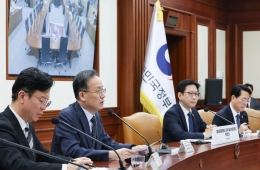
On September 4, Deputy Prime Minister and Minister of Economy and Finance Koo Yoon-chul held a joint "Market Situation Review Meeting" with relevant agencies at the Korea Federation of Banks in Jung-gu, Seoul, and announced these measures. The meeting was attended by Lee Ok-won, Chairman of the Financial Services Commission; Kim Eetak, First Vice Minister of Land, Infrastructure and Transport; Lee Chanjin, Governor of the Financial Supervisory Service; and Kwon Minsoo, Deputy Governor of the Bank of Korea. The participants conducted a comprehensive review of the trends in domestic and overseas financial and foreign exchange markets, as well as the real estate market, and discussed response strategies.

Deputy Prime Minister and Minister of Finance and Economy Koo Yoon-chul is presiding over the Market Situation Review Meeting held on the 4th at the Korea Federation of Banks in Jung-gu, Seoul. Ministry of Finance and Economy
View original imageThe meeting addressed recent delisting trends in the KOSDAQ market and the future direction of related systems. Previously, authorities decided to gradually raise the market capitalization thresholds required for delisting to 30 billion won for KOSDAQ and 50 billion won for KOSPI, having already raised the standards once in July. The intent is to filter out poorly managed and insolvent companies to improve the overall soundness of both the KOSDAQ and KOSPI markets. According to the original plan, market capitalization requirements were set to be raised once again on January 1 of next year: from 20 billion to 30 billion won for KOSDAQ and from 30 billion to 50 billion won for KOSPI.
However, as companies voiced concerns that worsening conditions in the KOSDAQ market would make it difficult to bear additional regulatory burdens, the government decided to delay the planned increase in thresholds by six months, from January to July next year. Given similar requests and considerations of fairness, the same grace period has been applied to the KOSPI market.
Furthermore, as an alternative for companies facing delisting due to insufficient market capitalization, the government will allow a direct transfer of listing to KONEX without settlement trading. Eligible candidates are companies designated as under administrative review for falling below the market capitalization requirement after July 1 of this year, provided they file an application with the exchange to move to KONEX. However, this does not apply to companies whose capital has been eroded. Eligible companies must meet at least one of the following requirements: (1) operating profit in two out of the last three fiscal years, or (2) operating profit in one out of the last three fiscal years along with equity capital of at least 20 billion won. These same requirements will apply to the KOSPI market as well.
Meanwhile, the meeting also featured an assessment of the recent upward pressure on interest rates. The attendees noted that the continued rise in interest rates can be attributed to several independent factors: increased government bond issuance in various countries, the supply impact from global artificial intelligence (AI) companies issuing corporate bonds, rising expectations for policy rate hikes in major economies, and higher oil prices driven by renewed tensions in the Middle East. In fact, international oil prices have risen amid ongoing security concerns, such as the expiration of the truce deadline between the United States and Iran and attacks on ships near the Strait of Hormuz.
Hot Picks Today
 "Better than stocks and real estate": Chinese investors rush in and snap up 430 metric tons of 'this' in a week
- "27,000 Won for an Hour of Walking?"... Robot Dog-Walking Jobs in the U.S. Now Pay by the Hour
- "Even with 9 Billion Won, I Can't Quit My Job"... The Unexpected Concerns of a Major-Company Employee in His 40s After an 'Investment Windfall'
- "I'm Married, but I Want to Meet Someone New"... Japan App for Married People Draws 500,000, Packed with Users in Their 30s and 40s
- "I Made an Extra 6 Million Won a Month"... "This Can Actually Make Money?" The Twist Behind a Few Pieces of Junk
In response, the government has decided to closely monitor trends in the domestic bond market and to manage the market in a stable manner to prevent excessive increases in volatility. In addition, after reviewing the effects of higher interest rates on vulnerable borrowers and the current soundness of mutual financial institutions, participants agreed that while conditions remain generally stable for now, significant future rate hikes could exacerbate difficulties. The government also confirmed its intention to steadily advance the support measures for vulnerable borrowers announced on August 28.
© The Asia Business Daily. All rights reserved. Unauthorized AI training and use prohibited.