"1,000% of Base Salary Allowed, But Not 10% of Operating Profit?"... Growing Controversy Over Performance Bonus Criteria [Why&Next]
Direct Impact on Management Decisions Over Operating Profit
Potential Conflicts with Other Profit Allocations
Controversy Persists Due to Lack of Legal Binding Force
On September 3, the government announced that the basis for excluding demands for “N% performance bonuses” from collective labor disputes is not the size of the bonus, but rather the standards on which the bonuses are calculated. For example, if the union demands “a performance bonus equal to 1,000% of the base salary,” the government does not consider the high percentage alone sufficient grounds to rule it out as a subject of negotiation. If the base salary is 5 million won, the performance bonus would amount to 50 million won. However, since a performance bonus based on the base salary pertains to wages and working conditions, the government believes it can fall within the scope of negotiation.
On the other hand, a demand such as “pay a performance bonus equal to 10% of the company’s operating profit” is viewed differently. If operating profit is 1 trillion won, the performance bonus alone would reach 100 billion won. The government believes that allocating a fixed proportion of company profits to workers goes beyond determining wage levels and could directly affect profit distribution and management decisions. A Ministry of Employment and Labor official explained, “Wages are determined after considering taxes and dividends to shareholders, but if N% of operating profit is set aside for performance bonuses, it will inevitably create conflicts with other profit allocations.”

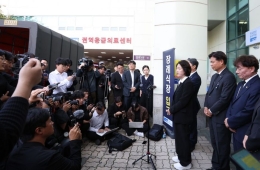
On the 23rd, union members shouted slogans at the Samsung Electronics Labor Union Joint Struggle Headquarters' "Change Transparently and Realize the Abolishment of the Cap - 4/23 Struggle Resolution Rally" held in front of the Samsung Electronics Pyeongtaek Campus in Pyeongtaek-si, Gyeonggi-do. Photo by Yonhap News.
View original imageWhy Is “N% of Operating Profit” Excluded From Labor Disputes?
Operating profit is linked not only to research and development (R&D) and capital investments but also to the rights and interests of third parties such as shareholders and creditors. The government is concerned that requiring companies to allocate a fixed percentage of profits to unions could limit the management’s authority in determining profit distribution. Ultimately, the legal character of a performance bonus depends on whether it is based on wage components such as base salary or on the company’s profits themselves.
However, some in the field point out that it can be challenging to clearly separate the two. There are systems that combine multiple criteria, using sales or operating profit to calculate performance bonuses, while linking the final payment to the base salary. Vice Minister of Employment and Labor Kwon Changjun stated, “We need to consider the structure and individual cases of each system.” Professor Seok Byounghoon of Ewha Womans University pointed out, “There are lingering issues such as fairness among workers and the application of administrative guidelines that lack legal binding force.”
!["1,000% of Base Salary Allowed, But Not 10% of Operating Profit?"... Growing Controversy Over Performance Bonus Criteria [Why&Next]](http://www.asiae.co.kr/news/img_view.htm?img=2026090411422016234_1788489740.png)
To What Extent Are Investment Decisions Subject to Negotiation?
Another key issue is the relationship between a company’s management decisions and subsequent changes to working conditions. Decisions such as establishing or relocating a factory, selling or acquiring business sites, altering production lines, or introducing artificial intelligence (AI) and automation are, in principle, not mandatory topics for negotiation. However, if such decisions are expected to result in specific changes to worker employment or working conditions, they may become subjects for negotiation. For example, the decision itself to relocate a provincial factory to the Seoul metropolitan area is not subject to negotiation, but if it leads to workforce reductions, reassignment, or changes in work locations, the standards for reassignment, support measures, and employment retention plans may all fall within the scope of negotiation. Similarly, the sale of a company itself is not a subject of negotiation, but employment succession, restructuring, and maintaining working conditions after the sale may be subject to discussion. The key is whether actual changes are objectively expected. A simple long-term business plan announcement or media report is insufficient; concrete investment plans or internal announcements that forecast changes in employment or working conditions are necessary.
Hot Picks Today
 "I Ate It Often Because It Tasted Good"... This Eating Habit Linked to 40% Higher Odds of Asymptomatic Cerebrovascular Damage
- "Booked a Cheap Flight, Only to Get Blindsided"... Travelers' Complaints "Explode" Over Extra Fees
- Woman in Her 70s Assaults Sister in Her 80s: “She Had an Affair with My Husband”
- “Dad Just Gave It to Us as a Gift”... Scratched a Lottery Ticket at a Family Gathering and Hit a 1 Billion Won Jackpot
- "We've gone this far to save on lunch"... Where office workers are flocking instead of restaurants
The same logic applies to artificial intelligence (AI) and automation. Their introduction is not in itself a subject for labor disputes, but if it leads to workforce reductions, reassignment, changes in working hours or work patterns, or safety issues, unions can demand negotiations on those outcomes. Park Jisun, professor at Korea University School of Law, pointed out, “Recognizing job reassignment as a subject of labor disputes in connection with business investment decisions essentially gives unions veto power over investments.” In labor circles, there is also concern that administrative guidelines, which lack legal binding force, could influence arbitration by the Labor Relations Commission or the legitimacy of labor actions, thereby restricting the union’s bargaining power and dispute rights. The Ministry of Employment and Labor maintains that the revised Labor Union Act is intended to increase predictability for both labor and management after its implementation, and to reduce unnecessary conflicts. Kwon Changjun, Vice Minister of Employment and Labor, stated, “The intention is not to prevent labor and management from negotiating these issues at the field level, but rather to encourage autonomous dialogue, compromise, and negotiation.”
!["1,000% of Base Salary Allowed, But Not 10% of Operating Profit?"... Growing Controversy Over Performance Bonus Criteria [Why&Next]](http://www.asiae.co.kr/news/img_view.htm?img=2026090316560215248_1788422162.gif)
© The Asia Business Daily. All rights reserved. Unauthorized AI training and use prohibited.


!["Please, Just Take Them Off" - They Made It All the Way to Bed... Then Fecal Bacteria Struck [Deep Scroll]](https://cwcontent.asiae.co.kr/asiaresize/307/2026101610053063338_1792112730.png)