"When Should You Refuel?"...Oil Price Volatility Rises Ahead of U.S. Midterm Elections [Weekend Money]
SPR Falls to Lowest Level Since 1982, Leaving Limited Options for Oil Price Intervention Before Election
Fourth-Quarter Average Projected at $91 per Barrel... Reopening of Hormuz Remains the Key Variable
Amid heightened volatility in oil prices ahead of the U.S. midterm elections scheduled for November, forecasts indicate that the average international oil price in the second half of the year will hover around $89 per barrel. In particular, some analyses suggest that it could rise to an average of $91 per barrel in the fourth quarter.
On September 3, SangSangIn Securities released a commodities investment strategy report titled “Oil Prices Above $90 per Barrel, Trump’s Remaining 61 Days.” In the report, analyst Choi Yechan of SangSangIn Securities stated, “With the U.S. midterm elections on November 3 approaching, U.S. President Donald Trump is running out of options to stabilize oil prices. The average oil price for the second half is expected to remain high at $89 per barrel.”
!["When Should You Refuel?"...Oil Price Volatility Rises Ahead of U.S. Midterm Elections [Weekend Money]](http://www.asiae.co.kr/news/img_view.htm?img=2026090320310515401_1788435065.png)
As military clashes between the United States and Iran have resumed, West Texas Intermediate (WTI) crude oil surged by over 5% on September 1 alone, breaking through the $90 per barrel mark. The oil price volatility index (OVX) also rebounded to 49 on the same day. The 12-month spread for WTI expanded from $9.4 on August 28 to $14.3 on September 1. Analyst Choi explained that this reflects disruptions in oil supply and demand, particularly for near-term contracts.
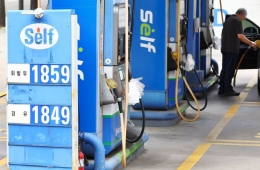
With oil prices continuing to rise, the average gasoline price in the United States has exceeded $4 per gallon, becoming a burden for the Trump administration as the midterm elections approach. Meanwhile, President Trump’s approval rating remains at a record low, stuck at 39.5% according to RealClearPolitics.
Another key point of concern is the significant decline in the U.S. Strategic Petroleum Reserve (SPR) capacity, which is a primary tool for responding to rising oil prices. The U.S. SPR currently stands at 290 million barrels, its lowest level since 1982. Of the 172 million barrels approved for release in March, only 46 million barrels remain. Analyst Choi predicted that at the current weekly release rate of 4.5 million barrels, the previously released reserves are likely to be exhausted around early November, in time for the midterm elections.
He assessed, “The scenario in 2022, where the Biden administration released 180 million barrels from the SPR and gasoline prices dropped by 20% ahead of the election, appears difficult to replicate at present.” He continued, “Emergency measures such as meetings with U.S. refiners or oil field deals with Venezuela are limited in their effectiveness before the elections due to supply time lags. In addition to refinery bottlenecks, the ongoing rise in crude oil prices has pushed the situation beyond the Trump administration’s control.”
Ultimately, the most direct means of lowering gasoline prices ahead of the November midterm elections is seen as a potential agreement to reopen the Strait of Hormuz. However, as both the United States and Iran are balancing their interests between negotiation and escalation, the situation remains highly uncertain.
Analyst Choi remarked, “The only card left to lower gasoline prices before November is an agreement to reopen Hormuz, but both the probability of agreement and escalation are rising at the same time.” He explained that the U.S. has incentives to strike infrastructure like Kharg Island to restore negotiating leverage, while Iran has incentives to force Trump’s defeat in the midterms by keeping oil prices high. He added, “Our fair value model for supply and demand (based on the August STEO inventory trajectory) still supports a fourth-quarter path of $91 per barrel.”
Hot Picks Today
!["Spend 200,000 Won, Get 100,000 Won Back?"... Government's Bold Move Unveiled [Essential Tips for Benefits]](https://cwcontent.asiae.co.kr/asiaresize/93/2022101316351067863_1665646511.jpg) "Spend 200,000 Won, Get 100,000 Won Back?"... Government's Bold Move Unveiled [Essential Tips for Benefits]
"Spend 200,000 Won, Get 100,000 Won Back?"... Government's Bold Move Unveiled [Essential Tips for Benefits]
- "I Always Visited When in Japan"...Crowds Flock and Pay Admission for Korean Launch 'Open Run' [Report]
- Starbucks' Sales Slump Reverses: Surprise Comeback Against Twosome Place as Card Payments Rebound
- "Surviving on One Meal a Day to Invest 3.5 Million Won Monthly... 'FIRE' Craze Sparks 'NISA Poverty' in Japan"
- "I'm Getting Married, But Please Don't Come"... Gen Z's Changing Wedding Trends [World is Z-gold]
Oil prices in the fourth quarter are expected to show high volatility depending on several scenarios. The report suggests considering scenarios such as: ▲ an agreement to reopen the strait before the elections, ▲ stalemate or low-intensity conflict, and ▲ escalation resulting from infrastructure strikes. Among these, the report views the low-intensity conflict as the base scenario, predicting that normalization of oil supply within this year will be limited. Analyst Choi forecasted, “While the average oil price in the second half will remain high at $89 per barrel, following the peak in the fourth quarter, the average price path will normalize to $65 in 2027.”
© The Asia Business Daily. All rights reserved. Unauthorized AI training and use prohibited.

![Listings Pile Up in Gangnam, While Gangbuk Has None Left to Sell... As Seoul Transactions Dwindle, Buying Sentiment Diverges [Real Estate A to Z]](https://cwcontent.asiae.co.kr/asiaresize/307/2026090415531016688_1788504791.jpg)
![[Report] "From AI Homes to Premium Lineups"… Chinese Electronics Dominate IFA 2026](https://cwcontent.asiae.co.kr/asiaresize/307/2026090505514216935_1788555102.jpg)
![[New York Stock Exchange] Interest Rate Hike Concerns Rise on Strong Employment Data... Dow Down 0.51%](https://cwcontent.asiae.co.kr/asiaresize/307/2026090223194913207_1788358790.jpg)