"K-Food+ Launches All-Out Effort to Achieve USD 16 Billion in Exports... Marketing Focused on 'Black Friday'"
Announcement of "Five Major Comprehensive Response Strategies" at the 3rd K-Food+ Export Planning Meeting
First-Ever USD 100 Million Export Goal for Grapes as a Single Item
Targeted Support for Strategic K-Food Items Such as Strawberries, Tradit
The government has designated the second half of this year as a critical “golden time” to achieve its K-Food Plus (+) export target of USD 16 billion, strengthening support for key products such as grapes and strawberries, while focusing efforts on global distribution network marketing timed for Thanksgiving and Black Friday.
On Thursday, September 3, the Ministry of Agriculture, Food and Rural Affairs convened the 3rd Public-Private K-Food+ Export Task Force meeting at the Korea Press Center in Seoul, with officials from relevant ministries, related organizations, and K-Food+ export companies in attendance. At the meeting, the ministry unveiled its “All-out Export Strategy for the Second Half of 2026” to achieve the annual export goal of USD 16 billion.

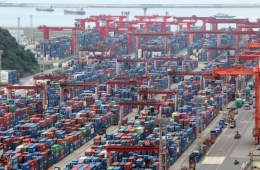
◆ Record-High K-Food+ Exports = As of the end of July this year, K-Food+ exports have reached USD 8.25 billion—an all-time high, marking a 5.3% year-on-year increase, even amid a complex set of global challenges. Instant noodles surpassed the USD 1 billion mark in just seven months, driving the processed food segment’s growth. Explosive demand from Taiwan, the US, and ASEAN countries has driven fresh fruit exports, with grapes up 35.0%, pears up 55.2%, and strawberries up 15.7%. Growth is being further underpinned by the emergence of new exports, including Jeju Hanwoo (Korean beef) and pork to Singapore (following successful quarantine negotiations), as well as heat-treated poultry meat to the European Union (USD 5.32 million, an increase of 488%) after quarantine approval.
By country, the US (USD 1.18 billion, up 9.8%) has seen broad-based growth across most product categories. In China (USD 940 million, up 6.7%), strong demand for instant noodles continues to drive growth. Despite the aftermath of ongoing conflicts, the Middle East (GCC) has shown a surge of 33.2% due to rising demand for tobacco and health supplements. Fueled by the K-spicy trend, Latin America (up 24.4%), the EU (up 18.9%), Central Asia (CIS, up 4.6%), and ASEAN (up 1.6%) are also experiencing simultaneous growth.
◆ Golden Time for USD 16 Billion Target in Second Half = The Ministry of Agriculture, Food and Rural Affairs is treating the second half—when the shipping season for fresh produce overlaps with major global shopping events—as the last golden opportunity to determine this year’s export outcome, and is embarking on a full-scale export drive.
First, the goal is to open a new chapter in which a single category of Korean fresh produce, grapes, achieves USD 100 million in exports in one year. To make this happen, the government plans to secure in advance 12,000 tons of premium-quality grapes (accounting for 93% of the export target), strategically target the off-season for South American imports (December to January), and boost US-bound export volume by 150% to 2,700 tons, leveraging new entry into retailers such as Costco.
For strawberries, the ministry will secure reliable airfreight capacity for year-end exports, launch a pilot program for exports of 30 tons of high-ripeness premium strawberries, and pioneer emerging markets such as Brazil. To address the over-reliance on the US market for pears (currently accounting for 55% of exports), premium distribution networks in Taiwan and Vietnam will be expanded, and export quantities will be stored and managed separately to lengthen the export period. Exporters of sweet persimmons (to China) and Hanwoo and pork (to Hong Kong and Singapore), whose quarantine negotiations have recently concluded, will receive support for large-scale local marketing to secure a foothold in new markets.
In six key cities, “K-Jumak” traditional liquor pop-up stores targeting young consumers will offer tasting and experiential marketing events. Major conglomerates such as CJ will launch sets combining traditional liquor and Korean side dishes in the US. To keep up with booming global demand for frozen kimbap, tteokbokki, and rice drinks, production rice supplies for K-ready meals will increase by 60,000 tons. Marking “Kimchi Day” in November, large-scale kimchi festivals will be held in the US, UK, Japan, and Vietnam to broaden its consumer base.

For agricultural machinery, the ministry will shift to a package-type export structure (products plus services) in North America, its main market. For animal medicines, it will facilitate export permits for lysine to Brazil and actively support new exports of African swine fever (ASF) vaccines to Southeast Asia, including the Philippines. For smart farms, consortia will receive tailored consulting to support signing of MOUs, contracts, and new project orders for overseas smart farm ventures within the year.
◆ All-Out Promotion Through Global Distribution Networks = The ministry will carry out large-scale promotional events tied to global anchor channels—such as Costco and H-Mart in the US, Ole and Lichun in China, and K-Market in Vietnam—to expand exports. In particular, marketing centered on holiday gifting, large discount sales during shopping seasons, and food pairing promotions during festival periods will be ramped up between September and December, with the number of major shopping events to increase from 124 to 159. This approach aims to secure new export momentum.
In addition, embassies and consulates in 30 locations will actively promote K-Food+ at major diplomatic events, such as National Day receptions, and smooth the entry of new products recently approved for quarantine in various countries. K-Fresh (fresh agricultural products) promotional videos will be displayed on high-visibility digital billboards at global landmarks, such as Times Square in New York, in sync with the local shipping seasons of key items. Localized marketing will also be conducted via partnerships with accommodation, airlines, and restaurant businesses to offer K-Food gift packages—featuring locally popular items—as welcome amenities, room services, in-flight meals, and desserts in each country.
Hot Picks Today
 He Left It in the Car and Forgot... "I Nearly Collapsed with Joy": Man Wins $1.48 Million Lottery
- "Maybe I'll just go to Japan," they'll say... Why are foreign visitors to Korea "flooding with complaints"? [2026 National Assembly Audit]
- 'EV Charging Is Profitable'... Private Equity Firms Compete with Major Companies to Scale Up [PE Now]
- Gas Prices Up 40%, Candy Sales Slump ... High Inflation Hits U.S. Halloween
- Beachgoer Finds 'Plastic' That Turns Out to Be Perfume Ingredient Worth More Than Twice as Much as Gold
Song Miryung, Minister of Agriculture, Food and Rural Affairs, stated, "The second half of the year marks the peak for fresh produce shipping and a major expansion in global consumption around Thanksgiving and Black Friday. This is a pivotal moment that will determine this year's export performance. The entire government and private sector will work as one team to build on the achievements of the first half and focus every resource on ensuring that our K-Food+ industry reaches audiences worldwide and leads global consumer trends as a strategic sector."
© The Asia Business Daily. All rights reserved. Unauthorized AI training and use prohibited.