Minimizing Retention in Seoul and Early Relocation Next Year: Government Finalizes Principles for Public Institution Relocation
Ministry of Land, Infrastructure and Transport Announces Principles and Directions for the Second Phase of Public Institution Relocation
The government has established five key principles, including minimizing the retention of public institutions in the Seoul metropolitan area, and has decided to push ahead with the second phase of relocating public institutions to non-capital regions starting next year. Employees who move earlier or to more distant locations will be given higher allowances. This measure is aimed at alleviating staff burdens and encouraging early settlement. The government also plans to address the problems and limitations that arose during the first phase of relocation.
According to the second phase principles and directions for the relocation of public institutions announced by the Ministry of Land, Infrastructure and Transport on September 3, 2026, employees will be given up to an additional 200,000 won per month for two years as a ‘remote area preferential allowance’ based on the distance of relocation. During the first phase of relocation, staff already received a relocation allowance and moving expenses of about 200,000 won per month for two years, but now an extra allowance will be provided.
Additionally, a new early relocation allowance of up to 500,000 won per month will be introduced. As it is highly likely that there will be difficulties in coordinating opinions among organization members or labor unions during the relocation process, this is seen as a type of 'incentive measure.' The government also plans to collaborate with relevant departments to prepare support measures to reduce gaps in housing stability, child education, and care. While specific plans have not yet been presented, preferential apartment supply and expanding flexible work arrangements are being considered.

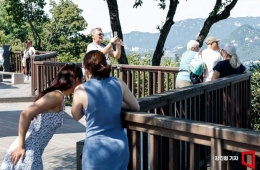
A panoramic view of the innovation city area developed around Yulgok-dong, Gimcheon City
View original imageMinister of Land, Infrastructure and Transport Kim Yunduk stated, "Compared to the first phase, we will significantly increase the level of support, with even greater benefits for institutions that relocate farther and more quickly," and added, "We will also devise effective measures to support housing so that the burden on relocated employees, who have to move their living base in a short period of time, is minimized."
The ministry reiterated the principle of minimizing retention in the Seoul metropolitan area and concentrating relocated institutions around existing innovation cities. The government also announced principles of linking to local universities and industries, expanding self-sustaining living infrastructure, and swiftly proceeding with the relocations. Leading institutions are expected to begin relocating as early as next year by leasing private buildings. This is intended to address issues that arose over the decade-plus period of the first phase of relocations.
The policy of relocating public institutions to regional areas began during the Roh Moo-hyun administration in 2003 as part of efforts to prevent overcrowding in the capital area and promote balanced regional development. In 2005, innovation cities and public institutions to be relocated were designated, and in 2007, development districts for innovation cities were established. The process essentially concluded with the relocation of the Ministry of Land, Infrastructure and Transport’s Land and Transport Human Resources Development Institute to Jeju in 2012 under the Lee Myung-bak administration and the relocation of the Korea Institute of S&T Evaluation and Planning to Chungbuk in 2019.

Prime Minister Han Seongsuk is speaking at a press conference on administrative and public institution relocation and public institution function reform held on September 3 at the Government Seoul Office in Jongno-gu, Seoul. Attending the conference from left are Yoon Hojung, Minister of the Ministry of the Interior and Safety; Kim Yundeok, Minister of the Ministry of Land, Infrastructure and Transport; and Heo Jang, Second Vice Minister of the Ministry of Economy and Finance. Photo by Jo Yongjun
View original imageThe issue is that innovation cities were scattered across the country, and local living conditions were not adequately prepared. During the first relocation, 10 innovation cities were designated, with about 153 institutions and 52,000 people, including individually relocated entities. However, in many cases, only public institutions were moved to these innovation cities, which often resembled isolated islands, without a cascade of follow-up relocations from private companies or research institutes. While a policy of mandatory local talent recruitment was introduced, practical technological collaboration and the creation of tangible results with local universities and industries remained lacking overall. Many evaluations pointed to an insufficient synergy between relocated institutions and local industries.
Each innovation city saw the relocation of just over 5,000 people, but educational, medical, cultural infrastructure, as well as housing and public transportation systems, were generally lacking, leading to a low rate of family migration. Many employees developed a pattern of commuting during the workweek and returning home to the Seoul metropolitan area on weekends. As a result, rather than population inflow from the capital area, in some cases, the new innovation cities absorbed populations from nearby older downtowns, which in turn intensified imbalances between new and old urban centers within local governments.
Hot Picks Today
 "Once Worth 4 Million Won a Day, Now Going for Chicken Money"... Chinese Robots' Humiliating Fall to 'Bargain-Bin' Prices in Just One Year
- "I Won't Take It Even If You Leave It to Me"... 9 Million Parents' Homes Sit Empty as 320,000 Japanese Renounce Inheritances
- "Who Says It's a Meal for Ordinary People? It Deserves 'Special Dish' Status Now"... The Era of 12,000-Won Bibimbap
- Governance Forum: "Solidigm Listing Must Be Halted... Only SK hynix Shareholders Lose Out"
- "It Wasn't Jeju or Busan"... 'Santorini of Korea' Draws Crowds of Travelers in Their 20s and 30s Lately
Minister Kim said, "The first phase was not sufficient to fundamentally reverse the trend of concentration in the capital area," adding, "With institutions dispersed across many regions, the relocations did not sufficiently drive regional development." He continued, "We will ensure that the second phase of public institution relocations becomes a new growth engine for local areas and delivers real results for balanced national development."
© The Asia Business Daily. All rights reserved. Unauthorized AI training and use prohibited.