Merging Oil and Gas, Uniting Five Power Firms... Emergence of 'Mammoth Public Enterprises'
KNOC and KOGAS to Merge as "Energy Resources Corporation"
Five Power Generation Companies to Be Integrated into "Korea Power Generation"
Four Major Port Authorities to Unite into a Single Entity
Three Livestock Institutions to Combine
Mammoth-scale public enterprises are emerging one after another, covering sectors from oil and gas to power generation and ports. The government will merge Korea National Oil Corporation and Korea Gas Corporation into a tentatively named "Energy Resources Corporation," and consolidate the five power generation companies into "Korea Generation." In addition, the four port authorities will be restructured into the "Korea Port Corporation." In the livestock sector, three institutions will be merged into one. These measures are part of an intensive streamlining and integration initiative focused on large-scale public institutions in the energy, maritime, and agri-food sectors.

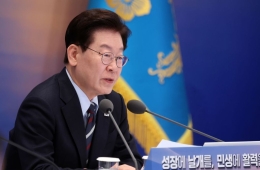
Prime Minister Han Seong-sook is speaking at a press conference on September 3 at the Government Complex Seoul in Jongno-gu, Seoul, regarding the relocation of administrative and public institutions and the reform of public institution functions. Attending the conference from the left are Yoon Ho-jung, Minister of the Ministry of the Interior and Safety; Kim Yoon-duk, Minister of the Ministry of Land, Infrastructure and Transport; and Heo Jang, 2nd Vice Minister of the Ministry of Economy and Finance. September 3, 2026 Photo by Jo Yongjun
View original imageMajor Overhaul of Energy Public Corporations... Integration of Oil and Gas Corporations
The most notable change is in the oil and gas sector. The government plans to launch the tentatively named "Energy Resources Corporation" by combining Korea National Oil Corporation and Korea Gas Corporation. This move aims to develop a comprehensive national energy strategy encompassing both oil and gas to respond to geopolitical risks and supply chain crises, while also strengthening the country's negotiating position with oil-producing nations and global energy companies. Petroleum stockpiling and limited exploration and development functions of the oil corporation will be transferred to the integrated corporation, while distribution structure improvement functions, such as the operations of discount gas stations, will be handed over to Korea Institute of Petroleum Management. The government is also considering establishing a separate subsidiary to handle the oil corporation's non-performing assets.
Affiliated subsidiaries will also be reorganized. KOGAS Security Management, KOGAS Service Alliance, and KNOC Service will be merged into the tentatively named "Energy Resources Corporation Management," while KCL LNG Tech will be dissolved. Korea Coal Corporation, whose mines have all ceased operations, will be liquidated as well. As of the end of last year, the coal corporation's debt stood at 2.59 trillion won. The government plans to secure debt repayment funding through inter-ministerial consultation and pursue necessary revisions to the Korea Coal Corporation Act.
The power generation public corporations will undergo a major restructuring, with the five companies—Korea South-East Power, Korea Southern Power, Korea East-West Power, Korea Western Power, and Korea Midland Power—being merged into a single legal entity tentatively named "Korea Generation." The government intends to pool personnel and investment capabilities, which had previously been dispersed, to better support an energy transition centered on renewable energy and to strengthen investment capacity through an integrated financial structure. Joint purchasing of fuel and maintenance supplies, as well as efficiency improvements to address redundant staffing, will also be pursued. The unified entity will include a Renewable Energy Division responsible for large-scale projects such as offshore wind power, and a Just Transition Division overseeing the phase-out of coal power. In addition, three to four regional renewable energy divisions will be established nationwide to oversee solar and onshore wind power projects.

Four Port Authorities to Merge... Integration in the Livestock Sector
In the maritime sector, four regional port authorities—Busan, Incheon, Ulsan, and Yeosu-Gwangyang—will be combined into the tentatively named "Korea Port Corporation." The policy and planning functions will be unified under the new corporation, while the existing port authorities will be restructured as four regional branches responsible for specialized local projects. Five subsidiaries—Yeosu-Gwangyang Port Management, Ulsan Port Management, Busan Port Security Corporation, Incheon Port Security Corporation, and Yeosu Expo Management—will be merged into the tentatively named "Korea Port Security Facilities Corporation."
Mergers and streamlining will also take place among maritime exhibition and research organizations. The National Uljin Ocean Science Museum, National Incheon Marine Museum, and National Maritime Museum will be integrated into the tentatively named "Korea Marine Culture Promotion Center." The National Marine Biodiversity Institute will be incorporated into the Korea Institute of Ocean Science and Technology, while the Korea Institute of Aids to Navigation will be merged into the Korea Maritime Transportation Safety Authority. In total, 11 organizations under the Ministry of Oceans and Fisheries will be reduced.
In the agriculture and livestock sectors, the Livestock Products Quality Evaluation Institute, the Animal Hygiene Quarantine Support Headquarters, and the Livestock Environment Management Institute will be merged under the tentatively named "Korea Livestock Promotion Corporation." The plan is to consolidate the functions of livestock product quality evaluation, animal quarantine, and livestock environment management within a single organization. The Korea Rural Hope Foundation will be integrated into the Korea Agency of Education, Promotion and Information Service in Food, Agriculture, Forestry and Fisheries. As a result, three organizations under the Ministry of Agriculture, Food and Rural Affairs will be cut.
Hot Picks Today
 Selling Like Crazy Every Year... 30-Year-Old Hetbahn Takes on a New Challenge: Tastes Better Than "Mom's Home Cooking" [On-Site Report]
- A 12-Year-Old Girl Went to the Hospital After Her Blood Pressure Hit 225 and Was Stunned: "What Is This Coral Reef-Like Thing in Her Aorta?"
- "Hey, Lady, Teach Your Kids to Behave!" ... 300,000 Won in Cash and a Bodily Injury Claim Demanded Over Child's Door Ding
- "It's a shame only Koreans get to enjoy something this good" Foreigners fall for K-baseball [K-Holic]
- I Thought Only 'Old Guys' Ate It... Young People Are Hooked on This 'Unusual Food' at Risk of Disappearing? [Delicious Stories]
Once each ministry has prepared detailed reform plans for their respective agencies, the government plans to submit them to the Public Institutions Management Committee. Matters requiring legal amendments will be coordinated with the National Assembly, and local governments will be consulted in cases involving regional interests. For employees of agencies subject to integration, all positions except executive roles will be guaranteed employment succession, and a pay system will be operated to ensure that existing compensation and benefits remain unchanged even after consolidation.
© The Asia Business Daily. All rights reserved. Unauthorized AI training and use prohibited.