President Lee: "Now Is the Time to Focus on Growth... Please Allow More Time for Distribution"
"Growth Bottleneck Created by the Previous Administration...
For Now, We Must Focus More on Restoring Growth"
On September 2, President Lee Jae-myung made it clear that the focus of his administration's economic and fiscal policies in its second year will be on restoring growth, saying, "Unavoidably, now is the time to concentrate on growth and scale up the pie." He emphasized the need to first revive the economy's growth potential and lay the groundwork for further welfare expansion, noting that it is realistically difficult to greatly expand both growth and welfare at the same time.

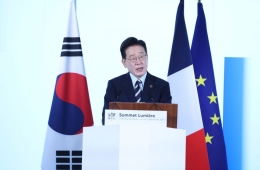
President Lee Jae-myung is speaking at the Cabinet meeting held at the Blue House on September 1, 2026. Photo by Yonhap News Agency
View original imageOn this day, President Lee shared an editorial on X (formerly Twitter) that pointed out the growth-oriented nature of next year's budget proposal, stating, "Regrettably, due to the growth bottleneck created by the previous administration, we must first focus more on recovering growth." He added, "However, this does not mean that welfare has been neglected. If we fail to restore sustained growth and end up with zero or even negative growth, polarization will intensify and, in fact, a reduction in welfare could follow."
President Lee continued, "Abandoning growth in favor of welfare expansion cannot be an option. Simultaneously expanding both growth and welfare is ideal, but unrealistic. At present, I believe it is time to focus on scaling up growth." He underscored that raising the growth rate and increasing the economy's overall added value are prerequisites for securing resources for distribution and welfare in the long term.
The president’s direct comments on growth and welfare come in response to criticism regarding the growth-centric orientation of the government's finalized 2027 budget proposal, announced the previous day. The administration has set next year's total expenditure at 820.9 trillion won, up 12.8% from this year. The core of the plan is to make large-scale investments in future growth engines such as artificial intelligence and semiconductors, mega-projects, and initiatives aimed at supporting youth and regional growth. The plan aims to boost potential growth rates by focusing on advanced industries such as AI and semiconductors, with the intention of breaking the cycle of low growth.
Hot Picks Today
!["Just 5 Minutes to Departure" Ride a Maybach to Your Flight... Ultra-Luxurious VIP-Only Terminal Available for 950 Euros [Reportage]](https://cwcontent.asiae.co.kr/asiaresize/93/2026090414502016544_1788501020.jpg) "Just 5 Minutes to Departure" Ride a Maybach to Your Flight... Ultra-Luxurious VIP-Only Terminal Available for 950 Euros [Reportage]
"Just 5 Minutes to Departure" Ride a Maybach to Your Flight... Ultra-Luxurious VIP-Only Terminal Available for 950 Euros [Reportage]
- "Five Dresses for Travel at 40,000 Won"...After the Perfect Photo, Straight to the Trash
- "Once a Dream Job With 1,000-to-1 Competition, Now on the Verge of Becoming an Unpopular Career in China"
- "Nowhere Else in Asia Like Korea"—What’s Giving Foreign Tourists 'Seoul Fever'?
- "The Smart Newcomer Never Stops Working... This 'Rookie' Is Intimidating [Click e-Industry]"
However, some observers have pointed out that the increase in welfare and distribution spending is relatively modest compared to investments in growth. President Lee firmly rejected the assessment that the budget neglects welfare, saying, "Although it may not be fully satisfactory, efforts are being made to expand welfare. There is even criticism that the budget represents excessive welfare populism." He added, "Only one year has passed, so I ask that you give us a little more time."
© The Asia Business Daily. All rights reserved. Unauthorized AI training and use prohibited.