Minister Park Hongkeun: "We Will Achieve Both a Rebound in Potential Growth and Fiscal Soundness"
12.5 Trillion Won of the Future Response Fund Allocated to Reducing Government Bonds
Future Response Fund Highlights Solution to Single-Year Fiscal Limitations
Park Hongkeun, Minister of Strategy and Finance, stated on September 1, "This budget proposal marks the starting point for a virtuous cycle, as it aims to boost the declining potential growth rate while simultaneously enhancing fiscal soundness." He added, "We will make sure to achieve both objectives."

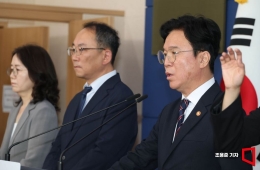
Hongkeun Park, Minister of Strategy and Finance, is briefing on the 2027 budget proposal and the 2026–2030 national fiscal management plan at the Government Complex Sejong in Sejong City on August 28. On the left is Vice Minister Yongbeom Cho. Photo by Yonhap News.
View original imageAppearing on SBS 8 News that day, Minister Park said, "By aggressively restructuring expenditures and pioneering fiscal innovation, we will ensure that the fruits of growth are widely shared among citizens and regions."
Addressing concerns that the newly established "Future Response Fund" could be reduced to a discretionary government reserve, Park explained, "In accordance with the National Fiscal Act, the fund will be subject to strict parliamentary oversight and discipline, just like the general account." He further emphasized, "Even if the government seeks to modify the fund's operational plans, it is only possible within the legal boundaries permitted by the National Assembly." Park added, "Should there be any changes, such as transferring or utilizing excess tax revenue within the fund, the system mandates immediate post-reporting to the National Assembly, preventing the government from arbitrary use."
In response to concerns that any increased tax revenue should first be used for sovereign debt repayment, Park said, "Out of the Future Response Fund, 12.5 trillion won will be directly allocated to reducing the volume of new government bonds to be issued next year." He continued, "As a result, the national debt ratio for the coming year will decrease to the 48 percent range, which is 3.3 percentage points lower than previously projected. By 2030, the last year of our administration, fiscal soundness will improve substantially, with the debt ratio more than 10 percentage points lower than midterm fiscal plans."
Regarding worries that excess tax revenues collected during a temporary boom—such as from the semiconductor sector—might become a fiscal burden in years of tax revenue shortfalls, Park stressed the "buffering function" of the fund. He explained, "If all tax revenues were funneled into the general account, the annual accounting rule would force government to spend it all within that year, which is a critical limitation." He added, "By saving temporary windfall tax income in the Future Response Fund, the plan is to invest in core future sectors during boom times and to use it for debt repayment during downturns." In his words, "This fund is a sophisticated safeguard designed to complement the weaknesses of single-year accounting by, in effect, spending more when revenues are high and spending less when revenues fall."
Minister Park also countered assertions that the Bank of Korea’s interest rate hike policy could clash with government fiscal expansion and fuel inflation. He commented, "Next year’s budget is not designed merely to stimulate consumption, but is carefully allocated to create future growth engines and provide targeted support for vulnerable groups so as to raise the potential growth rate." He added, "The Governor of the Bank of Korea has also made clear that structural policy investment aimed at lifting the potential growth rate does not contradict monetary policy." Park emphasized, "The budget is designed to control aggregate demand, which could spur inflation, while expanding supply capacity, so fiscal policy can work harmoniously with central bank monetary policy."
Hot Picks Today
 "Why Is the Amount in My Account So Low?"... Why Pension Savings Subscribers Were Surprised
- "After Sleeping Well with Strangers"... Who Is the 24-Year-Old Woman Who Won 19 Million Won?
- "SK hynix to Hit 4.7 Million Won, Samsung 670,000 Won"... Why Nomura's Bold Forecast justifies it
- "Even Underwear Has to Be Cut Up with Scissors"... China Hit by Rise of "Trash Hunters" in an "If You're Slow, You're Out" Scramble
- "NPS loses 240 trillion won, 1990s-born get zero pension"... What's behind rumors spreading after the KOSPI plunge?
Meanwhile, in accordance with the National Fiscal Act, the government intends to submit the budget proposal for next year to the National Assembly by September 3, which is 120 days before the start of the fiscal year. The submitted proposal will undergo preliminary review by the relevant standing committee and a comprehensive review by the Special Committee on Budget and Accounts before being finalized in a plenary session. The statutory deadline for parliamentary approval is December 2, 30 days prior to the beginning of the fiscal year.
© The Asia Business Daily. All rights reserved. Unauthorized AI training and use prohibited.