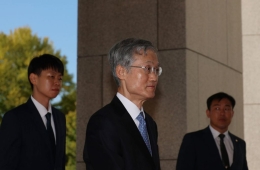
[2027 Budget Bill] Largest Public Servant Pay Increase in 16 Years...Union "Actively Welcomes"
Civil Servant Pay to Rise by 3.9% Next Year
Starting Monthly Salary for Grade 9 Entry-Level Officials to Reach 3 Million Won
Next year, public servant salaries will see their biggest increase in 16 years, rising by 3.9%. As a result, starting monthly salaries for Grade 9 public servants will reach around 3 million won. The unionized public sector employees, who have been demanding wage hikes and improved working conditions, have welcomed the government's full adoption of the Public Servant Compensation Committee's recommendations, which were the result of labor-management consensus.

On the 21st, public officials affiliated with the National Government Employees' Union held a protest at the 2nd Executive Resolution Rally for Wage Increase in front of the Government Complex Seoul. National Government Employees' Union
View original imageThe Ministry of Strategy and Budget announced on September 1 that the Cabinet had deliberated and approved the "2027 Budget Bill," which includes these measures. The salary increase rate for public servants next year is 3.9%—the highest since 2011's 5.1%. This marks a third consecutive year of raises exceeding 3%, following increases of 3.0% last year and 3.5% this year. The rate also surpasses next year's minimum wage increase of 3.7% and exceeds both the 2.2% and 2.3% inflation projections for next year by the government and the Bank of Korea, respectively.
Cho Yongbeom, Vice Minister of the Ministry of Strategy and Budget, explained, "We took into account the differences between public and private sector wage increases, as well as the minimum wage hike." He added, "We reflected the fact that the gap with the private sector is widening as private sector wage increases accelerate." The government expects that, with this increase, the total monthly salary (base pay plus allowances) for a first-step, entry-level Grade 9 public servant will be around 3 million won.
Previously, at the end of June, union representatives on the Public Servant Compensation Committee demanded a 7.1% pay raise for next year. This figure was based on projections for economic growth and consumer price inflation, along with the fact that public servant salaries are only 83.9% of those for employees at private companies with 100 or more permanent workers. After discussions, the committee reached a consensus to recommend a salary increase rate of 3.4% to 3.9% for next year, and the government reflected a 3.9% increase in the budget bill.
The Korean Government Employees' Union (National Government Employees' Union) issued a statement on the same day, saying, "We actively welcome the government's faithful implementation of the compensation committee recommendations, which were decided through labor-management agreement." The union added, "Although the final raise fell short of our initial request, compared to past cases in which agreed increases were trimmed due to budget shortages, this reflects genuine progress in improving public servant treatment."
However, the union cited the need for further improvements in overtime pay and fixed meal allowances. The union argued that, given the routine nature of overtime work in a situation where new hires are limited, the system for reducing overtime pay must be improved. It also asserted that, as the cost of a meal now approaches 10,000 won, fixed meal allowances must be adjusted to reflect current price levels.
Hot Picks Today
 "Quit Job to Start Life in Canada, Now Forced to Return Home"… Language School Closure Leaves Korean Students Stranded
- [Exclusive] "Oh, Oh! Why Is the Seatback Like This?" Hyundai Ioniq 9 Recalled in Korea: 15,000 Units Due to Power Seat Entrapment Risk
- "When Was the Last Time I Went?" With Fewer Visitors, 80% of Japan’s Neighborhood Bathhouses Disappear in 50 Years
- "Typical Italy? This Tour Package Sold 300% More"...Destinations Chosen by Koreans
- Hanwoo Can't Even Dream of This... "Melts in Your Mouth" as Wagyu Hits It Big in U.S. Supermarkets and Fast-Food Chains
Meanwhile, the government included in next year's budget bill a provision to ensure that irregular workers in the public sector receive adequate salaries—set at 118% of the minimum wage. In addition, 73 billion won has been allocated to provide 'fairness allowances' to compensate for job insecurity among workers with less than one year of employment contracts.
© The Asia Business Daily. All rights reserved. Unauthorized AI training and use prohibited.