200 Trillion Won to Be Invested in R&D Over 5 Years: Aiming for Top 3 in AI and 50% Semiconductor Self-Sufficiency
The government has announced a strategy to invest over 200 trillion won in research and development (R&D) over the next five years. Through this initiative, it aims to become one of the global top three leaders in artificial intelligence (AI) by 2030 and to achieve a 50% self-sufficiency rate in semiconductor materials, parts, and equipment.
The Ministry of Science and ICT stated on September 1 that it had finalized the "Second National R&D Mid- to Long-Term Investment Strategy" after approval at the 9th deliberation meeting of the National Science and Technology Advisory Council on August 31.

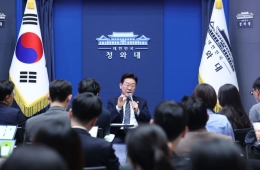
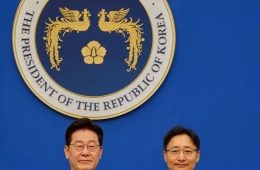
President Lee Jae-myung is examining a model of a container ship equipped with SMR ahead of the '7 SEED' future growth engine briefing held at the Blue House on the 12th. Photo by Yonhap News Agency
View original imageThis strategy, which is established every five years based on the Framework Act on Science and Technology, sets the annual direction and budget allocation for national R&D investments. It also serves as the guideline for 76 mid- to long-term plans from 20 central administrative agencies.
The vision of this investment strategy is "Making Korea Irreplaceable through Science and Technology N·E·X·T Investment." Eight specific tasks have been outlined within four key strategies: three mega-projects, development of seven SEED (core) technologies, ecosystem strengthening, and trust-based efficiency improvement. "NEXT" is an acronym derived from the initial letters of the four strategies.
First, in AI, the focus is on establishing world-class capabilities in model and physical AI as well as AI data centers to lay the foundation for AI transformation (AX) across all sectors. The goal is to move Korea’s global AI competitiveness from fifth to third place, become the world’s top player in physical AI, and develop AI data centers as an export industry.
In the semiconductor sector, the plan is to develop next-generation devices such as high-bandwidth memory (HBM), ultra-fine and stacked devices, and domestically produced AI model-specific semiconductors. Furthermore, a K-AI Semiconductor Full Package ecosystem, ranging from AI semiconductors to software and services, will be established using domestic technologies. The self-sufficiency rate in materials, parts, and equipment will be raised from the current 30% to 50%, while the localization rate for robot components will be increased from 41% to 80%.
Regarding the so-called "next-generation growth engines," the government will focus on fostering the seven SEED (core) areas, including advanced bio, quantum, and aerospace technologies. In the advanced bio sector, the target is to develop three blockbuster new drugs; in quantum, two types of domestically produced full-stack quantum computers; and in aerospace, to achieve a privately led lunar landing by 2030.
In advanced supply chains and future clean energy, the government plans to develop technology for rare-earth element alternatives, reduction and recycling, as well as extreme materials. In addition to AI-based energy management systems and high-efficiency energy storage devices, projects include the development of next-generation SMRs and nuclear fusion pilot plants, as well as commercialization of tandem solar cells.
In the defense sector, the goal is to create an environment conducive to the growth of K-Palantir, raising Korea's national defense science and technology ranking from eighth to seventh. There are also plans to develop missile defense systems and next-generation fighter jet engines to expand defense exports.
Government-funded research institutes will be expanded from two to five among the world’s top 100 research institutions. Investment in basic research will be increased to 10% of total government R&D spending. As a result, the number of highly cited researchers (HCR) is expected to rise from 54 to over 100, with the rate of new researchers benefiting from basic research growing to 70%. Additionally, the "Brain to Korea" project aims to attract 2,000 outstanding talents from overseas.
The share of regionally autonomous R&D, currently at 4.2% of the total, will be greatly expanded to 15%. Through investment-focused R&D and other initiatives, the government aims to usher in an era with 50 K-Unicorns. The goal is to establish a virtuous cycle ecosystem where investments lead to returns, which are then reinvested.
Hot Picks Today
 "Tried leveraged semiconductor stocks, watched 3.5 billion won shrink to 200 million won": Salaried investor in tears
- "Please Let Me Go Home"... Customers Trapped in Department Store Parking Lot for 5 Hours Vent Their Anger
- "I Should Enjoy It After Retirement": Prices Quadruple... Memberships Over 100 Million Won Popular, but Closures Mount
- “The Strong Drink This” Goes Viral on Social Media... What China's Millennials and Gen Z Are Hooked on After Ditching Coffee and Milk Tea
- "Come Live With Me on My Farm": Man Sells Everything and Travels 1,930 km, Trusting a Beautiful Woman
Park Inkyu, Head of the Office of Science and Technology Innovation at the Ministry of Science and ICT, stated, "While the past year was a time to restore a research ecosystem that had been shaken, the next four years must produce real results on top of that foundation. We will focus investments on mega-projects and the seven SEED areas, while also ensuring stable support for basic research, young researchers, and the regions. Four years from now, we aim for a transformed Korea that can be seen not just in numbers, but in research fields and the daily lives of our people."
© The Asia Business Daily. All rights reserved. Unauthorized AI training and use prohibited.