[2027 Budget] Ministry of Agriculture Sets Record High 22.2215 Trillion Won... Establishes Agricultural Development Fund to Utilize Special Rural Tax
Ministry of Agriculture, Food and Rural Affairs’ 2027 Budget Proposal: Up 10.4% from This Year
Era of 3 Trillion Won in Public Direct Payments and Introduction of the Agricultural Price Stabilization System
Basic Income for Rural and Fishing
The Ministry of Agriculture, Food and Rural Affairs has set its 2027 budget at 22.2215 trillion won, marking the largest in history. The public direct payment budget will be expanded to over 3 trillion won, and the pilot rural basic income project, currently supporting 17 counties, will be significantly expanded to 35 locations. The ministry also plans to establish the ‘Agricultural Development Fund’ (tentative name), which will provide a legal basis for the utilization of the special rural tax.
On September 1, the Ministry of Agriculture, Food and Rural Affairs announced that the 2027 budget plan amounts to 22.2215 trillion won, up by 10.4% (2.0853 trillion won) from the previous year.

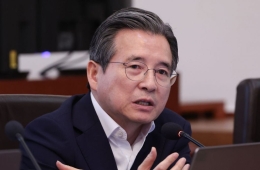
Kim Jonggu, Deputy Minister of the Ministry of Agriculture, Food and Rural Affairs, is explaining the 2027 budget plan of the Ministry of Agriculture, Food and Rural Affairs at the Government Sejong Complex. Ministry of Agriculture, Food and Rural Affairs
View original imageKim Jonggu, Deputy Minister of the Ministry of Agriculture, Food and Rural Affairs, explained, “Through this budget plan, we will enter the era of 3 trillion won in public direct payments, introduce the price stabilization system, and expand a government-backed safety net so that anyone can farm with peace of mind. We will also strengthen agricultural competitiveness through structural innovations across production, supply, and distribution, such as spreading collective farming and establishing public smart fulfillment centers. In addition to expanding the rural basic income and essential services to ensure fundamental standards of living in rural areas, we will accelerate the adoption of artificial intelligence (AI) and cutting-edge technologies in the field, drive the globalization of K-Food to secure future growth engines, bolster national food security, and lay the groundwork for advanced animal welfare on par with developed countries.”
◆The Era of 3 Trillion Won Public Direct Payment Budget · Reinforcing Basic Income for Farmers= To support stable income for farmers, the public direct payment budget will be increased to over 3 trillion won (from 2.9703 trillion to 3.0615 trillion won). The support level for basic direct payments will be raised, while choice-type payments, such as expanding strategic crop direct payments and introducing new direct payment programs, will be extended.
For basic direct payments, the payment rate for upland fields in non-promoted areas will be raised to match those for rice paddies, thereby eliminating the payment disparity between paddy and upland fields. Strategic crop direct payments will factor in suitable acreage and see increased payment rates (from 419.6 billion to 456.8 billion won) to support preemptive rice market stabilization and other crop supplies. In particular, green manure crops—offering real fallow effects—will be introduced (1.5 million won/ha) to flexibly respond to supply-and-demand situations such as rice oversupply or alternative crops like soybean. Payments for eco-friendly agriculture will also see both supported area and payment rate rise (from 40.7 billion to 64.1 billion won), and the payment rate for eco-friendly livestock will also be increased, with support funded at 3.7 billion won. Pilot payments for animal welfare livestock will launch for layer and pig farms (new 3.4 billion won), supporting the transition toward animal welfare.

Customers are shopping at Hanaro Mart Yangjae Branch in Seocho-gu, Seoul. Photo by Jinhyung Kang
View original imageTo help farmers continue farming despite sharp declines in agricultural product prices, an agricultural price stabilization system will be introduced (new 9.1 billion won). If the average price of key agricultural products falls below the standard price, the gap in full or in part will be subsidized.
With the increasing frequency and severity of agricultural disasters due to climate change, the number of crops eligible for agricultural disaster insurance will be expanded, and support for running integrated horticultural facility coverage for agricultural disaster and storm/flood insurance (with partial transfer from the Ministry of the Interior and Safety) will be increased (from 776.9 billion to 831.3 billion won). A ‘quasi-crop insurance’ system (new 7.7 billion won) will be set up to fill gaps by supporting crops for which insurance is hard to operate. The coverage level of farmer safety disaster insurance will be raised to match industrial accident insurance (from 95.6 billion to 122.8 billion won), strengthening support for farmers injured in work-related accidents.
To prepare for abnormal climate events, the foundation for agricultural water supply will also be strengthened. Pumping stations (from 24.6 billion to 250.9 billion won) will be improved to ensure stable and timely water supply during drought. Foundations for agricultural water supply in the Sinbuk district will be supplemented to support the smooth progress of the three major mega-projects alongside existing farming activities. A total of 73 billion won will be spent, with 2 billion won allocated next year. In conjunction with building a semiconductor industrial complex in the southwestern area, agricultural water supply in the beneficiary region near Lake Naju will be secured and supplied, aiming to both respond to drought and ensure stable farming for farmers.
◆1.1658 Trillion Won for Rural Basic Income... Expanding to 35 Locations from 17= To support the stable livelihood of rural residents and vitalize local areas, the rural basic income pilot project will be greatly expanded (including the 2026 supplementary budget, from 304.7 billion to 1.1658 trillion won). After expanding the number of target counties to 17 in 2026, it will further expand to 35 counties, about half of the 69 counties designated as depopulation areas, in 2027. The central government’s subsidy ratio will also be raised from 40% to 50% to lessen the financial burden on local governments.
![[2027 Budget] Ministry of Agriculture Sets Record High 22.2215 Trillion Won... Establishes Agricultural Development Fund to Utilize Special Rural Tax](http://www.asiae.co.kr/news/img_view.htm?img=2025121017581751187_1765357096.png)
The ministry also announced that the government will invest 200 billion won in the Rural Development Cooperation Fund. Since its introduction in 2017, the fund had accumulated only about 320 billion won as of June this year, just 32% of the target 1 trillion won. The government will therefore make up the shortfall with national funding—starting with 200 billion won next year and aiming at a total of 700 billion won by 2030 to reach the 1 trillion won target.
While supporting rural transportation services such as buses and taxis, the expansion of AI-based demand-responsive transport models to 82 counties is planned (from 29 billion to 72.4 billion won). This is meant to reduce the inconvenience of fixed route and schedule operations by flexibly operating vehicles in line with actual demand, thereby reducing rural residents’ waiting times for transportation.
Restructuring of rural spaces will be advanced through rural spatial plans reflecting local characteristics and conditions. Renovation projects for repurposing rural spaces, including housing and industrial functions, will be expanded (20 new areas, 132.2 billion won). The project to regenerate vacant rural houses as residential or entrepreneurial spaces, along with the construction of rural-stay type complexes providing urban citizens with opportunities to stay in rural areas, will be promoted to encourage the inflow of population into local areas.
◆Securing Future Growth Engines via Globalization of K-Food= The ministry plans to turn the increased recognition and demand for K-Food into substantial export expansion. Export voucher allocations will be increased (from 72 billion to 88 billion won), and support for the development of ‘Next K-Food’ to pioneer promising markets will expand (from 100 to 200 products, 6 billion to 20 billion won). Financial and logistics infrastructure to support export growth will also be reinforced. To connect the use of Korean ingredients at overseas Korean restaurants to actual exports, the ‘K-Food Ingredients Overseas Expansion Support Fund’ will be established (new 136 billion won). Complex-type logistics centers abroad will be expanded (from one to two countries, from 5 billion to 10 billion won) to reduce storage and transportation burdens.
![[2027 Budget] Ministry of Agriculture Sets Record High 22.2215 Trillion Won... Establishes Agricultural Development Fund to Utilize Special Rural Tax](http://www.asiae.co.kr/news/img_view.htm?img=2024110115535083362_1730444030.png)
To address labor shortages and boost productivity, the active utilization of physical AI will commence. Investments (20.8 billion won) will be made in on-the-ground demonstration and dissemination of physical AI in agri-food fields, which have previously remained at the R&D stage. AI agricultural machinery sharing centers will be established (15 locations), and dissemination of AI agricultural robots to farms and farming corporations will be supported (210 units).
In addition, continuous support will be provided for building the artificial intelligence transformation (AX) platform, which forms the foundation of the agricultural AI ecosystem (18 billion won). Investment in the construction of global business centers, demonstration centers, and growth-support data centers will continue (from 7.3 billion to 14.5 billion won). An AX data census (new 2 billion won) will also be implemented to lay the groundwork for AI training and service development.
◆Integrating Farmland, Agricultural Safety, and FTA Funds to Increase Utilization of the Special Rural Tax= The financial structure in the agricultural sector will also be reformed. By enacting relevant legislation within the year, an Agricultural Development Fund integrating the former Farmland Management Fund, Agricultural Product Price Stabilization Fund, and Free Trade Agreement (FTA) Fund will be established. The legal groundwork will be provided to additionally utilize resources such as the special rural tax and dramatically expand available funds by supplementing the current resources of each fund. Barriers between the funds will be lowered to enhance fiscal stability and operational efficiency.
The integrated fund will retain all existing resources, including farmland preservation charges, TRQ (tariff-rate quota) import surcharges, loan principal and interest, fund operation revenues, and proceeds from property sales and rentals. It will also provide the legal basis to receive inflows from other accounts, broadening its sourcing base. The main purpose is to utilize the special rural tax from the Rural Special Accounts more efficiently. The ministry explained that by expanding its role, the fund will ensure the stable implementation of major policy work such as the price stabilization system, agricultural supply stabilization, and farmland acquisition—avoiding reductions in expenditure due to lack of resources—while supporting emerging priorities brought by changing conditions such as climate change, aging, and AX (AI transformation).
Hot Picks Today
 "I Want to Pack Up and Move to Korea Right Now": Overseas Gen Z Drawn to Jobs Offering Housing and Health Insurance
- Basic Pension to Be Paid in Tiers of 350,000–380,000 Won Starting Next Year... Low-Income Couples to Receive 124,000 Won More
- Packed Crowds with “It’s So Cheap!”... Japan Travel by UK Millennials & Gen Z Surges 25% in a Year
- When "Cutting Down Reserved Tents" Brings Relief: Local Governments Take Action Against Escalating 'Reserved Tent' Problem
- "Tired of Seongsu and Euljiro?... The Hotspot Where Millennials and Gen Z Are Now Going Out of Their Way to Visit"
Minister Song Miryung stated, “The increased fiscal capacity secured through the special rural tax will be faithfully invested in addressing challenges faced by agriculture and rural areas as well as preparing for the future. Even during the National Assembly’s deliberation process, we will do our utmost to secure and supplement the necessary budgets for agriculture and rural communities so that tangible improvements reach the field.”
© The Asia Business Daily. All rights reserved. Unauthorized AI training and use prohibited.