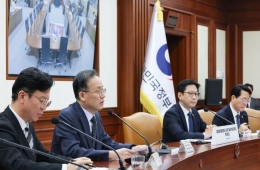
[2027 Budget Plan] 1.26 Trillion Won Special Account for Regional and Essential Healthcare...Expanded Investments in Medical AI and Care Robots
Ministry Sets 2027 Budget at 148.77 Trillion Won
Support for 490 Regional Doctor Track Students and 448 Contract-Based Essential Doctors
387 Billion Won for Medical AI, 349 Billion Won for Healthcare Data Hub
The Ministry of Health and Welfare will significantly expand its investments in the fields of regional·essential healthcare and artificial intelligence (AI) transformation (AX) in healthcare and welfare in next year's budget plan. A new "Regional Essential Healthcare Special Account" worth 1.26 trillion won will be established to reduce regional disparities in medical care. The ministry will also expand the local healthcare workforce and strengthen the capabilities of national university hospitals and public hospitals.
![[2027 Budget Plan] 1.26 Trillion Won Special Account for Regional and Essential Healthcare...Expanded Investments in Medical AI and Care Robots](http://www.asiae.co.kr/news/img_view.htm?img=2026090108573310077_1788220652.jpg)
On September 1, the Ministry of Health and Welfare announced that the total expenditure for the 2027 budget plan resolved at the Cabinet meeting amounts to 148.7697 trillion won, an 8.2% increase from this year's main budget of 137.4949 trillion won. The budget plan focuses on five core areas: ▲Strengthening the social safety net ▲Expanding investment in regional·essential healthcare ▲Integrated community care ▲Support for future generations ▲Healthcare and welfare AX and bio-innovation.
The most noticeable change is the establishment of a separate fiscal system for regional essential healthcare. The ministry will introduce a special account for regional essential healthcare worth 1.26 trillion won, and, based on the three principles of "greater investment the further from the capital region," "priority investment in public medical institutions," and "enhancing the autonomy of local governments," will focus investments in regional healthcare. In particular, the "Locally-led Medical Gap Resolution Project," which is being introduced for the first time in the special account, will see the central government present the budget and a standard menu for each city and province, allowing local governments to directly plan and implement medical services tailored to their regional characteristics. Local governments will be able to select the projects they need, taking into account the medical demand and workforce situation in their area.
Funds will also be allocated to expand the local medical workforce. Tuition and housing assistance will be provided to 490 students selected for the regional medical doctor track, who are required to serve for ten years in local areas. The number of participants in the contract-based regional essential doctor program will also increase from 136 in six cities and provinces to 448 nationwide, excluding Seoul. Support for hiring senior physicians will be expanded from 160 to 220 positions.
In addition, national university hospitals will be intensively fostered as the backbone of the "Five Regions, Three Specialized Areas" regional healthcare initiative, with the ministry aiming to raise their capabilities to the "Big 5" hospital level. For public hospitals, such as provincial medical centers, support will be provided for building treatment facilities and operating costs for essential medical care, thereby enhancing their capacity to the level of general secondary hospitals.
Investment in the care system for high-risk mothers and newborns will also be expanded. Specialists at maternal and child medical centers outside Seoul will receive a special allowance: 10 million won per month for medical specialists and 5 million won per month for residents. The number of advanced maternal and child care centers will be increased from two to four. The scope of support for medical liability insurance premiums in essential medical fields will also be expanded to include emergency room doctors at all regional emergency medical centers across the country.
From Care Robots to Medical AI...Full-Scale Launch of Healthcare and Welfare AX
The ministry will allocate 37.7 billion won to deploy care robots in home-based and residential care sites and support the commercialization of home care robots. It will also invest 14.5 billion won in new R&D for care technologies. By establishing data-driven infrastructure such as MyData for welfare and care and an open platform, the ministry will also implement AI literacy education to facilitate the use of AI in practice.
In the healthcare sector, an AX package for primary care in underserved areas and an emergency integrated AI platform connecting paramedics and hospitals in real time will be pursued. A total of 38.7 billion won will be invested in AI and QR-based medical imaging sharing, based on individuals’ personal health records (PHR).
In addition, 34.9 billion won has been earmarked for establishing a national healthcare data hub, "Sovereign AI," to utilize national healthcare data for AI development. This aims to lay the foundation for core medical AI technology that can be used in clinical settings.
Furthermore, to foster unicorn companies in the biohealth sector, new vouchers worth a total of 5 billion won will be provided to 13 young startup companies. The government will also enhance the competitiveness of K-beauty by expanding the scale of skin big data and increasing the number of overseas flagship hubs for experience and sales. A K-healthcare integrated hub platform, including non-face-to-face consultation functions for foreign patients, will also be established.
Hot Picks Today
 "Should I just pay 37,000 won to skip a 90-minute hospital wait?"... Japan in uproar over "medical fast passes"ვეთ
- "It's Never Too Late in Life": 50-Year-Old Grade 9 Civil Servant Shares His First-Day-at-Work Experience
- "Koreans Spend 1 Million Won Each and Come Back"... 'They Said They Were Going for Value for Money,' but Open Their Wallets Wide in Japan
- "I Have 9 Billion Won, but I Still Can't Quit"... The Unexpected Worry of a Major-Company Employee in His 40s Who Hit It Big with Investments
Minister of Health and Welfare Chung Eunkyung stated, "The 2027 budget plan has been put together with an emphasis on expanding regional, essential, and public healthcare, so that everyone, regardless of where they live, can be guaranteed a basic standard of life and health."
© The Asia Business Daily. All rights reserved. Unauthorized AI training and use prohibited.