A Journey Through Millennia Along the Imjin River... Gorangpo Trail in Yeoncheon, Perfect for Autumn Walks
Gyeonggi Province: A Journey Through History on One Trail,
Encountering Paleolithic Relics, Dolmens, Horogoru Fortress,
the Tomb of King Gyeongsun, and Soongui-jeon
Golden Fields and Refreshing River Breezes Create Harmony
Tongilbaragi Festival to Be Held at Horogoru from September 3 to 6
Walking along the waterway of the Imjin River, time rewinds from modern days, past the Goryeo and Three Kingdoms periods, all the way back to prehistoric times. Along a single path, one can encounter thousands of years of history, from Paleolithic hand axes and Bronze Age dolmens to Goguryeo fortress walls, the tomb of the last Silla king, and Goryeo dynasty shrines.

To mark the arrival of autumn, Gyeonggi Province introduced the "Gorangpo Trail" in Yeoncheon—the tenth route of the Peace-Nuri Trail—on September 1 under the theme "DMZ—Embracing Four Colors of Reflection."
The Peace-Nuri Trail is the northernmost walking trail in Gyeonggi Province, connecting four cities and counties along the DMZ border—Gimpo, Goyang, Paju, and Yeoncheon. Opened in 2010, it comprises 12 routes spanning a total of 189 kilometers: three in Gimpo, two in Goyang, four in Paju, and three in Yeoncheon. Travelers can walk along the barbed wire fences and witness the divided reality of the Korean Peninsula, taking in both natural scenery and historical sites.
The Gorangpo Trail, which connects Jangnam-myeon in Yeoncheon County with the surrounding Imjin River area, is often called "the path where you walk through time along the river." In September, when cool breezes blow, the golden fields and breathtaking river views make for an even more enjoyable walk.
The trail begins at Jangnamgyo Bridge. During the bridge's reconstruction in 2008, Paleolithic relics, including hand axes, were unearthed here—evidence that the Imjin River area has been a human habitat since prehistoric times.
Following the river and fields from Jangnamgyo Bridge, hikers arrive at Sami Stream. This is the site of the "Battle of Hook Hill" during the Korean War, where UN and Chinese forces clashed in fierce fighting over the Imjin River defensive line. The nearby village of Nogokri, named for its dense reeds and deep valleys, is particularly spectacular in late autumn, when the reed fields are at their peak.

Gorang Port Historical Park (Hwaseon Department Store). Provided by Gyeonggi Tourism Organization
View original imagePassing Nogokri and entering Hakgok-ri, you step back into the Bronze Age. In the center of the village sits a dolmen topped by a 2.7-meter-long basalt capstone. About ten minutes' walk from here, travelers come upon a stone mound tomb, believed to date from the early Baekje period. These relics offer a glimpse into the lives and powers of the people who once lived along the Imjin River.
At the end of the trail lies Soongui-jeonji. Soongui-jeon is a Confucian shrine built during the Joseon Dynasty to honor kings and meritorious subjects of Goryeo. The neat ceremonial grounds and tranquil surrounding landscape create a harmony with the crisp scenery of early autumn.
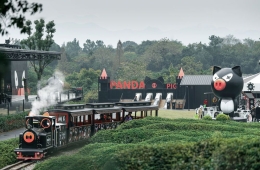
Located about 5 kilometers from Jangnamgyo Bridge, Gorangpo Port is another highlight. Once the main hub for daily life and logistics via the Imjin River, Gorangpo Port was so prosperous that a branch of Hwaseong Department Store opened here in the 1930s. However, it lost its function as a port after the Korean War. At the nearby Gorangpo Port Historic Park, visitors can see recreations of shops and street scenes from those days, offering a glimpse into its past.

Behind Gorangpo Port, atop a low hill, lies the tomb of King Gyeongsun, the last king of Silla. It is the only Silla royal tomb located outside of Gyeongju, in Yeoncheon. According to legend, he was buried here following the early Goryeo-era principle that royal tombs should be within one hundred li of the capital, Gaegyeong.
The tomb of King Gyeongsun was forgotten for centuries, until a stele inscribed with "Tomb of Gyeongsun of Silla" was discovered there in 1747, the 23rd year of King Yeongjo's reign in the Joseon Dynasty. Although the tomb was once again neglected during the Japanese colonial period and the Korean War, it was rediscovered by an Army officer inspecting the civilian control zone and subsequently restored to its current state.
Hot Picks Today
![Stock Down 40%, But Record Earnings: This Stock Touted as a "Buying Opportunity" [Weekend Money]](https://cwcontent.asiae.co.kr/asiaresize/93/2026090110113910454_1788225100.jpg) Stock Down 40%, But Record Earnings: This Stock Touted as a "Buying Opportunity" [Weekend Money]
Stock Down 40%, But Record Earnings: This Stock Touted as a "Buying Opportunity" [Weekend Money]
- "Almost Started a War"...U.S. Military Nearly Attacked Chinese Vessel Based on Fake AI-Generated Intelligence
- "The Year Isn't Over Yet—With More Than 3 Months Left, What Is the 'September Reset' Trending on SNS?" [Z Around the World]
- "Dogs Living More Luxuriously Than People"... Even $4,120 Fitness Centers Emerge in China [China.zip]
- In the Same Neighborhood, One Apartment Costs 2 Billion Won, Another 450 Million... What's Happening in Gangnam?
From Gorangpo Port, travelers can reach Horogoru, a major Goguryeo historic site that testifies to their territorial expansion. Climbing to Horogoru offers a sweeping view of the Imjin River region. The fortress walls, built from basalt, and the natural river defense illustrate the construction techniques and military strategies of Goguryeo. From September 3 to 6, the "Tongilbaragi Festival" will be held at Horogoru, featuring sunflowers and cosmos in full bloom as a scenic backdrop.

An official from Gyeonggi Province stated, "Along the Gorangpo Trail, layers of history unfold—from Paleolithic hand axes to Goguryeo fortress walls, King Gyeongsun's tomb, Soongui-jeon, a modern port, and the battlefields of the Korean War. In September, visitors can walk alongside the golden fields and the Imjin River, experiencing both nature and history together."
© The Asia Business Daily. All rights reserved. Unauthorized AI training and use prohibited.