[Beyond the Scene] Why Do Reporters Feel Like "The Boy Who Cried Wolf"?
The Government Repeatedly Postpones Announcement Schedules After Promising a March Release
Who Benefits from CEO Term Limits That Defy Shareholder Wishes?
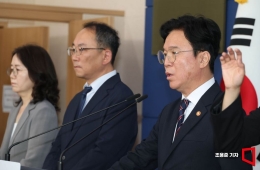
Recently, among reporters, there have been growing complaints that they feel "like the boy who cried wolf." The reason is the government's push for the so-called "Advanced Plan for the Governance Structure of Financial Companies," aimed at preventing the long-term rule of financial group chairmen. Both the market and the media were firmly convinced that the detailed plan would be released in March. This expectation was based on the fact that, immediately after President Lee Jaemyung criticized the financial group CEO appointment process as a "corrupt inner circle" at the Financial Services Commission’s work report in December last year, the authorities pledged to unveil an improvement plan before the shareholders' meetings in March.
However, when March arrived, the authorities first sent out a notification text message about the announcement schedule, only to abruptly cancel the release on the same day. When the plan was postponed the first time, there was a sense of understanding. The government, having to collect diverse opinions and consider the potential repercussions of its policies, had no choice but to remain cautious. Yet, the promise to announce the plan in July was delayed again to August, and now, as August draws to a close, only speculative reports regarding the key issue of the "ban on three terms" abound.
What is making the government so hesitant? The crux of the plan is to restrict the reappointment of financial holding group chairmen to just one additional term, thereby limiting their tenure to a maximum of six years. Based on coverage, it is known that there have been heated debates within the task force (TF) formed to discuss governance reform, specifically about the clause prohibiting a third consecutive term. In particular, all TF members reportedly opposed the idea of legally instituting the ban on three terms. Even the Citizens' Coalition for Economic Justice, which has regularly warned against the imperial style of many financial holding group chairmen, expressed opposition to the plan, clearly demonstrating the controversy. Some have even raised concerns that legally limiting the chairmen's terms could infringe upon the constitutional freedom to choose one's occupation.
One fundamental question that cannot be avoided is: "Why should the government, by law, block a CEO from being reappointed if the shareholders want them to continue because of their proven performance and abilities?" The decision regarding the reappointment of a financial holding group chairman should rest entirely with the shareholders. Furthermore, from the perspective of foreign and overseas institutional investors, the Korean government’s interference in the tenure of private financial company CEOs could breed distrust in the capital market. While government officials call for the modernization of Korea’s capital markets, legislating intervention in private companies’ personnel matters may appear contradictory. This is why there are criticisms that, despite pledging to tackle the "Korea discount," the government is instead casting the shadow of "government-controlled finance," thereby running counter to modernization efforts.
Hot Picks Today
 "Why Is the Amount in My Account So Low?"... Why Pension Savings Subscribers Were Surprised
- "SK hynix to Hit 4.7 Million Won, Samsung 670,000 Won"... Why Nomura's Bold Forecast justifies it
- "It Appeared on the Plane Floor, Then Disappeared"... Flight Canceled While Searching for 'This'
- "I wanted her to feel my passionate love"... Wife collapses after husband's overly tight hug, diagnosed with broken ribs
- "No Walks Needed, Affordable"... Strange but Cute Pets Gain Popularity in China
The government’s inability to make a decision and its indecisive stance seem to reflect the many concerns being raised in the field, as well as the burden of potential side effects caused by the policy’s implementation. No matter how good the intention or rationale may be, if the government pushes ahead with measures that go against the natural order of the market, the very side effects that have been warned about are likely to become a reality. Now, the ball is in the National Assembly’s court. Given that warnings are coming from all sides, the legislature needs to carefully consider the effectiveness of term limits, the potential for constitutional issues, and the possible negative impact on the market.
© The Asia Business Daily. All rights reserved. Unauthorized AI training and use prohibited.