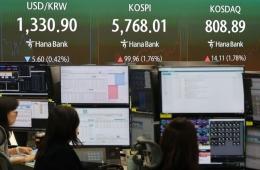
[Good Morning Market] Semiconductor Stocks Cushion Downside Despite U.S. Market Decline... "Korea Expected to Start Weak, Finish Strong"
Oil and Treasury Yields Rise Amid U.S.-Iran Tensions
Semiconductor Stocks Cushion Downside in Equity Markets
Domestic Market Also Impacted; Exports Serve as Buffer
As geopolitical tensions in the Middle East have once again escalated, the overall U.S. stock market declined overnight, while semiconductor stocks showed strong performance. On September 1, it is expected that in the domestic stock market, semiconductor stocks will help alleviate the downward pressure caused by rising oil prices and higher government bond yields.
On the previous day, August 31 (local time), the Dow Jones Industrial Average closed at 53,185.90, down 0.70% from the previous session. The S&P 500 fell 0.33% to 7,686.14, and the Nasdaq Composite Index finished at 26,370.89, down 0.12%.

The resumption of military clashes between the United States and Iran caused international oil prices to rise by nearly 3%. As a result, government bond yields also increased, having a negative impact on the stock market. The yield on 10-year U.S. Treasuries is currently around 4.75%, on the verge of entering the 4.8% range. Han Ji-young, a researcher at Kiwoom Securities, explained, “Such a rise in yields exerts pressure on the equity market discount rate, implying a risk of exposure to correction pressure.”
However, the gains in semiconductor stocks such as Nvidia (up 1.5%) and Micron (up 2.8%) helped support the lower end of the indices. Suh Sangyoung, a researcher at Mirae Asset Securities, commented, “The strong performance of semiconductor stocks limited the decline in indices, as factors such as Nvidia’s investment in MediaTek, warnings regarding U.S. President Donald Trump’s opposition to the construction of data centers, and a rebound following last Friday’s sharp drop all played a role.”
In the domestic market, similar factors are expected to prevent a significant downside move. Suh predicted, “Although rising long-term U.S. bond yields and oil prices will exert downward pressure on the Korean stock market on September 1, various mitigating factors—including the situation on U.S. stock markets, the strength of U.S. semiconductor stocks, and Korea’s export momentum in August—are likely to act as buffers, resulting in a market that starts weak but finishes strong.”
Hot Picks Today
 "Please Let Me Go Home"... Customers Trapped in Department Store Parking Lot for 5 Hours Vent Their Anger
- "I Should Enjoy It After Retirement": Prices Quadruple... Memberships Over 100 Million Won Popular, but Closures Mount
- "Jealous of Koreans" - Now a Must-Do on Every Trip... The Place Where Foreigners Spent KRW 229.8 Billion
- “The Strong Drink This” Goes Viral on Social Media... What China's Millennials and Gen Z Are Hooked on After Ditching Coffee and Milk Tea
- "Come Live With Me on My Farm": Man Sells Everything and Travels 1,930 km, Trusting a Beautiful Woman
He also evaluated improvements in market fundamentals from a supply-demand perspective positively. “Although the KOSPI showed a modest recovery and held steady throughout August, structural improvements are underway beneath the surface,” he explained. “While the KOSPI, KOSPI200, and large-cap stocks have remained somewhat stagnant, other indices such as the KOSPI200 equal-weight and KOSDAQ have shown strong performance. It indicates that market liquidity did not concentrate solely on a few large-cap stocks but extended to other sectors as they reacted to individual factors, leading to favorable sector rotation,” he added. “It is highly likely that this market character will be maintained going forward.”
© The Asia Business Daily. All rights reserved. Unauthorized AI training and use prohibited.