The Basic Pension Is Passed to the National Assembly Like a Hot Potato, Public Institution Relocations Are Delayed... 'Lee Jaemyung's Reforms' on Shaky Ground
Passing the "structural reform" burden to the National Assembly as the fiscal bomb looms
Minister replaced after pledging "zero remaining in Seoul"... Announcement postponed until after October
Key reform initiatives of the Lee Jaemyung administration are increasingly adrift. The basic pension reform, which has been described as a fiscal time bomb, has been handed over to the legislature without making the necessary "structural decisions." The second phase of public institution relocations to regional areas, which the administration had vowed would proceed rapidly with "zero remaining in Seoul," has had its announcement postponed due to strong union opposition and intense competition among local governments. As the government steps back from one key issue after another, concerns are mounting that this retreat, combined with declining approval ratings, could undermine the momentum for national reform.
With a KRW 46 trillion fiscal bomb looming in 2050... The basic pension issue handed over to the National Assembly

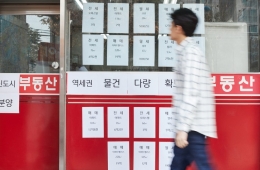
On the 18th, members of the National Financial Industry Labor Union shouted slogans at a press conference condemning the hasty attempt to relocate national policy banks to local areas in front of the Blue House Sarangchae in Seoul. Photo by Yonhap News.
View original imageThe basic pension reform plan released by the Ministry of Health and Welfare on September 1 lacks any "structural reform" to ensure fiscal sustainability. Without revising the current 70% payout coverage, annual basic pension expenditures—now about KRW 23 trillion—are projected to soar to KRW 46 trillion by 2050, amid a rapidly aging population. Although this fiscal time bomb continues ticking, the government has postponed fundamental reforms such as changing the eligibility from the "bottom 70% income group" to a "median income threshold," stating that further discussions are needed in the National Assembly and with society at large. This plan comes after the government twice delayed the originally scheduled briefing.
The problem lies in the fact that the National Assembly, now tasked with solving the issue, is a political arena extremely vulnerable to voter sentiment. Raising the National Pension premium rate from 9% to 13%—a change of just 4 percentage points—took an astonishing 28 years, demonstrating just how difficult pension reform is for lawmakers. Critics argue that asking the political parties to shoulder the burden of pension structural reform, without a clear government proposal and facing constant electoral considerations, is tantamount to declaring the abandonment of reform.
The controversy over "opaque reform" is also growing. On this day, the National Action for Public Pension Enhancement and Assemblyman Jeon Jongdeok of the Progressive Party held an emergency press conference at the National Assembly’s press center, strongly condemning the government's one-sided approach to reform. They highlighted the unprecedented confusion last month, when a planned briefing on the 26th was abruptly canceled 70 minutes before its scheduled time, pointing out that genuine public engagement and deliberation are entirely lacking and that the policy is being pushed behind closed doors. Furthermore, they argued that linking the basic pension to the median income for the sole purpose of cutting fiscal costs, along with a tiered benefit system that favors wealthier recipients, would foster division among beneficiaries and undermine the universal safety net for old age, stressing the need for comprehensive public debate.
Minister replaced after guaranteeing "zero remaining in Seoul"... Deflated momentum for public institution relocation

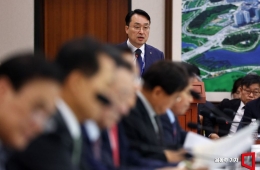
At the National Defense Academy Founding Public Hearing, Hann Kiho, a member of the People Power Party (center), is blocking a Ministry of National Defense official who is trying to stop attendees from speaking. Photo by Yonhap News.
View original imageThe "second phase of public institution regional relocation," which had been promoted as a core task for regional-led growth, is also at a standstill. The planned announcement, originally promised for August or September, has now been pushed back to after October. Labor unions in the financial sector are preparing for a general strike on the 4th, vowing to prevent the relocations. Meanwhile, Yoonduk Kim, Minister of Land, Infrastructure and Transport, who had declared a strong stance with "zero remaining in Seoul," will be replaced in the upcoming cabinet reshuffle.
The government is citing "the need for public discourse" as the reason for the delay, but there is growing speculation that the real reasons are fierce union opposition, overheated competition among local governments, and mounting public discontent in affected regions. At the same time, efforts to consolidate the Army, Navy, and Air Force academies into a single Korea Military Academy have triggered intense backlash from veterans’ groups and within the military itself, escalating into a national security dispute. Similarly, attempts to reform local education finance in response to declining student numbers have encountered fierce, organized resistance from regional education offices and the broader education sector.
'From "refreshing" to "calibration"... Prioritizing the deliberation process'

This shift in atmosphere is coinciding with a decline in the administration's approval ratings. According to a poll released on August 31 by Realmeter on behalf of Energy Economy News, which surveyed 2,509 voters aged 18 and over nationwide from the 24th to the 28th of last month, President Lee's positive approval rating for state affairs fell for a seventh consecutive week, dropping to 38.9%—its lowest point since his inauguration and a dip into the 30% range for the first time. Negative sentiment reached as high as 58.7%.
Hot Picks Today
 "If You Don't Apply, My KRW 1.7 Million Will Be Gone"... Unclaimed National Pension Refunds Vanish After 'This Deadline'
- "King crab is 3,000 won per 500 grams; just eating it makes the trip worthwhile"... Chinese flock to North Korea on 'fake business trips'
- "When I get Home from Work, This Is All I Do, and It's Making Me Stupid"... Short-Form Craze Sparks 'Electronic Drug' Debate in China
- Lee Juwan, Who Forecast Samsung at 70,000 Won and SK hynix at 200,000 Won, Says They're "Still Overvalued"; Others Counter: "Fundamentals Are Solid, Correction Is Excessive"
- "What Was I Thinking..." Gen Z Regrets Habitual Delivery Orders After Seeing the Bill, Falls Into "Delivery Guilt"
Early in its term, the Lee Jaemyung administration pushed through key policy issues such as the first and second rounds of commercial law revisions and the "Yellow Envelope Law" (amendments to Articles 2 and 3 of the Trade Union and Labor Relations Adjustment Act), earning a reputation for "refreshing governance." However, in recent times, the government has increasingly retreated from contentious issues, repeatedly delaying decisions and solidifying a pattern of deferral. In a cabinet meeting on July 25, President Lee remarked, "Just as it's less painful to give an injection with care and time, we must take a practical and effective approach," explicitly referring to the need for a "calibrated pace." Observers note that even if this approach is perceived as "frustrating reform," the government appears to be shifting its focus to the importance of public discourse and consensus-building.
© The Asia Business Daily. All rights reserved. Unauthorized AI training and use prohibited.


!["Please Take Them Off!" They Made It All the Way to the Bed... Then "80% of Fecal Bacteria" Struck [Deep Scroll]](https://cwcontent.asiae.co.kr/asiaresize/307/2026101610053063338_1792112730.png)