[2027 Budget Proposal] Record-High 108 Trillion Won Spending Restructuring... 2,100 Underperforming Programs Abolished
38.6 Trillion Won Saved in Discretionary Spending, Exceeding the 15% Target
Mandatory Expenditure Cut by 69 Trillion Won
Subsidy Calculation System Overhauled for the First Time in 55 Years
The government has carried out a spending restructuring worth a total of 108 trillion won in the process of preparing next year's budget, exceeding its initial targets.
According to the "2027 Budget Proposal" released by the Ministry of Strategy and Finance on the 1st, the government reduced discretionary spending by 38.6 trillion won, the largest amount to date, achieving its previously announced goal of a 15% reduction. This is an increase of 11.7 trillion won from the 26.9 trillion won spent on restructuring in the previous year. In particular, more than 2,100 underperforming programs, accounting for nearly 10% of all fiscal projects, were abolished. Representative cases include the Ministry of Education’s customized national scholarship program (210 billion won), installation and improvement of hydrological survey facilities by the Ministry of Climate, Energy and Environment (9.4 billion won), establishment of a 3D printing industry fostering platform by the Ministry of Science and ICT (4.6 billion won), and operation of the Free Trade Agreement Implementation Support Center by the Ministry of Agriculture, Food and Rural Affairs (1.3 billion won).

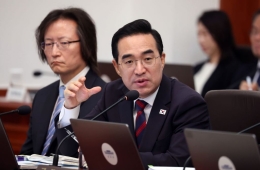
Hongkeun Park, Minister of Strategy and Finance, is reporting the 2027 budget proposal and the 2026-2030 national fiscal management plan at the cabinet meeting presided over by President Jae-myung Lee at the Blue House on the 1st. Photo by Yonhap News
View original imageAmong inefficient projects, 3.8 trillion won was saved by consolidating agricultural and fishery policy funds and converting renewable energy loan interest subsidies. An additional 51.7 billion won was cut by surveying all informatization projects across ministries and consolidating idle systems. Furthermore, the R&D (research and development) budget was trimmed by 6.2 trillion won in line with the latest technology trends, and 900 billion won was cut from Official Development Assistance (ODA) through restructuring of underperforming programs.
Previously, a "comprehensive fiscal program performance evaluation" was conducted for 2,487 individual projects, resulting in 858 being reduced, 3 abolished, and 40 integrated. The Ministry of Strategy and Finance initially estimated that applying the principles of a 15% cut and 100% abolition with no exceptions would yield about 7.7 trillion won in restructuring. Hongkeun Park, Minister of Strategy and Finance, explained, "We thoroughly reviewed all fiscal programs from scratch to ensure that not a single won of the people's precious taxes would be wasted, boldly cutting back or abolishing projects that were unnecessary or redundant so that funds can be invested where they are truly needed."
Hot Picks Today
 "I Want to Pack Up and Move to Korea Right Now": Overseas Gen Z Drawn to Jobs Offering Housing and Health Insurance
- "I Thought Money Could Tame Him"... Fukuyama Admits His Misjudgment After 30 Years
- Is Samsung Electronics' Hurdle Clearing?... Target Price Surges, Driven by New Product Mix Expansion and Yield Improvement [Click eJongmok]
- "Over 6,000 Infected, Half Dead"... DR Congo on Alert Amid 'Worst-Ever Ebola Outbreak'
- Packed Crowds with “It’s So Cheap!”... Japan Travel by UK Millennials & Gen Z Surges 25% in a Year
The mandatory expenditure category was also reduced by 69 trillion won, exceeding the original target (10%). Notably, the method of calculating education subsidies, which had been mechanically linked to domestic taxes for 55 years, was fundamentally overhauled, resulting in savings of 32.5 trillion won from education subsidies and 30.5 trillion won from the local grant tax. In addition, the government saved 1.4 trillion won by revising the unemployment benefit system so that payments are only made for paid days, excluding unpaid leave. A Ministry of Strategy and Finance official stated, "To enhance the effectiveness of the early reemployment allowance system, the scope of recipients has been adjusted and incentives for employment have been strengthened," adding, "The surplus resources secured through these institutional reforms will be actively reinvested in addressing low birth rates, including enhanced maternal protection."
© The Asia Business Daily. All rights reserved. Unauthorized AI training and use prohibited.