KOSPI Drops Over 2% as Fed Chair’s Hawkish Stance Emerges
Chairman Kevin Warsh of the Fed: "Concerns About U.S. Inflation"
Probability of September U.S. Interest Rate Hike Rises Sharply
Renewed U.S.-Iran Clashes in the Strait of Hormuz Also Weigh on Market

The KOSPI fell more than 2% as concerns about a possible hike in the U.S. benchmark interest rate resurfaced. The expectation that the U.S. Federal Reserve may raise rates sooner than anticipated led technology stocks, including semiconductor shares, to show a notable decline. Additionally, the renewed confrontation between the United States and Iran in the Strait of Hormuz after a month acted as another adverse factor for the Korean stock market.
KOSPI Falls by Over 2% amid Chairman Kevin Warsh's 'Inflation Concerns'
As of 10:02 a.m. on August 31, the KOSPI was trading at 6,604.68, down 2.71% from the previous session. At the same time, the KOSDAQ index was trading at 809.36, plunging 3.46%.
Hawkish remarks from Federal Reserve Chair Kevin Warsh during the Jackson Hole symposium weighed on the Korean stock market. On August 28 (local time), at the economic symposium held in Jackson Hole, Wyoming, Warsh expressed concerns about inflation. He stated, "From the standpoint of our mandate to ensure price stability, the related indicators are concerning." He continued, "We must be clearly confident that underlying inflation is moving toward the target at a sufficient pace. If not, then there is work to be done."
Following Warsh's comments, U.S. Treasury yields rose while stock prices fell. The two-year U.S. Treasury yield jumped by 11.8 basis points (1bp=0.01 percentage point) compared to the previous session, closing at 4.348%, marking the largest one-day increase since March. The 10-year yield climbed by 5.0bp to 4.72%, and the 30-year yield rose by 1.6bp to reach 5.20%. According to CME FedWatch, the federal funds rate (FFR) futures market reflected a 57.5% probability that the Federal Reserve would raise rates at the September Federal Open Market Committee (FOMC) meeting, up sharply from 35.4% the previous day—a surge of more than 20 percentage points.
Amid concerns over interest rate hikes, the Dow Jones Industrial Average fell by 0.02% last Friday, the Standard & Poor's (S&P) 500 Index lost 0.25%, and the Nasdaq Composite Index dropped 0.52%. Nvidia declined 4.57%, and Marvell Technology plummeted 10.28%. Other major semiconductor stocks were also generally weak: Micron (-0.27%), Western Digital (-0.55%), and Seagate (-2.06%). As a result, the Philadelphia Semiconductor Index dropped 3.47%.

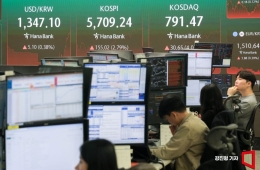
On the 31st, employees are working in the dealing room at the Hana Bank headquarters in Jung-gu, Seoul. On that day, the KOSPI started at 6,613.58, down 175.30 points (2.58%) from the previous session, and the KOSDAQ started at 821.67, down 16.74 points (2.00%). Photo by Yonhap News Agency
View original imageSemiconductor Stocks Stand Out on the Downside in Korean Market
Semiconductor shares also showed marked weakness on the Korean market. As of 10:05 a.m., Samsung Electronics was trading at 250,000 won, down 2.72% from the previous session, and SK hynix was down 3.57% at 1,594,000 won. Most other top market cap stocks were also down, including SK Square (-2.73%), Samsung Electro-Mechanics (-3.38%), LG Energy Solution (-0.68%), Hyundai Motor (-0.50%), and Samsung Biologics (-1.08%).
Experts commented that Warsh's remarks acted as a short-term negative factor for the market. Han Ji-young, a researcher at Kiwoom Securities, said, "At the Jackson Hole meeting, Kevin Warsh highlighted that underlying inflation remains at a high level despite a slowdown in July's inflation indicators. These comments were interpreted as hawkish, and as a result the probability of a September rate hike has increased, with the market now preparing for this risk."
However, some suggested that a sudden market collapse like last month is unlikely, considering Korean companies' solid earnings and their undervaluation. Lee Kyungmin, a researcher at Daishin Securities, said, "Chairman Warsh's remarks can be interpreted as hawkish, but if upcoming employment and inflation indicators, which will be announced in September, are favorable, the rate hike may be delayed. Also, considering that the KOSPI's forward price-to-earnings ratio (PER) currently stands at 5.6, a historic undervaluation, the possibility for further market declines may be limited."
Meanwhile, the renewed military exchanges between the United States and Iran after a month also acted as an additional burden on the Korean stock market. According to foreign media, on August 30 (local time), the U.S. military struck two Islamic Revolutionary Guard Corps (IRGC) rocket launch sites on Larak Island in the southern part of the Strait of Hormuz.
Hot Picks Today
 "The Inner Aisles Are Dangerous, I Never Buy These": 3 Foods a Doctor Warns Against
- A 700 Million Won Bonus Was Peanuts... 'This Company' Spent '4 Billion Won per Employee' Amid the AI Boom
- "Only 3-4 Years of Golden Time... China Will Take Over Everything" China’s All-Out Push Into the South Korean Market [China Shock, K-Industry on the Brink | Automobiles] 4
- [2026 Parliamentary Audit] Debate over NongHyup Reform... Ruling Party: "Reform Inevitable" vs. Opposition: "Autonomy Stripped Away"
- Kang Minkyung Raved, "Worth the Money," Then It Sold Out in 10 Minutes... Convenience Store Collaborations Pay Off
The U.S. attack against Iran came about a month after a military strike on Iran was called off on July 24 by order of U.S. President Donald Trump. Since then, the Trump Administration shifted its stance to imposing large-scale economic sanctions to cut off the Iranian regime's funding instead of launching further military attacks. In response to the U.S. military's attack, Iran reportedly launched missiles at U.S. naval vessels in the Strait of Hormuz.
© The Asia Business Daily. All rights reserved. Unauthorized AI training and use prohibited.
!["Please Take Them Off!" They Made It All the Way to the Bed... Then "80% of Fecal Bacteria" Struck [Deep Scroll]](https://cwcontent.asiae.co.kr/asiaresize/307/2026101610053063338_1792112730.png)