Lee Hyung-il Begins First Day as Second-Term Economic Chief, Faces Key Challenges Including Tax Reform and Growth Recovery
No additional message on his first day after nomination
Traditional bureaucrat transitioning directly from vice minister
Expected to smoothly pass the confirmation hearing
Emphasis on continuity in the control tower
Collaboration antic
Lee Hyung-il, the nominee for Deputy Prime Minister of Economy and Minister of Strategy and Finance in the Lee Jaemyung administration, has been nominated as the second top economic policymaker. As a traditional bureaucrat transitioning directly from his current post as First Vice Minister, and given that he has already been leading major economic issues, there is a general consensus that passing the confirmation hearing should not be difficult. He faces the complex task of repairing tax reforms that have provoked resistance as his first test, while he must also ensure that the benefits of semiconductor-driven growth extend to areas such as employment and welfare amid high interest rates and inflation.
According to the Ministry of Economy and Finance and other sources on August 31, Lee began preparing in earnest for the confirmation hearing by arriving at the Government Seoul Complex at 8:30 a.m. that morning. Upon arrival at the front entrance of the Seoul Complex at around 8:30 a.m., he greeted the reporters waiting for him with a slight bow before entering the building. Since issuing a brief statement sharing his reaction to the nomination the previous day, he has not released any further messages.

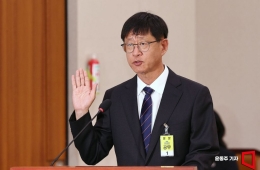
Hyungil Lee, Deputy Prime Minister and Minister of Finance and Economy nominee (currently First Vice Minister of Finance and Economy), is arriving at the Government Complex Seoul in Jongno-gu, Seoul on August 31, 2026. Photo by Yongjun Cho
View original image
Hyungil Lee, Deputy Prime Minister and Minister of Finance and Economy candidate (currently First Vice Minister of Finance and Economy), is arriving at the Government Complex Seoul in Jongno-gu, Seoul on August 31, 2026. Photo by Yongjun Cho
View original imageThe confirmation hearing preparation office is expected to be set up at the Korea Deposit Insurance Corporation in Jung-gu, Seoul. As early as September 2, Lee is expected to begin reporting for work there and prepare hearing materials. The confirmation hearing is likely to take place in the third week of September, coinciding with the opening of the regular session of the National Assembly on September 1. For Lee, as with the other five ministry nominees, most observers expect the vetting process to focus on his policy capabilities rather than on moral or legal issues. An official at the Ministry of Economy and Finance stated, "Because the nominee is already well-versed in current issues, he faces little pressure regarding briefings, and since he has continuously undergone screening, we do not anticipate any major problems at the hearing."

This appointment is seen as an effort to ensure continuity in the control tower, particularly in collaboration with Kim Yongbeom, the Blue House policy chief who remains in office, while also raising the administration's expertise in economic policy overall. Originally from Daegu, Lee entered public service after passing the 36th Higher Civil Service Examination in 1992 while studying economics at Seoul National University. In the aftermath of the IMF currency crisis, he served in key macroeconomic and financial policy positions, including Director of the Financial Policy Bureau and the Economic Policy Bureau, as well as Director of Comprehensive Policy and Economic Analysis (in the Ministry's predecessor, the Ministry of Planning and Budget), Director General for Economic Policy, and Assistant Minister. With a neutral political profile, he has been valued and promoted regardless of administration.
Since the launch of the Lee Jaemyung government, Lee has served as First Vice Minister of the Ministry of Economy and Finance, leading the so-called "3·4·5 Vision" economic growth strategy, which aims for a 3% potential growth rate, a top-four position in exports, and a national income of USD 50,000, as well as the implementation of the oil price cap system in response to inflation stemming from the Middle East war. In the statement he released after his nomination the day before, Lee said, "Based on the policy capacity secured through the semiconductor boom, I will do my utmost to advance policies for people's livelihoods, such as overcoming polarization," adding, "Through the implementation of the three mega-projects, I will work to create new investment and growth opportunities and lay the foundation for a rebound in potential growth rate."
Within the civil service community and beyond, there are high expectations for Lee as a "young economic policymaker in his 50s, born in 1971." He will be the first-ever Deputy Prime Minister of Economy born in the 1970s, and there is no precedent for a sitting vice minister being directly promoted to deputy prime minister. Traditionally, even those from within the Ministry of Economy and Finance have been appointed to the Deputy Prime Minister position only after serving as minister or vice minister elsewhere. Chief Presidential Secretary Kang Hoon-sik noted in a briefing the previous day that "as a young economic leader, Lee is expected to translate record-breaking economic indicators into qualitative improvements in people's lives, overcome polarization, and ensure stable growth for our economy."
However, Lee also faces critical challenges such as resolving the real estate tax reform plan, which is facing strong tax resistance, and spreading the benefits of semiconductor-driven growth to domestic demand, employment, and people's livelihoods at a time of high inflation and interest rates. On August 3, the government announced a reform plan aimed at increasing the property tax burden on non-resident single-home owners, shifting the tax structure toward owner-occupation, and reducing the benefits of the Individual Savings Account (ISA), drawing strong criticism. The Ministry of Economy and Finance is currently finalizing some revisions through last-minute coordination and plans to submit the finalized plan to the National Assembly after a Cabinet meeting on September 1.
Hot Picks Today
 24-Year-Old Wins Sleep Contest, Takes Home 19 Million Won After Sleeping Soundly Alongside Strangers
- "My portfolio was so battered, I didn't even want to look" - Companies that shone amid October's market plunge
- "Even Underwear Has to Be Cut Up with Scissors"... China Hit by Rise of "Trash Hunters" in an "If You're Slow, You're Out" Scramble
- "Please Make More," After Hitting It Big in China and Vietnam... Orion Custard Expands Production Lines
- "Photos of Kim Jong Un Released by North Korea Are a Deception"... Debate Over Death Rumors Continues
Price management, which Lee has taken special care with since his time as First Vice Minister, also remains a key task. Due to the effects of the Middle East war, prices have generally entered an upward phase. While some containment has been achieved through measures such as the oil price cap, consumer prices have still recorded a growth rate of around 3% for the past three months and are expected to climb back to the 3% range in August.
© The Asia Business Daily. All rights reserved. Unauthorized AI training and use prohibited.