[Gallery Walk] How Does One Voice Become a Chorus?... 46 Voices Gather by the Sea in Busan
2026 Busan Biennale "Dissident Chorus" Opens
Three Venues: A Closed School, a Century-old Ship Warehouse, and Eulsukdo
From Kim Jinsook’s 309 Days to Folk Songs... Reading Resistance and Solidarity through "Sound"
A century-old warehouse facing the sea in Yeongdo, Busan. Nineteen speakers, each at a different height adjusted to the level of a human, are arranged in the space. One emits English, another French and Portuguese. At first, the voices are all different, but they gradually begin to overlap. This is "Chorus of Dissonance: The Creation of the Sea," by Belgian artist Brahim Tall. Beyond the speakers, through the doorway, lies the real sea. As the people within the artwork sing, "I want to become the sea," even the noise of waves and the harbor joins the chorus.

British writer of Iranian origin, Aliasgar Abakas, completed the artwork "Order" on the old Busan Nam High School playground by connecting recycled fabrics together with local residents. The piece, reminiscent of a massive musical score, conveys wishes for protection and well-being. Busan Biennale
View original imageWhen does one person's voice become part of a chorus? The 2026 Busan Biennale, which opened on August 29, poses this simple question to the city of Busan. The theme is "Dissident Chorus." Co-artistic directors Evelyn Simons and Amal Khalaf do not see a chorus as a group making the same sound. In fact, they warn against the erasure of difference and tension in the name of unity. For that reason, there is no conductor in this chorus. Forty-six artists (or collectives) from 22 countries present their own distinct voices across three venues: the Busan Museum of Contemporary Art, the former Busan Nam High School, and Space Wonji.
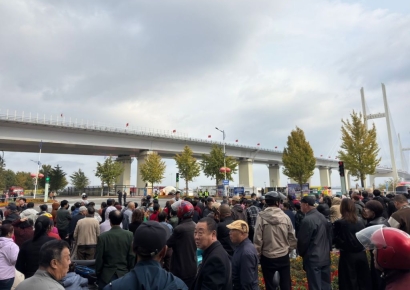
In the background is the enduring voice of Busan itself. In 2011, Kim Jinsook spent 309 days on Crane No. 85, 35 meters above the Yeongdo Shipyard, resisting mass layoffs at Hanjin Heavy Industries. What began as a solitary protest drew hope buses and citizens beneath her. A single cry sparked the gathering of others, ultimately transforming into a collective voice. The art directors read this scene—along with the April 19 Revolution, the Busan-Masan Uprising, the “candlelight vigils,” and the 2024 light stick protest—as part of Korea's "history of sound," anchoring this exhibition.

On the 28th, participants are examining the exhibited works at the press preview event of the 2026 Busan Biennale held at the former Busan Nam High School in Yeongdo-gu, Busan. Photo by Yonhap News Agency
View original imageThe exhibition spaces themselves do not conform to tidy white cubes. Space Wonji in Yeongdo was originally a 100-year-old warehouse that stored ship equipment. Its salt stains, rusted iron frames, and worn walls hold the traces of dock labor through the years. JoaR Soncuya, a Filipino artist and former sailor, recreates time spent on deck and in harbors through paintings and sound. Once a sailor entering Busan Port, he has now returned to the same sea as a Biennale artist. In this exhibition, the sea is less a scenic backdrop than a huge passage that sends off, receives workers, and carries their memories.
The recently vacated former Busan Nam High School harbors a completely different kind of silence. Timetables scrawled on blackboards and classroom rules remain, but artworks have replaced the students. On the playground, Aliasgar Abakas has laid out a massive “Order”—an installation created by joining used clothing with Busan residents. This space questions what lies outside the knowledge schools impart and whose voices have been left out of the curriculum. Choosing a closed school as a venue for questioning the future of education is one of this Biennale’s most clever devices.

On the 28th, participants are viewing exhibition works at the press preview event of the 2026 Busan Biennale held at the former Busan Nam High School in Yeongdo-gu, Busan. Photo by Yonhap News
View original imageAt the Busan Museum of Contemporary Art in Eulsukdo, the chorus becomes even more uncanny. In Ryoo Seongsil’s “Ten Thousand Dreams,” twelve mannequin-like ghosts sing atop lifts. The work introduces a child pressured to achieve success after a trip around the world, a skeleton still burdened by great ambitions at 95, and a girl saddled with a task that never ends, even after centuries. The piece upends Korean society’s relentless directives to grow, accomplish, and dream—turning them into a 15-minute, bizarre choral drama. It is not so much a beautiful harmony as a song that is funny yet unnervingly chilling.
Hot Picks Today
 "King crab is 3,000 won per 500 grams; just eating it makes the trip worthwhile"... Chinese flock to North Korea on 'fake business trips'
- "This Mixed-Breed Dog Will Bite People"... Tourist Hears 'Verbal Abuse' While Visiting Attraction With Pet Dog
- Woman in Her 70s Assaults Sister in Her 80s: “She Had an Affair with My Husband”
- "Why on earth come to Korea and do this?" ... Chinese Man in Hanfu Says He'll Promote Chinese Culture at Gyeongbokgung
Of course, with terms like “resistance,” “solidarity,” and “voice” so prominent, sometimes the curator’s explanation precedes the experience of the artwork itself—a common trap for politically charged biennales. Yet, the strongest works break free from such explanations. In Yazan Khalili’s piece, visitors buy and wear 39 hats embroidered with lines of poetry and then leave the exhibition. Instead of becoming complete, the work dissolves; the more people disperse, the more the poetry spreads, fading across Busan. The paradox is that solidarity is not simply about collecting voices in one place.

On the 28th, Lee Jun, Executive Director of the 2026 Busan Biennale, spoke at the press preview opening briefing held at the former Busan Nam High School in Yeongdo-gu, Busan. Photo by Yonhap News.
View original imageThe Biennale continues for 65 days through November 1. After seeing all three venues, your understanding of the word “chorus” subtly changes. It is not about everyone singing the same song. It is about someone first raising their voice, and someone else listening. The sea of Busan continues this ancient act to this day.
© The Asia Business Daily. All rights reserved. Unauthorized AI training and use prohibited.


!["Please Take Them Off!" They Made It All the Way to the Bed... Then "80% of Fecal Bacteria" Struck [Deep Scroll]](https://cwcontent.asiae.co.kr/asiaresize/307/2026101610053063338_1792112730.png)