President Lee Opts for 'Direct Breakthrough' With Larger-Than-Expected Cabinet Reshuffle, Seeks Broader Progressive Unity
Simultaneous Replacement at Six Ministries, Including Finance and Land
Cabinet Reshuffle Includes Blue House Secretaries
One-Third of All Ministries Changed... A Sweeping Overhaul
From Politicians Yong Hyein and Lee Haemin to Kim Kyungsoo
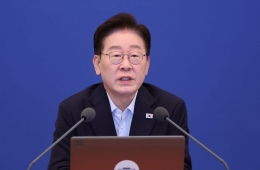
On August 30, President Lee Jae-myung initiated a cabinet reshuffle affecting six ministries, outpacing prior expectations and signaling a decisive approach to steering the administration in its second year. Although President Lee is known for generally avoiding decisions that appear to be driven by public pressure, faced with persistently declining public approval ratings and mounting calls for reform, he opted to replace ministers in approximately one-third of the government’s 19 ministries at once. A high-ranking official in the Blue House summarized the significance of this personnel overhaul as, "A call to tighten our shoelaces and push forward with renewed determination."

The Blue House announced that President Lee Jae-myung nominated six ministerial candidates on the 30th, including the Deputy Prime Minister and Minister of Economy and Finance.
From the top row, left to right: Lee Hyung-il, 1st Deputy Minister, nominated for Minister of Economy and Finance; Kim Seung-won, member of the Democratic Party of Korea, nominated for Minister of Justice; Kang Shin-chul, former deputy commander of the Combined Forces Command, nominated for Minister of National Defense.
From the bottom row, left to right: Yong Hye-in, member of the Basic Income Party, nominated for Minister of Gender Equality and Family; Hong Ji-sun, 2nd Deputy Minister, nominated for Minister of Land, Infrastructure and Transport; Lee So-young, member of the Democratic Party of Korea, nominated for Minister of SMEs and Startups.
2026.8.30 Yonhap News
Photo by Yonhap News
As reported by The Asia Business Daily on August 31, this reshuffle reflected President Lee’s intention to "change the people, but maintain the direction of core policies, while broadening the political base to include the wider progressive bloc." The administration responded to public discontent over real estate and economic policies by replacing key economic ministers, while keeping policy continuity by promoting the current vice ministers to the top posts. In contrast, in the areas of politics and reform, and among Blue House advisors, the administration expanded its recruiting pool to include figures from the Basic Income Party, the People’s Innovation Party, and pro-Moon Jae-in factions, thereby strengthening internal cohesion within the broader ruling camp. Whereas the administration’s first-year personnel policy had centered on building centrist alliances, this reshuffle leaned more towards the progressive side.
President Lee nominated Lee Hyung-il, the 1st Vice Minister of Economy and Finance, as Deputy Prime Minister and Minister of Economy and Finance—the administration’s "economic control tower." For the highly watched "real estate supply policy," Hong Ji-sun, 2nd Vice Minister of Land, Infrastructure and Transport, was nominated as Minister. Kim Seung-won, a Democratic Party of Korea lawmaker, was tapped as Minister of Justice; Kang Shin-chul, former Deputy Commander of the Combined Forces Command, as Minister of National Defense; Lee So-young, another Democratic Party of Korea legislator, as Minister of SMEs and Startups; and Yong Hye-in, a Basic Income Party lawmaker, as Minister of Gender Equality and Family. In the Blue House, Assemblyman Lee Hae-min of the People’s Innovation Party was appointed Senior Secretary for AI Future Planning, and former Governor Kim Kyung-su of Gyeongnam was designated Special Political Advisor to the President. Former AI chief Ha Jung-woo returned as Vice Chair of the National AI Strategy Committee, and Lee Won-joo, Director of the Energy Transition Policy Office at the Ministry of Climate and Environment, was named the inaugural Advisor for Mega Projects in the Presidential Secretariat.
Initially, it was expected within the ruling bloc and beyond that the cabinet reshuffle would proceed gradually, focusing first on the Ministry of SMEs and Startups left vacant by the selection of Han Sung-sook as Prime Minister and the Ministry of Justice, which became vacant following the resignation of former Minister Jeong Seong-ho. Contrary to expectations, however, President Lee simultaneously replaced the heads of the Ministry of Economy and Finance, Ministry of Land, Infrastructure and Transport, Ministry of National Defense, and Ministry of Gender Equality and Family. The suddenness of the reshuffle was highlighted by the fact that Vice Prime Minister Koo Yoon-chul learned of his replacement only after arriving at Incheon Airport to depart for a business trip to the United States, even considering canceling his flight on the spot. According to a source in the ruling camp, "It is safe to say that none of the working-level staff in the Blue House knew about the content or the timing of the reshuffle."
The Scale of the Cabinet Reshuffle Sends a Message in Itself
Within and outside the Blue House, there is broad consensus that the scale of the reshuffle itself serves as a message. In a survey conducted by Gallup Korea from August 25 to 27 and released on the 28th, the positive assessment of President Lee’s job performance hit a post-inauguration low of 42%, while the negative assessment crossed the 50% mark for the first time. Notably, "real estate policy" was cited as the top reason for negative evaluations (27%), according to the Central Election Poll Deliberation Commission’s website for more details. While the exact figures may differ across various polls, there was little dissent, even within the ruling party, that the momentum for state governance had waned compared to the early days of the administration. In this context, President Lee chose not to simply fill the two existing vacancies with "caretaker appointments," but rather to infuse his administration with renewed energy by taking on economic, real estate, and defense issues through a major personnel overhaul.
This does not indicate a shift in the core direction of economic policy. Rather, the appointments to the Ministry of Economy and Finance and the Ministry of Land, Infrastructure and Transport are seen as a compromise between renewal, continuity, and expertise. Nominee Lee Hyung-il has shaped economic policy blueprints since the beginning of the current administration and led several major initiatives, including the "oil price ceiling" and the "August 3 tax reform" during the Middle East crisis. It is the first time in 20 years that a sitting vice minister from the Ministry of Economy and Finance (including its predecessor organizations) has been promoted to minister.
Similarly, Hong Ji-sun, the nominee for Minister of Land, Infrastructure and Transport, previously served as Director-General for Urban Housing in Gyeonggi Province under President Lee’s governorship, designing major housing policies such as "basic housing," and actively participated in policy implementation as the ministry’s 2nd vice minister. By elevating insiders with deep experience in economic and real estate policy, the administration aims to demonstrate "change" to the public, while maintaining policy execution speed. The continued presence of senior economic aides in the Blue House, such as Policy Chief Kim Yong-bum and Chief Economic Growth Advisor Ha Joon-kyung, underlines the continuity in the administration’s economic framework.
Progressive Expansion of Political Appointments…Generational Shift with Cabinet Members in Their 30s and 40s

The Blue House announced that President Lee Jae-myung appointed former AI chief Ha Jung-woo (from the left) as the Vice Chair of the National Artificial Intelligence Strategy Committee on the 30th. In addition, former Governor Kim Kyung-su of Gyeongnam was appointed as the President's Special Political Advisor, Assemblyman Lee Hae-min of the People’s Innovation Party was appointed as the Senior Secretary for AI Future Planning in the Presidential Secretariat, and Lee Won-joo, Director of the Energy Transition Policy Office at the Ministry of Climate and Environment, was appointed as the Advisor for Mega Projects in the Presidential Secretariat. August 30, 2026, Yonhap News Agency.
View original imageIn contrast, the selection of political figures expanded to include the broader progressive camp. President Lee brought in Assemblywoman Yong Hye-in as the nominee for Minister of Gender Equality and Family and Assemblyman Lee Hae-min as Senior Presidential Secretary for AI. Both their parties have consistently advocated for more progressive reforms than the mainstream Democratic Party of Korea. Similarly, by calling Kim Kyung-su—known as a "pro-Moon standard-bearer"—back to serve as Special Political Advisor, the administration appears to be aiming not only to mend divisions that surfaced inside the Democratic Party of Korea during its recent convention, but also to embrace center-left and reform-oriented forces outside the party within the boundaries of governance.
The appointment of Assemblyman Kim Seung-won as Minister of Justice is also seen as enhancing the administration’s commitment to prosecutorial reform. Kim has advocated strong reformist positions on issues such as prosecutors’ supplementary investigative authority, often exceeding those of his own party. Unlike President Lee and the former Minister Jeong, who left some room for the retention of partial investigative powers for the prosecution, Kim has taken a harder line. A ruling camp insider said, "There had been considerable concern within the broader ruling coalition about President Lee’s stand on prosecutorial reform. This reshuffle is seen as a decision aimed at allaying those concerns." In the areas of economic and public welfare, civil servants were advanced for stability, while the reform agenda was bolstered with clearer signals to the support base.
The generational shift is also apparent. Assemblywoman Lee So-young, born in 1985, is 41 years old, and Assemblywoman Yong Hye-in, born in 1990, is 36. Should both pass the National Assembly’s confirmation hearings and be appointed, there will simultaneously be cabinet members born in the 1980s and 1990s. In particular, if either Yong Hye-in or Lee So-young is confirmed, they would set a new record as the youngest minister since democratization in 1987. The current record is held by Assemblywoman Kim Hee-jung of the People Power Party, who became Minister of Gender Equality and Family at age 43 in 2014 during the Park Geun-hye administration. With this reshuffle, the number of female cabinet members, including Prime Minister Han, will increase from four to five, which brings generational diversity to the cabinet—a meaningful development in light of the administration’s relatively weak support among younger voters.
Confirmation Hearings at the Regular National Assembly...Assuming the Political Costs
This reshuffle is also notable for its assumption of considerable political risk. With the opening of the September regular session of the National Assembly imminent, the simultaneous nomination of six ministers requires the Blue House and the ruling party to contend not only with the budget bill and contentious legislative agendas but also a large-scale confirmation hearing process. Should unexpected issues arise during vetting—related to real estate, assets, or past remarks—the intended effect of reform could be weakened. Nevertheless, the decision to opt for a sweeping reshuffle, rather than gradual appointments, suggests the administration viewed the need for a decisive reset of the political climate as outweighing potential political costs.
Hot Picks Today
 "Is This Serious? Should I Go Back to Korea?"... New U.S. Internship Guidelines Put International Students on Edge
- "Driverless" Chinese Robotaxis to Run Freely on Seoul Roads: Up to 200 Vehicles as Early as 2028
- NPS Draws the Line on ‘Additional Payment’ Controversy: “Foreigners Who Paid Contributions Cannot Be Charged Higher Hospital Fees”
- Korea and China Resume FTA Services and Investment Follow-up Negotiations, Accelerating Market Opening
- Lee Jaemyung Congratulates Yong Hyein on Birth of Child... 1990-Born Nominated as Gender Equality Minister [Profile]
It is still too early to say for certain that this reshuffle completes the selection of the administration’s second-term cabinet. The Ministry of Health and Welfare, Ministry of Education, and Ministry of Foreign Affairs—originally among those expected to be affected—were not included in this round. There remains a possibility that additional reshuffles will occur after the conclusion of the regular session of the National Assembly, the subsequent government audit, and the passage of the budget, based on the progress of national tasks and individual ministerial evaluations. Indeed, there has been ongoing discussion both inside and outside the Blue House about proceeding with the second-term appointments in stages, in line with the National Assembly’s schedule, rather than finalizing all at once.
© The Asia Business Daily. All rights reserved. Unauthorized AI training and use prohibited.