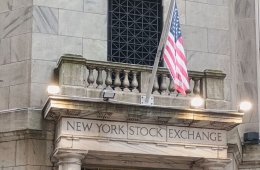
[Market ING] KOSPI Trapped in a Box Range, Stock-Picking Trend Expected to Continue
Weekly KOSPI Forecast Range: 6,400–7,500 Points
Last week, the KOSPI once again failed to reclaim the 7,000-point threshold. In the absence of short-term momentum, there are expectations that the market will see a stock-picking trend within a trading range.

Last week, the KOSPI fell by 1.79%, while the KOSDAQ rose by 4.55%. Kim Jongmin, a researcher at Samsung Securities, stated, “With a lack of major events, the market remained calm. From a macro perspective, the market is digesting the direction of long-term interest rates, and from a micro perspective, policies on shareholder returns and company earnings. The slight stabilization of long-term U.S. Treasury yields and strong earnings reports from artificial intelligence (AI) hardware and software companies like Nvidia and Salesforce have reinforced the market's downside rigidity.”
For the time being, a market characterized by stock-picking within the trading range is expected to continue. Kim analyzed, “With no short-term momentum to drive the index sharply higher, the KOSPI has entered a short-term trading box between 6,000 and 7,000 points. While the upside is limited due to pause in the semiconductor big two and leading stocks from the first half, internal market vitality and quality improvement continue to spread, with as many as 23 sectors outperforming the KOSPI’s return since the second half began.” He added, “The recent strong performance of certain sectors compared to the index can be attributed to increased institutional investor inflows. This suggests that the competition among institutions to boost fund returns ahead of year-end book closing has intensified, so investors should actively respond to this stock-picking environment.”
Rather than a sharp rally, the outlook calls for a “stepwise” or “staircase” pattern of gains. Lee Jaewon, a researcher at Yuanta Securities, said, “With major second-quarter earnings events ending with Nvidia’s results, market attention will focus on macro events until the September FOMC. A swift V-shaped rebound is unlikely, and we expect a step-by-step, gradual uptrend to play out as volatility is absorbed.”
With the market expected to focus on macro events, attention turns to U.S. employment data scheduled for release this week. Na Jeonghwan, a researcher at NH Investment & Securities, commented, “The biggest event in September is the FOMC meeting on September 15-16, and the dot plot released there will draw considerable interest. Thus, stock prices will react sensitively depending on U.S. employment data for August (September 4) and consumer price index for August (September 11), both of which could influence the FOMC outcome.” NH Investment & Securities projected the KOSPI to trade in a range between 6,400 and 7,500 points this week.
Meanwhile, on August 28 (local time), at the Jackson Hole Economic Policy Symposium in Wyoming, Federal Reserve Chair Kevin Warsh expressed strong concerns about rising inflation and indicated that the Fed could implement additional tightening if inflation does not sufficiently subside. The market interpreted this as a hawkish signal, suggesting that rate hikes remain on the table. According to the CME FedWatch Tool, the probability of a rate hike at the September FOMC, based on federal funds futures, jumped from 35.4% the day before the speech to 55.7% afterwards.
Key scheduled events for this week include the release of China’s National Bureau of Statistics Manufacturing Purchasing Managers’ Index (PMI) for August on August 31. On September 1, data to be announced include Korea’s exports for August, the U.S. Institute for Supply Management (ISM) Manufacturing Index for August, and the Job Openings and Labor Turnover Survey (JOLTS) for July. On September 2, the U.S. ADP National Employment Report for August will be released, followed by the ISM Manufacturing Index for August on September 3, and the U.S. jobs report for August on September 4.
Hot Picks Today
 "Once Worth 4 Million Won a Day, Now Going for Chicken Money"... Chinese Robots' Humiliating Fall to 'Bargain-Bin' Prices in Just One Year
- "Who Says It's a Meal for Ordinary People? It Deserves 'Special Dish' Status Now"... The Era of 12,000-Won Bibimbap
- "I will open fire at a childcare center"... Australian man in his 20s arrested over AI chatbot conversation
- Trump: "I'll Spend $400 Million on Midterms"... Aims to Rally Supporters
- "I Won't Take It Even If You Leave It to Me"... 9 Million Parents' Homes Sit Empty as 320,000 Japanese Renounce Inheritances
Researcher Lee Kyungmin warned, “Volatility stemming from U.S. employment data results is a risk factor. While July jobs data showed a clear slowdown, if August employment proves to be stronger than expected, the possibility of additional Fed rate hikes could increase, putting upward pressure on bond yields. As the recent rise in U.S. Treasury yields is already limiting the stock market's upside momentum, it serves as a variable warranting caution.”
© The Asia Business Daily. All rights reserved. Unauthorized AI training and use prohibited.