[Reporter’s Notebook] "Safer in Groups?"... Jeju Governor Fans the Flames of Public Outrage

Governor Seongon Wi of Jeju is facing intense criticism for his remark, “It’s safer to travel in groups,” in response to the case of Miran Jang’s disappearance in Jeju, which has fueled fears over public safety. Instead of calming public anxiety, the governor’s statement—widely perceived as effectively relinquishing responsibility for local security—became the subject of widespread ridicule across internet communities over the weekend, with many accusing him of pouring fuel on an already worsening public mood.
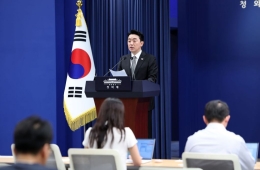
On August 26, just as anxiety on the island was peaking, Governor Wi attended the 10th Central-Local Cooperation Meeting at the Blue House, focusing on introducing his “AX Transformation for the Jeju Region”—a future vision centered on building an artificial intelligence demonstration city.
While independent Assemblyman Donghoon Han from another region was investigating fatal investigative errors by the police and correcting public misperceptions caused by distorted statistics, Jeju’s top administrative authority neglected an acute public safety crisis closely tied to the lives of residents—squandering a golden window of opportunity that could have quelled growing negativity at its outset.
Driven by mounting criticism, the Jeju government hastily announced the “Jeju Integrated Safety Measures” on August 27, but immediately faced complaints that the proposed solutions had missed the mark.
Extending the public CCTV storage period from 30 to 60 days and expanding the use of artificial intelligence (AI)-powered surveillance cameras failed to address the real issue at hand.
The core problem is not the short CCTV storage period, but the collapse of the investigative system—local police failed to review surveillance footage for 96 days. No matter how much the deadline is extended or expensive AI systems are introduced, without worksite officials actually monitoring and reviewing the material, such measures are rendered meaningless under an indifferent administrative system.
Above all, the governor’s actions and remarks have only aggravated concerns about public safety in Jeju, exacerbating the crisis rather than providing solutions.
Despite having the exclusive authority nationwide to command the “Jeju Autonomous Police Force,” a direct local police organization, the governor drew criticism for failing to implement immediate practical measures—instead offering the “Crisis Response Manual for Solo Travelers” as a key policy. In a broadcast interview following his announcement, he further inflamed public sentiment by saying, “There are many unsafe places; don’t go alone—go together,” an admonishment widely deemed preposterous.
The top administrative official in Jeju openly acknowledged the island’s “security vacuum,” essentially shifting responsibility for crime prevention from the state to individuals traveling alone.
Angry public sentiment erupted on online communities with sarcastic complaints such as, “Is Jeju like the front line? Should we always move in pairs like new military recruits?” Sharp ridicule continued, with many comparing Governor Wi’s “AX Transformation” initiative to the crisis—some commented, “Better to let AI run the administration at this rate.”
The fallout was so extensive that this controversial remark even made its way into popular wiki sites. On the profile page for Governor Seongon Wi, the comment has now been permanently preserved under its own heading: “Controversy over Safety in Numbers,” symbolizing how rapidly the repercussions have spread.
Despite this deepening crisis in public opinion, Governor Wi has done little beyond holding a single official meeting, showing no further substantive response.
Given that his remarks and insufficient policies have exacerbated the situation, it is imperative, even at this late stage, that the governor himself gets personally involved to resolve the turmoil. He should immediately join the police chief in public patrols or visit high-risk areas himself, sending a strong message and taking concrete action—such as assuring citizens, “The entire administration is fully mobilized to ensure safety, so please be reassured.”
The language of leadership must be that of positivity, vision, and encouragement.
Even amid growing public anxiety and fear, had he simply stood by the core principle of “mobilizing all available resources to prevent crime to the utmost,” public concern might have been alleviated.
While police are responsible for investigating missing person and death cases, the local administration must do all it can to support those efforts and safeguard the wellbeing of the community.
Hot Picks Today
 "Is This Serious? Should I Go Back to Korea?"... New U.S. Internship Guidelines Put International Students on Edge
- "Even Mongolians Known for Sharp Eyesight Flock to Korea... Chinese Spend 57.7 Billion Won, Japanese 28.5 Billion on K-Medical"
- Lee Jaemyung Congratulates on Childbirth: 1990-Born Yong Hyein Nominated as Minister of Gender Equality and Family [Profile]
- "10 Billion Won for Married Employee Couples?" Flood of Questions... An Inside Look at Samsung Electronics' 1.5% Annual Home Loan Up to 500 Million Won
- Actress Runs 100km Marathon in Sweltering Heat for Daughter With Rare Disease... TV Show Faces Criticism for "Enforced Emotion" [Sunday Culture]
Tourism depends on psychology. In these difficult economic times, keeping negative perceptions at bay is the only way Jeju, as a tourist destination, can survive. The governor must take a hands-on approach to dispel lingering concerns—resolving this crisis is crucial for the future of Jeju’s economy.
© The Asia Business Daily. All rights reserved. Unauthorized AI training and use prohibited.