"Why Did Nepal Reject Foreign Rescue Teams Despite the Urgency?... The Lingering Trauma of 2015 Human Trafficking"
Coordination Challenges with Foreign Rescue Teams in 2015
Surge in Human Trafficking Targeting Vulnerable Groups After the Earthquake
Amid significant loss of life caused by record-breaking rainfall and glacial collapse in the Himalayan mountains, attention is turning to the background of the Nepalese government’s decision to initially refuse direct deployment of foreign rescue teams.
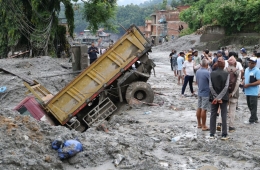
Previously, on the 26th (local time), a massive mudslide and flood occurred when glaciers and rocks collapsed in the border area between Nepal and Tibet, China. The Bhotekoshi and Trishuli river regions suffered extensive damage, with villages, roads, bridges, and hydropower facilities destroyed in succession.

On the 28th, as flood and landslide rescue operations continue, a helicopter is moving at Tribhuvan International Airport in Kathmandu, Nepal. Photo by Yonhap News Agency
View original imageIn response, several countries, including India and China, offered to send rescue teams and equipment, but the Nepalese government initially declined. Nepal’s Ministry of Foreign Affairs stated that domestic forces, including the military and police, were responsible for search and rescue efforts and that, at that point, there was no need for foreign rescue teams. Instead, Nepal chose to accept financial aid, relief supplies, and expert technical support.
However, as the scale of the disaster increased, the Nepalese government’s stance began to shift. On the 29th, local media including The Kathmandu Post reported that Nepalese authorities decided to accept foreign support, but limited solely to three specialized areas: internal tunnel search at hydropower plants, DNA analysis, and forensic investigation.

On the 29th (local time), Nepalese soldiers and relevant personnel are restoring the road leading to the hydropower plant being constructed by Korea South-East Power and Doosan Enerbility in Bidur, Nepal. Photo by Yonhap News
View original imageThe main reason for Nepal’s initial rejection of international assistance stems from lessons learned after the earthquake 11 years ago. In April 2015, Nepal experienced a 7.8-magnitude earthquake. Although the international community dispatched rescue teams, medical staff, and relief organizations, there were considerable challenges coordinating the diverse personnel and equipment on the ground. This time, the Nepalese government was determined to avoid a repeat of those difficulties and to conduct rescue operations under its own command structure.

On the 29th (local time), in front of the Bidur Trishuli military base in Nepal, a citizen holding a flyer looking for a Doosan Enerbility Nepali worker showed tears. On this day, helicopter landings and takeoffs continued at the Trishuli military base for the search of the missing person. Yonhap News
View original imageAdditionally, while the Nepalese government did not formally state this as an official reason, observers believe that concerns about trafficking targeting vulnerable groups, such as women and children, also played a role. In the aftermath of widespread deaths and displaced populations, families and local communities collapsed, and international organizations and human rights groups warned of heightened risks of children who lost parents or their homes being trafficked across borders for labor or sexual exploitation. In fact, data from the Indian Border Security Force responsible for the India-Nepal border show reported trafficking victim cases rose from 33 in 2014 to 336 in 2015, and 501 in 2016.
Hot Picks Today
 "Is This Serious? Should I Go Back to Korea?"... New U.S. Internship Guidelines Put International Students on Edge
- "Even Mongolians Known for Sharp Eyesight Flock to Korea... Chinese Spend 57.7 Billion Won, Japanese 28.5 Billion on K-Medical"
- Lee Jaemyung Congratulates on Childbirth: 1990-Born Yong Hyein Nominated as Minister of Gender Equality and Family [Profile]
- "10 Billion Won for Married Employee Couples?" Flood of Questions... An Inside Look at Samsung Electronics' 1.5% Annual Home Loan Up to 500 Million Won
- Actress Runs 100km Marathon in Sweltering Heat for Daughter With Rare Disease... TV Show Faces Criticism for "Enforced Emotion" [Sunday Culture]
Even after the recent floods, children who lost parents or guardians and residents displaced from their homes face a heightened risk of falling prey to trafficking crimes. UN Women estimated around 157,050 women and girls in flood-hit Rasuwa and Nuwakot have endured flooding and are fully exposed to threats of sexual violence, labor exploitation, and trafficking.

Residents near the hill collapsed by the major flood in Bidur, Nepal, are passing through mud-filled roads using motorcycles. Photo by Yonhap News Agency
View original imageFollowing the 2010 earthquake in Haiti, trafficking crimes also surged, with children and women found to be especially vulnerable.
© The Asia Business Daily. All rights reserved. Unauthorized AI training and use prohibited.