"Enough to Submerge a 381m Building"... Warning That Glaciers as Large as South Korea Melting Could Inundate Asia
About 95,000 Glaciers in Asia's Mountain Regions, Losing Mass Every Year
Experts: "High-Altitude Glaciers Are Like Time Bombs"
Beyond Floods and Landslides: Concerns Over Water Shortages for Drinking and Agriculture
The large-scale floods that struck the border area between Nepal and China have once again brought attention to the risk of glacier collapse in high mountain regions. Experts have issued warnings that, as glaciers rapidly melt due to climate change, massive glacial lakes are forming, and if these lakes collapse, they could trigger large-scale floods and landslides.
On the 28th (local time), CNN in the United States reported the words of Dan McGrath, professor of earth sciences at Colorado State University, who noted that there are about 95,000 glaciers in Asia's mountainous regions and that their total area is similar in size to South Korea.

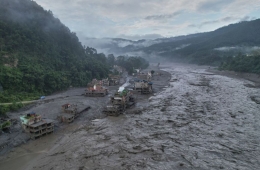
Buildings in Bidur, Nepal, affected by the large-scale "glacial lake tsunami," are buried under landslides. Photo by Yonhap News
View original imageProfessor McGrath explained, "These glaciers are losing mass at a very rapid rate," and added that the amount of glacier melting each year is enough to submerge a city up to about 381 meters—the height of the Empire State Building in New York.
On the 26th, in the border area between Nepal and the Tibet Autonomous Region of China, a torrent of water, mud, and rocks swept through the Trishuli River basin, destroying homes, roads, bridges, and more. While the exact cause is still under investigation, experts point out that rising temperatures are destabilizing glaciers and the surrounding mountain terrain, increasing the risk of disasters.
Jason Gulley, a professor at the University of South Florida who has studied the Himalayas and surrounding regions such as Nepal, recently contributed an article to The New York Times likening high mountain glaciers to "time bombs." As glaciers melt due to warming, water accumulates in concave terrains to form massive glacial lakes. If the ice or rocks acting as natural dams collapse, a huge amount of water can rush downstream.
According to the International Centre for Integrated Mountain Development (ICIMOD), there are over 25,000 glacial lakes larger than 3,000 square meters across the Hindu Kush-Himalaya region. The number of glacial lakes larger than 10,000 square meters increased from 2,306 in 2000 to 4,420 in 2020, nearly doubling. Many of these are considered to be at risk of collapse.

A truck is buried in soil in Bidur, Nepal, which suffered massive damage from a "glacial lake tsunami." Photo by Yonhap News Agency
View original imageSuch risks have already become reality. In Sikkim, India, in 2023, the collapse of the South Lhonak glacial lake released about 50 million tons of water, resulting in 55 deaths and 74 people missing. Last year, floods related to glacial lakes also caused human casualties and infrastructure damage in Nepal and Tibet.
Furthermore, there are concerns that the disappearance of glaciers could not only lead to flooding and landslides, but also cause shortages of drinking and agricultural water. Glaciers act as "natural reservoirs"—storing water during winter and monsoon seasons, then releasing it during the dry season. While rivers may swell as glaciers melt, the long-term reduction of the glaciers themselves will eventually decrease the overall water supply.
Hot Picks Today
 "Is This Serious? Should I Go Back to Korea?"... New U.S. Internship Guidelines Put International Students on Edge
- From 240,000 Won to 500 Million: The Incredible Twist of an Investment Rarer Than Winning the Lottery
- "Even Urine Melted the Glacier": Everest Climbers Melted 2,500 Tons of Ice in One Season
- Over Six Months into the Iran War: U.S. Military Leadership Warns Hegseth, "We Can't Sustain This Much Longer"
- "Does Being a Natural Beauty Increase Your Worth?"... Why Last Year's Miss Korea Jin Reacted Strongly to Plastic Surgery Controversy
The ICIMOD forecasts that water supplies in the Hindu Kush-Himalaya region will peak around 2050 and then begin to decline. More than 2 billion people, both in mountain areas and downstream, are known to depend on water from this region.
© The Asia Business Daily. All rights reserved. Unauthorized AI training and use prohibited.